Your check just got cut in half — and the form SSA wants you to fill out is seven pages of financial disclosure you may not even need
Social Security says you owe an overpayment, and for new Title II overpayment notices sent on or after April 25, 2025, SSA's default rate is up to 50% of the monthly benefit (except in cases involving fraud or similar fault or cross-program recovery). For a retiree who was already stretching a fixed income to cover rent, prescriptions, and care bills, losing half the monthly deposit is a crisis. For the adult child trying to keep the household running, it's a scramble to figure out what can be negotiated, how fast, and with which form.
The overpayment notice gives you a dollar amount and a recovery schedule. What it doesn't tell you is that, for Title II beneficiaries still receiving benefits, SSA does not need financial information for a repayment plan within 12 months; for a plan that takes more than 12 but no more than 60 months, the field office can collect financial figures verbally without Form SSA-634. It doesn't mention that, for Title II overpayments, beneficiaries receiving Medicare Extra Help or cash public assistance qualify for a fast-track rate as low as $10 a month without financial paperwork. And it doesn't explain that when Form SSA-634 is required, the expenses people may overlook — out-of-pocket prescriptions, home care costs, medical transportation — can affect how SSA evaluates the request.
The Recovery Rate System: Know Which Path Applies Before You Touch a Form
The Overpayment Repayment Plan Guide is built around the threshold rules in POMS GN 02210.030 for Title II rate-change requests. Most beneficiaries don't know there are three distinct tracks — the verbal path for current Title II beneficiaries whose plans take more than 12 but no more than 60 months, the Title II Extra Help and public assistance fast track, and the full Form SSA-634 financial disclosure for beneficiaries still receiving benefits whose plans exceed 60 months — and end up on the hardest one by default. The guide walks through the decision in order: calculate whether your proposed payment clears the debt within 60 months, check whether a special exemption applies, and only then — if neither does — prepare the financial statement with every allowable expense captured.
This isn't a summary article or a form reprint. It's a structured system that starts with the math, routes you to the right process, and walks through every step of that process — including what to say on the phone for a verbal request, how to organize the financial statement when SSA-634 is required, and how to file with proof so nothing gets lost.
What You Get
- The Repayment Rate Calculator — a one-page worksheet that divides the debt by your proposed monthly payment so you can see whether Form SSA-634 is required and, for current Title II beneficiaries whose plans take more than 12 but no more than 60 months, whether the verbal financial process applies
- Default Rate Decoder — the 50% default withholding rate for new Title II notices sent on or after April 25, 2025 and matured overpayments beginning August 2025 (except fraud or similar fault and cross-program recovery), and the prior 10% rate retained if recovery resumes after SSA affirms a reconsideration or denies a waiver for a pre-April 25, 2025 notice, unless a new overpayment occurred; also the separate SSI recovery limit (the lesser of the monthly payment or 10% of total monthly income)
- Medicare Extra Help and Public Assistance Fast Track — for Title II overpayments, the POMS rule that instructs technicians to grant any requested rate down to $10 a month without Form SSA-634 when the beneficiary receives a 100% Medicare Part D subsidy or cash public assistance, with the documentation that proves eligibility
- Form SSA-634 Section by Section — the December 2023 revision, what each field asks for, which expense categories are commonly left off (out-of-pocket prescriptions, home care assistance, medical transportation, vehicle maintenance), and how omitting them inflates net income and raises the rate SSA sets
- The Household Budget Organizer — a two-page worksheet for organizing the resources, income, and expenses to report on SSA-634
- Installment Plans for Title II Non-Beneficiaries — what happens when Title II benefits have stopped: direct billing, monthly installment agreements under POMS GN 02210.180, and how an active plan can prevent Treasury Offset Program referral
- Treasury Offset and Collection Tools — tax-refund seizure, federal payment offset, credit bureau reporting, and administrative wage garnishment, with the specific steps to stop or avoid each one
- Cross-Program Recovery — when an SSI overpayment is recovered from Title II benefits or the reverse, and the limits that apply
- The Agency Communication Log — a landscape log for every phone call, fax, certified mailing, online upload, and field-office visit, with confirmation numbers and follow-up dates so you can prove when SSA received the request
- When the Rate Is Still Unaffordable — requesting a further reduction, filing a waiver (Form SSA-632-BK) while a plan is active, and how pending waivers interact with active withholding
- Helper Authority Guide — how family members may help complete Form SSA-634, what a Representative Payee can do, and how Form SSA-1696 appoints a representative for a specific SSA matter
- The Document Checklist — a one-page list of common supporting documents for Form SSA-634, with a column to check whether each is no more than 3 months old on the request date
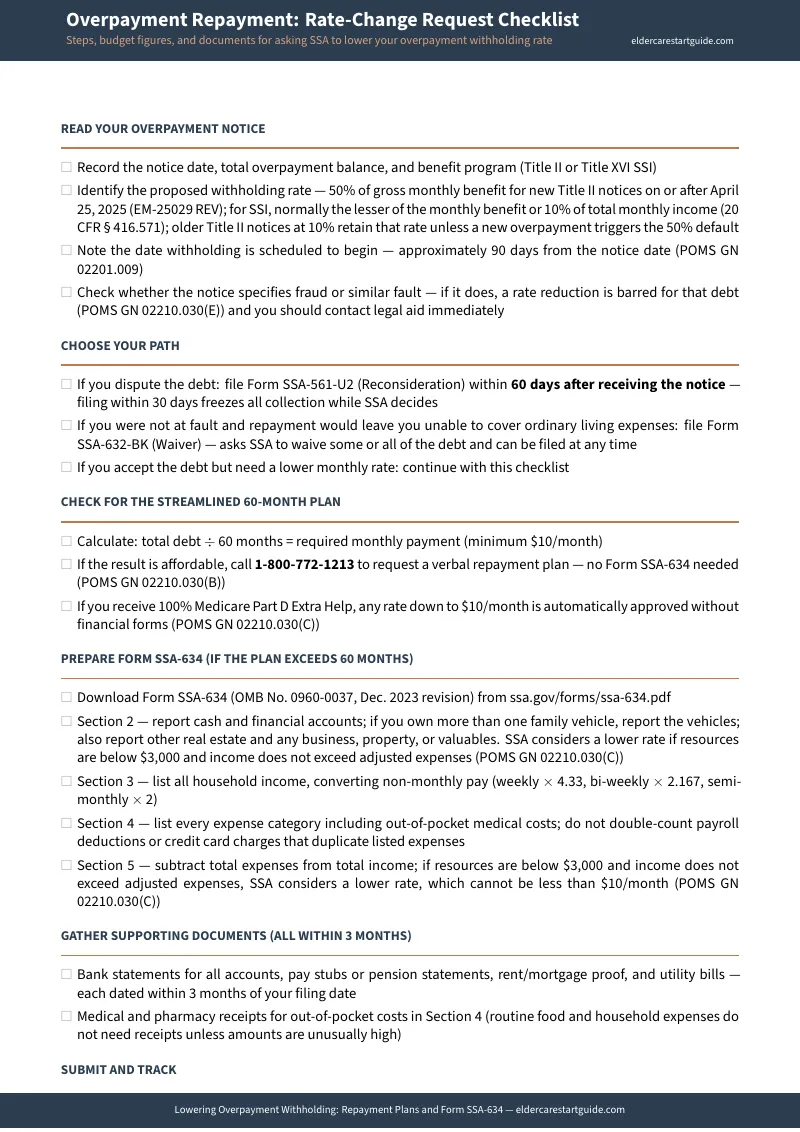
Plus: a 23-item action checklist that covers every phase from "read the overpayment notice" through filing and follow-up. The download is 6 PDFs: the guide, the checklist, and four printable worksheets (Repayment Rate Calculator, Household Budget Organizer, Document Checklist, Agency Communication Log).
Who This Guide Is For
- Retirees whose check has been cut to repay an overpayment they accept they owe, who need the monthly withholding lowered to a rate they can live on — without hiring a lawyer
- Adult children managing a parent's finances who need a structured system to gather the financial documents, run the numbers, and get the request filed correctly — especially when the parent isn't comfortable dealing with SSA on the phone
- Former Title II beneficiaries no longer receiving benefits who face direct billing or the threat of a tax-refund offset and need to set up an installment plan before collection escalates
- Representative payees who handle a beneficiary's affairs and need to understand what they can request and sign on the beneficiary's behalf
- Anyone whose first rate-change request was set too high and wants to know the next step — including when to request a further reduction versus filing a waiver
Why Not Just Call SSA or Use the Free Form?
Form SSA-634 is free on ssa.gov, and this guide says so on the first page. Legal aid organizations publish overpayment toolkits for people who qualify by income. And calling the SSA 800 number or visiting a field office is always an option — for current Title II beneficiaries whose plans take more than 12 but no more than 60 months, POMS allows the field office to collect financial figures verbally without Form SSA-634.
But the form itself doesn't explain the 60-month threshold that makes it unnecessary for many people. It doesn't flag the Extra Help or public assistance exemptions. When SSA staff complete the form with you, they enter what you give them — but they don't organize your expenses into the categories that show your real disposable income. The free toolkits are written for legal aid advocates, not for a retiree or an adult child who has never read a POMS citation.
This guide fills the gap between "here's a form" and "here's how to get a rate your household can actually afford, with the right process, the right numbers, and proof that it was filed." It is the structured system that keeps you off the wrong track and keeps the financial statement from accidentally working against you.
Satisfaction Guarantee
If the guide does not deliver what you expected, email [email protected] for a full refund, no time limit. Every purchase also includes the free Rate-Change Request Checklist — download it now to get the 60-month math, the Extra Help exception, and the document list immediately, even before you decide on the full guide.
Get the Repayment Plan Guide →
Or download the free Rate-Change Request Checklist to start with the 60-month calculation and document list — no purchase needed.
Frequently Asked Questions
What if the rules change after I buy?
We update the guide when the rules change. Email us any time, even years later, and we'll send you the current edition free.