You claimed early and kept working — now SSA is withholding your entire monthly check
You started collecting retirement benefits before full retirement age and took a job — or kept one — because the monthly check alone was not enough. Then the deposit stopped. SSA says your earnings exceeded the annual exempt amount, and they are holding full monthly checks until the required withholding is satisfied. The notice does not explain how many months will be held, whether the missing money comes back, or what happens if your earnings change mid-year.
Or maybe you have not received a notice yet, but you are about to start working and you need to know exactly how much you can earn before SSA starts withholding. The annual limit is easy enough to find online — but the withholding mechanics, the first-year monthly rule, the self-employment hours test, and the benefit recalculation at full retirement age are scattered across dozens of SSA web pages, policy manuals, and forum threads that contradict each other.
The Earnings Test Control System: Know What SSA Will Withhold Before It Happens
The Working Before Full Retirement Age guide is built around one idea: the earnings test is not a penalty — it is a temporary withholding that SSA credits back at full retirement age. But that only works in your favour if you understand the limits, report accurately, and verify the recalculation when it comes.
This is not an article that quotes the annual limit and stops. It is a complete control system — from calculating how many checks SSA will hold this year, to tracking self-employment hours month by month, to verifying that every withheld month is credited back into a higher benefit for life.
What You Get
- Earnings Test Limits Reference — the 2026 and 2027 annual and monthly exempt amounts for both tiers (under full retirement age all year, and the year you reach FRA), the two withholding ratios, and the month the test stops applying
- Withholding Mechanics with Worked Examples — three scenarios showing exactly how SSA calculates the number of full monthly checks withheld at different earnings levels, because the agency holds entire months upfront rather than trimming each check
- Earnings & Withholding Tracking Log — a structured worksheet for calculating expected annual earnings, scheduling quarterly reviews, and documenting SSA contacts, so you can update your estimate as income changes
- First-Year Monthly Rule Navigator — step-by-step guidance for mid-year retirees on how the monthly earnings test protects benefits in months when earnings stay under the monthly limit, regardless of how much was earned earlier in the year, with the rules for qualifying grace years
- Self-Employment Hours & Net Income Ledger — a weekly hour-logging template tied to the 45-hour substantial-services guideline, the highly-skilled-business exception, and the net earnings from self-employment calculation
- Family Benefit Withholding Map — how a worker's excess earnings reduce the total family benefit after family-maximum adjustments, why a working auxiliary's own excess earnings reduce only that person's benefit, and the cross-record rule for auxiliary benefits
- Adjustment of Reduction Factor Verification Checklist — how SSA recalculates the monthly benefit at full retirement age to credit every withheld month, permanently increasing the amount for life, with a worked example and the steps to verify that SSA's recalculation matches your records
- Special Wage Payment Guide (Form SSA-131) — how to coordinate with an employer to report qualifying vacation pay, severance, and deferred compensation for work done before the year of payment
- Reporting & Estimating Procedures — every method for filing and updating estimated earnings (my Social Security portal, phone, mail), the consequences of over-estimating versus under-estimating, and how to adjust mid-year when overtime, bonuses, or seasonal income changes the picture
- Free Help Directory — SSA field offices, the national 800 number, my Social Security online tools, Legal Aid / LSC, Area Agencies on Aging, SHIP counselors, Protection & Advocacy organizations, and Adult Protective Services
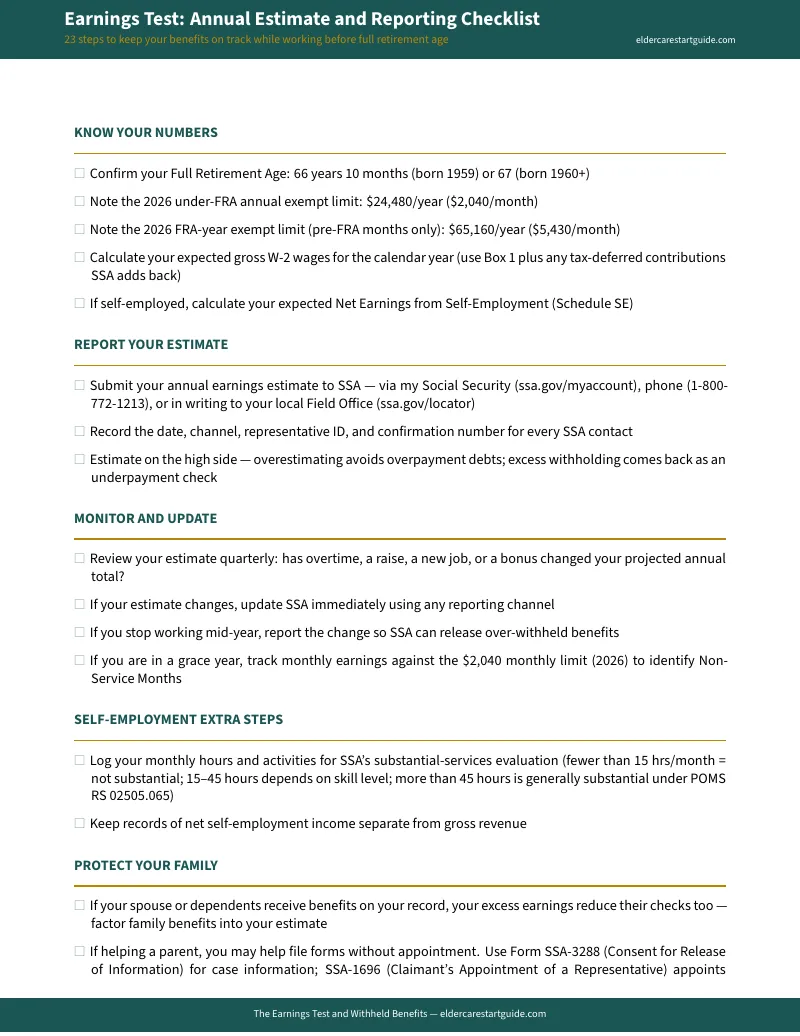
Plus: a printable 23-item checklist covering the annual estimate, the reports that prevent overpayments, and the documents to keep on file.
Who This Guide Is For
- Early retirees who kept working and need to know exactly how many checks SSA will withhold this year — or who already lost a deposit and want to understand what happened
- Adult children sorting through a parent's SSA mail who need to report earnings, update an estimate, or figure out why the monthly deposit stopped
- Mid-year retirees who left full-time work partway through the year and need the first-year monthly rule explained in plain language, not agency shorthand
- Self-employed retirees running a business, consulting, or doing gig work who need to track service hours against the monthly threshold and net earnings against the annual limit
- Anyone approaching full retirement age who wants to verify that SSA will recalculate the benefit to credit the withheld months
Why Not Just Read SSA.gov or Call the Office?
Every rule in this guide comes from public SSA publications and POMS policy manuals, and this guide says so plainly. You can read them yourself — they are free. And calling SSA is always an option.
But SSA Publication 05-10069 gives you the annual limits, withholding examples, what income counts, and the first-year rule — but no tracking log for your own earnings. The POMS manual that explains how withheld months are credited back at full retirement age is written for agency claims technicians, not for the person whose check just disappeared. And a phone call does not leave you with a tracking log, a first-year monthly matrix, or a self-employment hours ledger you can use all year.
This guide fills the gap between "here's the limit" and "here's exactly what happens to your money, month by month, and how to make sure every withheld check comes back." It is the organised reference that keeps an earnings-test year from turning into an overpayment surprise.
Satisfaction Guarantee
If the guide does not deliver what you expected, email [email protected] for a full refund, no time limit. Every purchase also includes the free Earnings Test Reporting Checklist — download it now to get the 2026 limits and the key reporting steps immediately, even before you decide on the full guide.
Or download the free Earnings Test Reporting Checklist to start with the limits and reporting steps — no purchase needed.
Frequently Asked Questions
What if the rules change after I buy?
We update the guide when the rules change. Email us any time, even years later, and we'll send you the current edition free.