Your Parent Needs a Nursing Home. Rhode Island Medicaid Says They Have $6,200 Too Much in the Bank — and the Caseworker Can't Tell You How to Fix It.
Your parent is being discharged from the hospital. The rehab days are running out. The nursing home wants $12,000 a month, and your parent's savings will last about five months before every dollar is gone. Someone at DHS mentioned Medicaid, but the asset limit is $4,000 and your parent has $10,200 in checking.
You called The POINT. The options counselor explained the programs and told you to apply. But when you asked how to reduce the $6,200 without triggering a penalty, she said she couldn't advise on that. State employees and nonprofit counselors are legally prohibited from recommending asset protection strategies.
So you searched online. Half the results are from national sites quoting last year's numbers. The other half are from Rhode Island elder law firms offering $6,000–$15,000 planning packages. The free checklist from the state tells you what documents to gather. Nobody tells you what to do with those documents once you have them.
The DHS-2 Filing Blueprint
This is not a reprint of eligibility limits from dhs.ri.gov. It is the process around the limits — the part that $6,000–$15,000 elder law attorneys explain in billable consultations and that state agencies are legally prohibited from covering.
The guide covers every financial threshold, every care program, every asset protection mechanism, and every application step available under Rhode Island law — organized in the order you will actually need them, from the first hospital discharge through Personal Choice enrollment to estate recovery defense after your parent passes.
What's Inside
- Rhode Island's Medically Needy Spend-Down — the Rule National Sites Get Wrong — Unlike income-cap states such as Florida or Texas, Rhode Island does not require a Miller Trust (Qualified Income Trust) when your parent's income exceeds $2,982 per month. Instead, excess income is spent down on care costs. The guide explains exactly how the medically needy pathway works, how patient liability is calculated, and why searching for "Rhode Island Miller Trust" leads you down a path that doesn't apply to this state.
- Probate-Only Estate Recovery — Rhode Island's Hidden Advantage — Under R.I. Gen. Laws § 40-8-15, EOHHS can only recover Medicaid costs from assets that pass through formal probate or the small estates statute. Unlike Oregon and other expanded-recovery states, Rhode Island cannot reach joint tenancies, payable-on-death accounts, transfer-on-death designations, or properly structured life estate deeds. The guide walks through exactly how to restructure your parent's assets into non-probate formats so the family home and liquid savings bypass recovery entirely.
- Spousal Protection Formulas and Worksheets — When one spouse enters care, the community spouse retains between $32,532 and $162,660 in countable assets through the Community Spouse Resource Allowance, plus a Monthly Maintenance Needs Allowance of $2,705 to $4,066.50 per month. The guide includes a fillable worksheet for calculating the exact CSRA and MMMNA using Rhode Island's $676 Standard Utility Allowance and $811.50 shelter standard — because most families accept the minimum when the formula entitles them to far more.
- The 60-Month Look-Back Audit — DHS reviews every financial transaction from the past five years. The guide explains what triggers a penalty (uncompensated transfers, gifts, below-market sales), how penalties are calculated using the $335/day divisor (rising to approximately $398/day from July 2026), and why the IRS $19,000 annual gift-tax exclusion has absolutely nothing to do with Medicaid — a confusion that leads thousands of families to discover too late that birthday gifts to grandchildren created a penalty period.
- Legitimate Spend-Down Strategies — The complete list of Rhode Island-approved methods for reducing countable assets without penalty: paying off existing debts, prepaying irrevocable funeral contracts, making home accessibility modifications, purchasing a Medicaid-compliant annuity, and paying for home care under a written caregiver agreement at fair market value. Each method includes the documentation DHS requires to prove the spend-down was legitimate.
- The Personal Choice Program — Rhode Island's self-directed care option lets Medicaid LTSS participants hire, train, and manage their own caregivers — including adult children, siblings, and other relatives (spouses and legal guardians are excluded). The guide covers the enrollment steps, fiscal intermediary requirements, and how to structure the arrangement so your family member can legally be paid as your parent's caregiver while keeping your parent at home.
- DHS-2 Application Walkthrough — A section-by-section instructional guide for the paper DHS-2 application, including the accompanying GW-OMR-PM-1 medical evaluation, MA-PAS-1 pre-admission screening, and DHS-25M disclosure authorization. Explains the 35-day resource reduction window for denied applications, how to avoid administrative denials from missing documentation, and how the Cranston LTSS unit processes applications over the 45–90+ day timeline.
- PACE and @Home Alternatives — The Program of All-Inclusive Care for the Elderly covers medical, nursing home-level, and social services through CareLink's Providence center — your parent remains in the community but receives comprehensive day-center care. The @Home cost-share program provides personal assistance at income-scaled monthly fees for those who don't qualify for full Medicaid LTSS. The guide explains both programs, their eligibility paths, and when each is the better option.
- Guardianship and the Legal Authority Gap — Many families hit a wall when they realize the adult child handling the application has no legal authority to sign the DHS-2, access bank accounts, or execute a spend-down. The guide covers Rhode Island durable power of attorney with the Medicaid-specific planning clauses DHS expects, health care proxies under R.I. Gen. Laws § 23-4.10, and the guardianship/conservatorship process through Rhode Island Probate Court when cognitive capacity is already gone.
- Assisted Living Under the Global Waiver — Unlike nursing home care, assisted living coverage is not an entitlement under Rhode Island's waiver — it is slot-restricted and waitlists are common. Medicaid covers care services only; room and board must be paid privately using Social Security or personal funds. The guide details the Category D state supplemental payments, care service tiers, and what happens when a resident's needs escalate beyond the facility's capacity.
Plus: Fillable Worksheets and Calculators
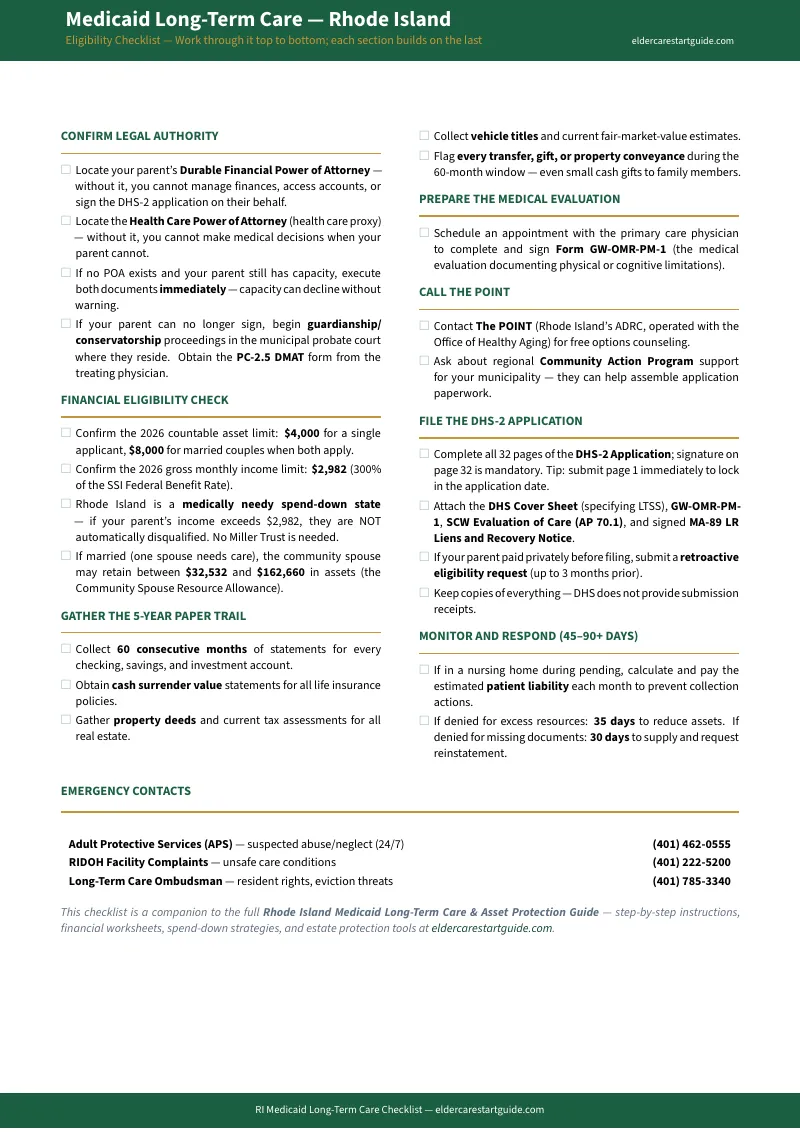
- Medicaid LTC Eligibility Checklist — A 20-item quick-start action list covering legal authority, financial records, asset classification, application filing, and post-approval monitoring.
- Income & Asset Eligibility Worksheet — Fill-in worksheet with 2026 Rhode Island thresholds for mapping countable vs. exempt assets and determining eligibility.
- Spousal Protection Calculator — CSRA and MMMNA worksheets with the excess shelter cost calculation, including Rhode Island's Standard Utility Allowance and housing allowance figures.
- 60-Month Look-Back Audit Log — Transfer log for recording every gift and sale in the look-back window, penalty calculation, and cure options.
- Spend-Down Planner — Approved penalty-free strategies with checkboxes and a running total tracker for reducing assets to the $4,000 limit.
- Estate Recovery Worksheet — Asset-by-asset audit for probate vs. non-probate exposure, with restructuring steps for each asset type.
- Application Document Checklist — Every document the Cranston LTSS unit requires, organized by category (identification, income, assets, medical, property).
Who This Is For
- Adult children whose parent is being discharged from the hospital and someone needs to figure out who is paying $10,000+ per month for a nursing home
- Families whose parent has more than $4,000 in countable assets and needs a legitimate spend-down plan that DHS will accept
- Spouses trying to avoid impoverishment when one partner enters a nursing home or memory care facility
- Families who made gifts or transfers in the past five years and need to understand the look-back penalty before DHS calculates it for them
- Out-of-state children coordinating long-distance care for a parent in Providence, Cranston, Warwick, or anywhere in Rhode Island
- Caregivers researching the Personal Choice Program who want to understand how to get paid as their parent's caregiver while keeping them at home
- Anyone who assumed the family home was automatically protected and needs to understand what estate recovery can and cannot reach
Why Not Free Government Resources?
The POINT provides options counseling. DHS publishes the DHS-2 application packet. The Office of Healthy Aging maintains a directory of aging services.
Here is what none of them provide:
- A step-by-step spend-down strategy list distinguishing penalty-free methods from penalized transfers — including the caregiver agreement structure that avoids look-back violations
- The specific asset restructuring steps that exploit Rhode Island's probate-only estate recovery rule, so EOHHS cannot file a claim against the family home
- The spousal protection calculation using the full excess shelter cost formula — not just the default minimum that leaves thousands on the table
- A walkthrough of the DHS-2 application explaining what each section actually asks for and how to answer complex questions about transfer history and trust assets
- The Personal Choice Program enrollment sequence and fiscal intermediary setup for families who want to pay a relative as the caregiver
Government sites administer rules. Elder law firms explain them for $6,000 to $15,000. This guide bridges the gap — translating hundreds of pages of Rhode Island administrative code into a sequence you can execute in an evening.
Satisfaction Guarantee
If the guide doesn't give you a clearer path forward, email [email protected] and we'll make it right.
— Less Than One Hour of an Elder Law Attorney's Time
An initial consultation with a Rhode Island elder law attorney runs $300 to $500 per hour. A full Medicaid planning engagement costs $6,000 to $15,000. A contested guardianship proceeding in Rhode Island Probate Court adds another $10,000+ in legal fees.
This guide won't replace an attorney for complex irrevocable trust drafting or contested guardianship litigation. But for the asset inventory, spend-down documentation, spousal protection calculations, estate recovery restructuring, and DHS-2 application that most Rhode Island families need, it covers 90% of the work at a fraction of the cost — and if you do need an attorney, you'll walk in with a fully organized file instead of a box of unsorted bank statements.
Start with the free checklist to see if the approach fits your situation. The full guide goes deeper — every threshold, every strategy, every form, every contact number.