
Your parent's dementia diagnosis just changed everything. Rhode Island's care system doesn't come with a map.
You've spent hours on the EOHHS website, the DHS portal, and The POINT hotline, trying to piece together what your parent qualifies for. Rhode Island runs its entire Medicaid long-term care system under a single 1115 Global Waiver — no separate HCBS waivers like most states — and the result is one unified but deeply confusing system that routes you through multiple agencies before anything happens. Meanwhile, your parent's legal capacity is narrowing, the private-pay memory care bills are approaching $10,000 a month, and you still don't know what the 60-month lookback period actually means for the house.
The national directories want your phone number so they can sell you a facility placement. An elder-law attorney can navigate the system for you — at $250 to $500 an hour. The state portals give you regulations, not guidance.
You need something between a free government brochure and a five-thousand-dollar legal retainer.
The Rhode Island Dementia Care Navigator
This is a step-by-step system that walks you through every decision in sequence — legal authority, financial eligibility, subsidized home care, facility placement, safety programs, and asset protection — with the specific Rhode Island rules, dollar thresholds, and agency contact paths at each step. It bridges the gap between the state's fragmented portals and the expensive professional advice you may or may not need.
It's built for the caregiver who needs to act now, not the one who has months to research.
What's Inside
- The Global Waiver Decoded — Rhode Island is one of a handful of states that operates all Medicaid long-term services under a single 1115 Demonstration Waiver. The guide explains how Managed Long-Term Services and Supports actually works, which agency handles what, and why understanding this structure prevents you from being bounced between DHS, EOHHS, and The POINT for weeks.
- Power of Attorney and MOLST Timing Guide — Under Rhode Island law, your parent must have sufficient mental capacity to sign a healthcare proxy and durable power of attorney at the moment of execution. The guide explains the legal standard, the warning signs that capacity is closing, and the difference between a straightforward POA and a $5,000–$15,000 probate court guardianship when the window shuts. It also covers the Medical Orders for Life-Sustaining Treatment form — what it does, when to complete it, and how it differs from a standard advance directive.
- Medicaid LTSS Eligibility Walkthrough — Rhode Island's 2026 financial limits: $4,000 in countable assets for a single applicant, $2,982 monthly income cap. The guide walks you through the full application process, explains how the 60-month lookback period works, and shows how the $752,000 home equity exemption protects the primary residence.
- At HOME Cost Share Navigator — This state program covers families who earn too much for Medicaid but still need subsidized home care. No asset limit — income up to 250% of the Federal Poverty Level qualifies. The guide explains the clinical eligibility criteria, the 20-hour weekly cap, and the subsidized adult day care co-pays of $7 to $15 per day versus $90 to $100 private-pay.
- RIDOH Memory Care License Verifier — Rhode Island requires a specific Dementia-Care License or Alzheimer's Special Care Unit Endorsement under RIDOH regulation 216-RICR-40-10-2 for any facility marketing memory care. The guide includes a 20-question facility vetting checklist covering license type, staff training records, secured perimeter standards, and private-pay contract terms — so you know what to verify before signing anything.
- 60-Month Financial Document Organizer — Rhode Island's Medicaid lookback period covers five full years of financial records. This organizer helps you gather, categorize, and document every bank statement, property deed, and asset transfer before you sit down with a caseworker or attorney — reducing billable professional hours by arriving prepared.
- Safety Program Enrollment Kit — How to register your parent with Project Lifesaver through local law enforcement, prepare the documentation the Rhode Island State Police need to activate a Silver Alert, and enroll in your municipality's special needs registry so first responders are flagged for cognitive-impairment response.
- Spousal Impoverishment Protections — When only one spouse needs care, the Community Spouse Resource Allowance and Monthly Maintenance Needs Allowance protect a portion of joint assets and income for the spouse remaining at home. The guide shows how these calculations work so the community spouse doesn't lose everything.
- Care-Crisis Decision Flowchart — When the wandering episode happens, when the hospital admission comes, when the facility refuses readmission after discharge — a step-by-step sequence for each crisis, with the specific Rhode Island rules on 5-day bed holds, improper eviction procedures, and Adult Protective Services reporting obligations.
Who This Guide Is For
- Adult children managing a parent's care in Rhode Island — whether you live nearby or coordinate from out of state
- Spouses facing the financial reality of $9,700-to-$10,861 monthly memory care bills with no Medicaid coverage for room and board in assisted living
- Families preparing for the attorney meeting — walking in with organized financials, a completed asset inventory, and the right questions saves three to five hours of billable time
- Caregivers who have just been told "your parent needs more care than you can provide at home" and need to understand the Rhode Island options before the hospital discharge planner hands them a list
Why Not Just Use Free Resources?
The DHS Medicaid portal, the EOHHS service authorization system, the RIDOH licensing database, The POINT referral network, the OHA At HOME Cost Share program page — they all exist. None of them talk to each other. The Medicaid portal tells you the asset limit but not how the 60-month lookback applies to your parent's house. The POINT can refer you to a case manager but cannot advise on whether home care or nursing home Medicaid makes more financial sense for your family. The attorney's blog explains the Global Waiver but not the specific forms the DHS caseworker will ask for.
This guide connects every step into a single decision sequence. You open it at the chapter that matches your current crisis — legal capacity closing, first facility tour, Medicaid application prep — and follow the instructions forward.
Satisfaction Guarantee
If the guide doesn't give you a clearer path forward within the first reading, email us and we'll refund you — full refund, no time limit, no hoops.
Start With the Free Checklist or Get the Full Guide
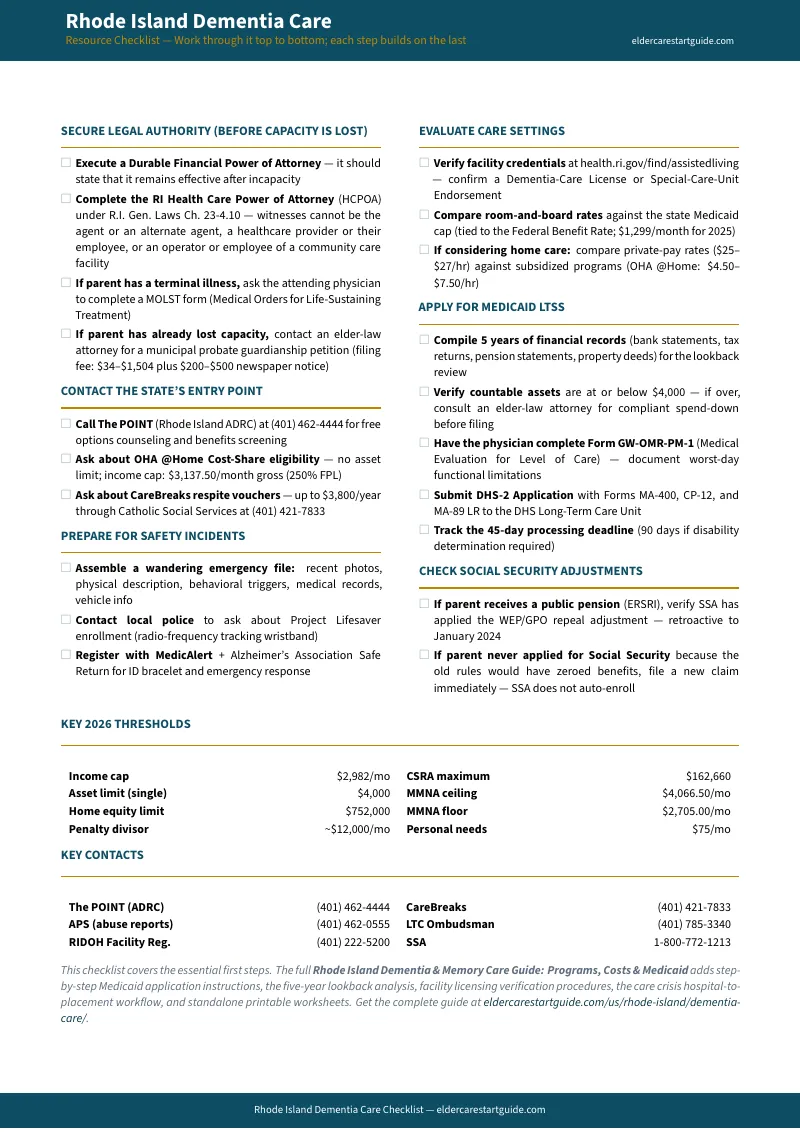
The free checklist covers the key action items across six phases: legal authority, financial eligibility, community support, facility placement, spousal protections, and home safety. It tells you what to do.
The full Rhode Island Dementia & Memory Care Guide tells you how — with the specific Rhode Island statutes, dollar thresholds, form numbers, and step-by-step procedures at every stage. Includes seven standalone printable worksheets and the complete resource directory with agency contact information for every region of the state.