Your parent needs more care. Pennsylvania's system gives you 52 agencies, two Medicaid tracks, and zero instructions.
The hospital discharge planner hands you a list of facilities. The internet gives you referral services paid by those same facilities. The state website scatters eligibility rules across four different departments. And every source contradicts the last one about whether your parent qualifies for help or whether you are paying the full $12,000 a month out of pocket.
You are not confused because the system is complicated. You are confused because nobody has laid out the sequence — what to do first, what qualifies your parent for state-funded support, and which facilities are actually safe.
The Pennsylvania Care Navigation System — One Sequential Plan From Assessment to Placement
This is not a pamphlet of general caregiving tips. The Choosing Care in Pennsylvania Guide is a state-specific operational manual that walks you through every decision point, every eligibility threshold, and every regulatory checkpoint in the exact order you will encounter them. It replaces the scattered, contradictory information you are finding online with a single plan you can execute.
Where free referral services steer you toward their paying partners and skip the publicly funded programs entirely, this guide covers every option — including the Community HealthChoices waiver, the OPTIONS program, and the LIFE/PACE alternative that commission-based advisors will never mention.
Assess whether the current arrangement is still safe
A structured framework for evaluating your parent's functional decline — medication errors, wandering behavior, falls, nutritional deterioration, inability to perform activities of daily living. Use it before you involve state agencies so you understand what you are reporting and why it matters for eligibility.
Compare every care setting with Pennsylvania-specific cost data
Private-duty home care at a statewide median of $34 per hour — over $77,000 a year at 44 hours per week. Assisted living averaging $6,352 per month. Semi-private nursing home rooms running about $9,581 per month. Memory care adding 20–30% on top of base rates. The guide shows the exact breakpoint where home care becomes more expensive than facility placement — and explains the regional cost differences between Philadelphia, Erie, Gettysburg, and Scranton that can shift your math by thousands per year.
Navigate the Chapter 2600 vs. 2800 licensing trap
Pennsylvania licenses residential care under two separate frameworks: Chapter 2600 for Personal Care Homes and Chapter 2800 for Assisted Living Residences. Only 33 facilities statewide hold the ALR license — so most places marketing as "assisted living" are actually Personal Care Homes with different clinical service limits. The guide shows you how to verify a facility's actual license type through the DHS Provider Directory before you waste time touring a facility that cannot legally provide the care your parent needs.
Map the Community HealthChoices enrollment process
CHC is Pennsylvania's Medicaid managed care program for long-term services and supports. Three MCOs administer it across five geographic zones. But getting enrolled requires a 90-day process through the Independent Enrollment Broker — referral intake, two in-person visits, a Physician Certification Form that must be returned within 86 days, a Functional Eligibility Determination by your local AAA, and a financial review by the County Assistance Office. The guide maps every step and highlights the bottleneck that causes most application delays.
Understand OPTIONS — the program for seniors who do not qualify for Medicaid
If your parent's income exceeds Medicaid thresholds, the OPTIONS program funds home and community-based services through the 52 Area Agencies on Aging with no strict income cap. The guide explains the sliding-scale co-payment structure, the Needs Assessment Tool scoring process that determines waitlist priority, and what services OPTIONS actually covers.
Run the Medicaid financial eligibility math
Pennsylvania's 2026 thresholds: $2,982 monthly income limit, $8,000 effective asset limit (with the $6,000 standard disregard), spousal protections allowing the community spouse to retain up to $162,660 in assets and $4,066.50 in monthly income. A 60-month look-back period with a $421.20 daily penalty divisor for improper transfers. The guide walks through the entire financial eligibility analysis and the spend-down strategies that keep you on the right side of the look-back rules.
Close the legal-authority gap before it stalls the application
Adult children routinely manage their parent's care without realizing they lack the legal authority to access financial records, sign facility contracts, or complete the MA-51 evaluation form. Without a Durable Power of Attorney or court-appointed guardianship, the County Assistance Office review stalls and the family absorbs private-pay costs while the application sits incomplete. The guide explains exactly when and how to secure the legal documents you need.
Vet facilities using state inspection records
The DHS Provider Directory publishes licensing records for Personal Care Homes. The Department of Health Nursing Care Facility Locator publishes inspection reports for nursing homes. The guide walks you through both databases — how to access the Statement of Deficiencies, how to interpret citation severity, and how to verify that a facility's Plan of Correction was actually implemented. Plus the Long-Term Care Ombudsman — when to use this free, confidential advocacy resource.
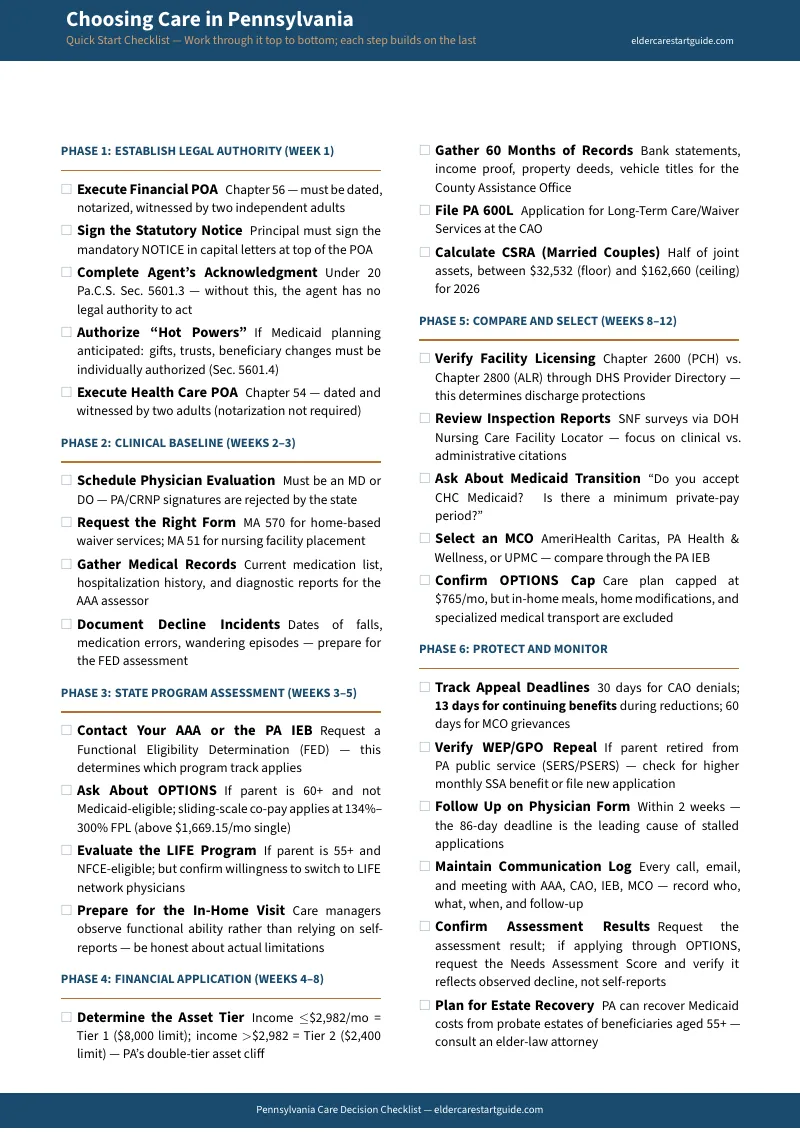
The Pennsylvania Elder Care Decision Checklist
A printable reference with 29 action items across 6 phases — from legal stabilization through program enrollment, facility vetting, and care activation. Print it. Carry it to meetings. Use it as a tracking sheet so nothing falls through the cracks.
Who this guide is for
- You are facing a hospital discharge deadline and need to understand the difference between post-acute rehab and long-term placement, evaluate facility options, and know your parent's discharge rights — before the pressure forces a decision you have not researched.
- You are a family caregiver reaching burnout and need to understand your options for transitioning care before a crisis forces one — including Community HealthChoices, OPTIONS, and the LIFE/PACE program.
- Your siblings cannot agree on what to do and you need an objective cost-comparison framework that moves the conversation from opinions to data — with Pennsylvania-specific numbers for every care setting.
- Your parent's savings are running out and you need to understand the 2026 Medicaid eligibility thresholds, the IEB enrollment process, spousal impoverishment protections, and the 60-month look-back rules.
- You are coordinating care from out of state and need a map of Pennsylvania's 52 AAAs, the IEB process, the COMPASS portal, and every key agency contact — organized so you can manage assessments, applications, and facility vetting remotely.
Why free tools and referral services are not enough
Free senior placement services like A Place for Mom operate on a commission model — they receive 50–100% of the first month's rent from partner facilities when your parent moves in. That means they only recommend private-pay facilities in their paying network. They do not cover Community HealthChoices, the OPTIONS program, or the LIFE/PACE alternative because those programs do not generate commissions.
State websites publish policy manuals and provider directories, but the information is scattered across the Department of Human Services, the Department of Aging, the Department of Health, and 52 separate Area Agencies on Aging. Navigating the IEB enrollment process incorrectly can delay waiver approval for months, leaving the family paying private rates while the application sits in queue.
Elder law attorneys provide expert guidance on asset protection and Medicaid planning, but consultations start at $300–$500 per hour with retainers of $3,000–$10,000. Families who arrive unprepared pay billable hours for basic administrative work — organizing bank records, filling out intake questionnaires — that a structured planning tool could handle.
This guide is 100% independent. It accepts no referral commissions, no partner fees, and no advertising from any facility or service provider. It covers every care setting, every funding program, and every regulatory checkpoint — including the options that commission-based advisors skip.
100% satisfaction guarantee
If the guide does not give you a clearer path forward for your parent's care, email us for a full refund. No forms, no conditions.
Get the guide now — or start with the free checklist
The Pennsylvania Elder Care Decision Checklist is a free, printable reference with 29 action items organized in 6 phases. Download it now and start tonight.
When you are ready for the full system — the 49-page guide plus 8 standalone planning tools including the Medicaid financial worksheet, care budget planner, facility tour checklist, and enrollment timeline tracker — get the full Choosing Care in Pennsylvania Guide for less than the cost of a single hour with an elder law attorney.