
Your Parent Needs Help at Home. Oklahoma Has Programs That Pay for It — If You Can Navigate Two Agencies at Once.
Your parent fell. Or maybe they didn't fall — they just stopped cooking, stopped taking their medications on time, left the door unlocked three nights in a row. Either way, you're the one who noticed, and now you're the one trying to figure out what to do about it.
You searched for home care in Oklahoma and discovered there's a program called the ADvantage Waiver that pays for in-home services — even for family caregivers through something called CD-PASS. You called the OKDHS Aging Services office. You found the SoonerCare application. But nobody told you that your parent has to pass a clinical assessment and a financial screen run by two completely separate state agencies before anything happens.
Meanwhile, you priced out private home care. $25 per hour. $6,000 per month for 8 hours a day. Over $72,000 a year. And your parent's savings won't last 18 months at that rate.
The Oklahoma Home Care Navigation System
This is not a list of eligibility rules you can find on oklahoma.gov. It is the process around the rules — the part that $350/hour elder law attorneys explain in billable consultations and that OKDHS caseworkers never have time to walk you through.
Oklahoma's home care system runs on two parallel tracks managed by separate agencies: the clinical track (OKDHS Aging Services, which administers the UCAT III assessment) and the financial track (OHCA SoonerCare, which evaluates income and assets). Your parent can be clinically approved by a nurse assessor and still wait weeks for the financial unit to process the resource screen — and nobody tells you which track is holding things up.
The guide covers every step from establishing legal authority to securing state-funded home care, navigating the dual-track application, choosing between the ADvantage Waiver and State Plan Personal Care, setting up consumer-directed care through CD-PASS, funding home modifications, protecting the family home from estate recovery through Transfer-on-Death deeds, and building a crisis backup plan — organized in the order you will actually need them.
What's Inside
- Legal Authority Lockdown — Your parent's cognitive capacity is a ticking clock. This chapter walks you through the Oklahoma Uniform Power of Attorney Act, the Advance Directive Act, the "hot powers" provision that requires your parent to individually initial certain high-risk authorities, and the Title 30 guardianship process if capacity is already gone. Filing fees range from $204 to $220 depending on county — compared to thousands in attorney fees if you wait too long.
- Dual-Track Application Walkthrough — The complete ADvantage Waiver application process explained as two linked but separate workflows. How to schedule the UCAT III clinical assessment through OKDHS Aging Services, what the nurse assessor evaluates, how to document your parent's ADL limitations to establish Nursing Facility Level of Care, and how to simultaneously submit the SoonerCare financial application to OHCA — so neither track delays the other.
- SoonerCare Financial Eligibility — The Oklahoma Rules — Oklahoma is a strict income-cap state. If your parent's gross monthly income exceeds $2,982, they are categorically ineligible for the ADvantage Waiver unless they establish a Qualified Income Trust (Miller Trust). This chapter explains the income cap, the $2,000 asset limit, the Community Spouse Resource Allowance of up to $162,660, exempt assets including the family home, burial trusts up to $10,000, and one vehicle — plus the legitimate spend-down strategies that elder law attorneys charge thousands to explain.
- Program Comparison Matrix — ADvantage Waiver vs. State Plan Personal Care vs. private hire, compared side by side. Eligibility thresholds, service packages, income limits, provider options, consumer-directed care availability, and waitlist realities for each program. SPPC has lower income limits ($1,350/month) but a higher asset threshold ($9,950) and covers basic personal care only — no skilled nursing, no home modifications, no respite. The ADvantage Waiver covers the full service range but requires nursing-facility-level clinical need.
- UCAT III Assessment Preparation — The Uniform Comprehensive Assessment Tool determines whether your parent qualifies clinically for the ADvantage Waiver. This chapter breaks down exactly what the OKDHS nurse assessor evaluates — ADL limitations, IADL capacity, cognitive function, medical stability — and how to document your parent's worst days, not their best. A parent with Alzheimer's or dementia must still demonstrate physical need for nursing-facility-level care; a cognitive diagnosis alone is not enough.
- Consumer-Directed Care — Getting Paid Through CD-PASS — Oklahoma's Community Directed Personal Assistance Services and Supports program allows your parent to hire family members — including adult children — as paid caregivers. Your parent becomes the employer of record, selects their own workers, sets the schedule, and directs how authorized service hours are used. A fiscal management agency handles payroll, taxes, and workers' compensation. This chapter covers enrollment, employer responsibilities, and how to structure the arrangement to satisfy both SoonerCare compliance and employment rules.
- Home Modifications and Assistive Technology — A room-by-room safety assessment checklist, plus the funding map: ADvantage Waiver Environmental Modification benefits, USDA Rural Housing Repair Loans and grants (critical for rural Oklahoma homeowners), Veterans Affairs HISA grants, and local AAA-funded safety modification programs. Grab bars, wheelchair ramps, walk-in showers, doorway widening — what each program covers and how to apply.
- Estate Recovery Shield — Oklahoma's Medicaid estate recovery operates on a probate-only model. The state can only seek reimbursement from assets that pass through probate after a SoonerCare recipient's death. Property structured to transfer outside probate — through Transfer-on-Death deeds filed with the county clerk, joint tenancy with right of survivorship, beneficiary designations, or properly funded trusts — is generally protected. This chapter details which ownership structures survive, how TEFRA liens work during the recipient's lifetime, spousal and caregiver-child exemptions, and the specific process for recording a TOD deed in Oklahoma.
- Caregiver Support and Respite — How to access the National Family Caregiver Support Program through your local Area Agency on Aging, Oklahoma's respite care voucher programs, adult day health services through SoonerCare, and the Lifespan Respite Coalition. When you've been providing unpaid care for months and you're burning out, these programs provide temporary relief — but only if you know they exist and how to request them.
- Community Resources Directory — How to connect with your local Area Agency on Aging (statewide hotline: 1-800-211-2116), Oklahoma Meals on Wheels, SoonerRide medical transportation, Legal Aid Services of Oklahoma for free legal help, and the Oklahoma SHIP counseling program for Medicare questions. Key agency contacts, what each office handles, and when to use each one.
Plus: 10 Printable Standalone Tools
Every worksheet, checklist, and reference card from the guide — extracted as standalone PDFs you can print individually and bring to appointments, post on the refrigerator, or hand to siblings.
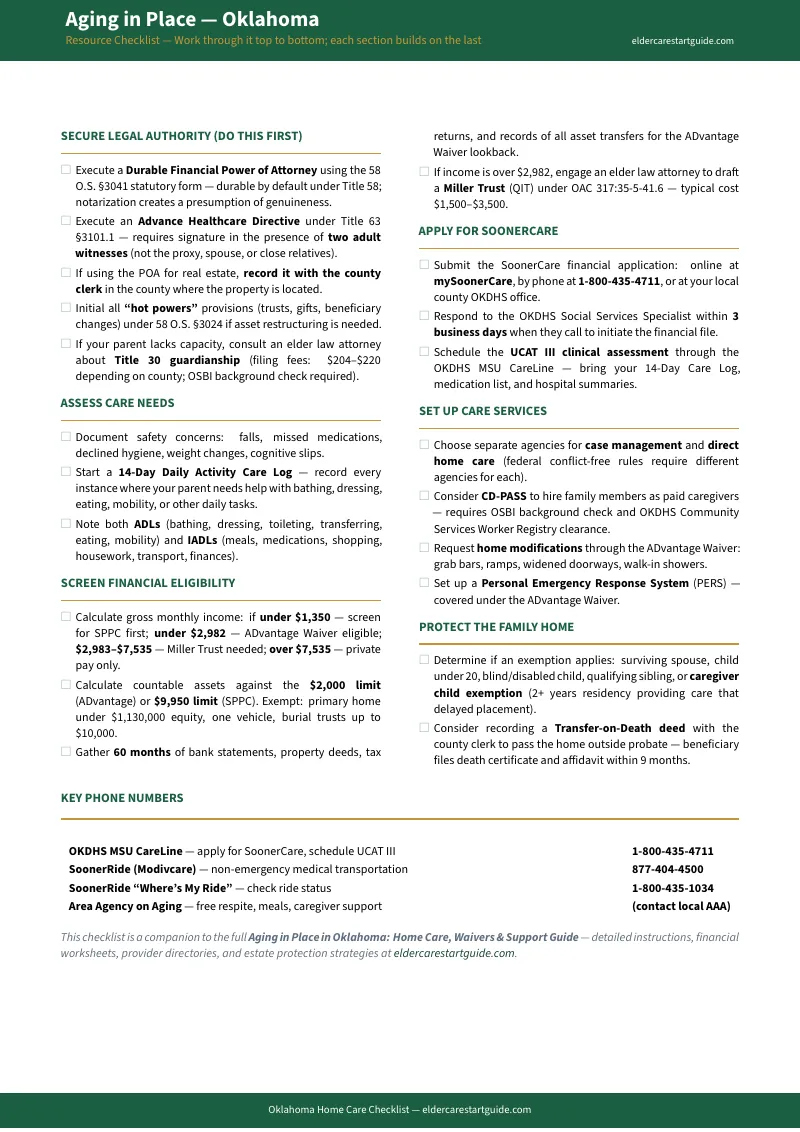
- Aging in Place Checklist — 20-item action list organized by timeline (Days 1–90)
- Legal Authority Checklist — Step-by-step POA, advance directive, and guardianship steps
- 14-Day Daily Activity Care Log — Fillable log for documenting ADL limitations before the UCAT III assessment
- Financial Screening Document Checklist — Every document to gather before filing SoonerCare
- Financial Screening Decision Tree — Visual flowchart matching income to the right program
- Program Comparison Matrix — Side-by-side comparison of all five home care pathways
- UCAT III Assessment Preparation — What the nurse assessor evaluates and what to have ready
- Home Safety Assessment Checklist — Room-by-room walkthrough with modification funding sources
- Estate Protection Action Checklist — TOD deeds, exemptions, and steps to protect the family home
- Key Contacts & Forms Reference — Agency phone numbers, key forms, and when to call a professional
Who This Is For
- Adult children whose parent is being discharged from the hospital and someone needs to figure out how to pay for home care that costs over $72,000 a year
- Families who need to qualify a parent for the ADvantage Waiver but don't understand how OKDHS and OHCA divide the process across two separate tracks — or why an approved clinical assessment doesn't mean services start
- Caregivers who want to get paid through CD-PASS as a family provider but don't know how to handle employer responsibilities, fiscal management, or SoonerCare compliance
- Families terrified that SoonerCare will seize the family home after a parent's death — and who need to understand what Oklahoma's probate-only estate recovery actually reaches versus what it cannot touch
- Anyone whose parent earns just over the $2,982 income cap and has been told they don't qualify — without being told about the Miller Trust workaround
- Out-of-state siblings coordinating an Oklahoma home care application remotely with no idea which agency does what
Why Not Free Government Resources?
OKDHS Aging Services publishes eligibility criteria. The OHCA website has SoonerCare policy manuals. Your local Area Agency on Aging distributes directories of programs and phone numbers.
Here is what none of them provide:
- A dual-track application strategy that coordinates the clinical assessment (OKDHS) and financial screen (OHCA) simultaneously instead of sequentially — so you don't lose weeks waiting for one agency while the other has already approved your parent
- A UCAT III assessment preparation walkthrough showing you exactly what the nurse assessor evaluates, how ADL limitations are scored, and how to document your parent's functional decline accurately enough to establish Nursing Facility Level of Care — not just "call OKDHS and request an assessment"
- A financial eligibility analysis that explains the income cap, the Miller Trust requirement, exempt vs. countable assets, the Community Spouse Resource Allowance, and legitimate spend-down strategies in plain language — not 40 pages of Oklahoma Administrative Code scattered across three different OHCA manuals
- An estate recovery analysis explaining which ownership structures survive Oklahoma's probate-only recovery model, how Transfer-on-Death deeds work, and how TEFRA liens apply — not a one-line "consult an attorney" disclaimer
- A CD-PASS enrollment guide for family members who want to provide paid care — including the fiscal management agency setup, employer responsibilities, and compliance requirements that the program brochure doesn't cover
— Less Than One Hour of Private Home Care
A geriatric care manager in Oklahoma charges $150 to $250 per hour. An elder law attorney charges $300 to $500 per hour for an initial consultation. Private home care costs $25 per hour — and without the right programs in place, those hours add up to $72,000 a year.
This guide costs less than a single hour of private home care. It covers the same application strategy, financial planning, and estate protection information that professionals charge thousands to explain — organized so you can work through it at your own pace, revisit any section, and share it with siblings who need to understand the process.
30-Day Satisfaction Guarantee
If the guide does not deliver clear, actionable steps for your family's Oklahoma home care situation, email [email protected] within 30 days for a full refund. No forms, no questions.
Start with the free checklist to see the quality and depth of the resource. When you're ready for the complete system — 13 chapters, 10 standalone worksheets, every strategy — the full guide is here.