
Your parent's care costs $8,000 a month. The rules that protect your family's savings are buried in 400 pages of Ohio Administrative Code.
The hospital discharge planner gives you a list of nursing facilities and a number: $8,000 to $12,000 a month, starting the day Medicare's skilled nursing benefit runs out. You have 45 days before the Medicaid application is due. In that window, every financial decision you make — every check you write, every gift you give, every account you move — is subject to Ohio's five-year lookback audit. One wrong step creates months of restricted coverage where nobody pays the bill except your family.
Ohio is an income-cap state with strict unauthorized-practice-of-law rules. That means most "Medicaid planning" services can't legally advise you on strategy, and the county caseworker who processes the application can't tell you how to qualify. You're expected to navigate the spend-down, the trust, the application, and the managed care system on your own — or pay an elder law firm $5,000 to $12,000 to do it for you.
The Medicaid Care Planner: a structured system for the 90% of Ohio families who don't need an attorney
The Ohio Medicaid Long-Term Care & Asset Protection Guide is a 59-page, four-phase process that takes you from "we just got the bill" to "application submitted, assets protected, care plan in place." It covers every decision point in the sequence Ohio requires — not as a list of rules, but as a chronological workflow you execute step by step.
The guide was built around what actually trips families up: the Power of Attorney that banks reject because it's missing one initialed clause. The gift to a grandchild three years ago that nobody thought to document. The pension increase from the Social Security Fairness Act that pushed income over the $2,982 cap. The PASSPORT waiver that could keep your parent at home but nobody mentioned because the hospital discharge team works with facilities, not home-care agencies.
What's inside
- The Legal Authority Audit — Before you touch a single dollar, the guide walks you through Ohio's statutory Power of Attorney (O.R.C. § 1337.60) to confirm your document includes the explicit "Actions Requiring Express Authority" that banks, investment firms, and the CDJFS actually enforce. Without these specific initialed clauses, your POA is a piece of paper that gets rejected when you need it most.
- Safe Harbor Spend-Down Playbook — A sequenced checklist of Ohio-approved transactions that convert countable assets into exempt resources: irrevocable preneed burial contracts (no dollar limit), capital home improvements, vehicle upgrades, outstanding debt payoff, and documented medical expenses. Every item includes the OAC citation so you can show the caseworker exactly where the exemption lives.
- Miller Trust (QIT) Setup Protocol — If your parent's gross monthly income exceeds $2,982, this chapter walks you through establishing a Qualified Income Trust: drafting the trust agreement, opening the dedicated bank account, naming the State of Ohio as primary beneficiary, and managing the monthly deposits that keep your parent eligible. Includes the exact language the trust document needs.
- Application Assembly Guide — An annotated, section-by-section walkthrough of Form ODM 07216 and the Long-Term Care Supplement, plus the five-year financial document organization system that gets the 60-month lookback audit completed without the back-and-forth delays that add weeks to processing.
- PASSPORT Waiver Navigation — How to get your parent assessed for Ohio's primary home-care waiver through your local Area Agency on Aging, including the cost-effectiveness threshold (waiver services capped at 60% of nursing facility cost), the Structured Family Caregiving option that lets family members receive compensation for providing care, and how PASSPORT interfaces with the Next Generation MyCare managed care transition.
- Spousal Protection Calculator — The 2026 Community Spouse Resource Allowance ranges from $32,532 to $162,660. The guide shows you how to calculate your protected share, how the Minimum Monthly Maintenance Needs Allowance works (including the Excess Shelter Allowance increase), and how to request a Bureau of State Hearings review if the standard allowance isn't enough to cover the at-home spouse's actual living costs.
- Estate Recovery Defense Map — Ohio's Attorney General expanded Medicaid estate recovery to cover non-probate assets — Transfer-on-Death accounts, jointly held bank accounts, and revocable living trusts. The guide maps out which exemptions apply (surviving spouse, minor child, disabled child, hardship waiver) and the executor notice requirements under O.R.C. § 5162.21.
- Next Generation MyCare Enrollment — For dual-eligible parents (Medicare + full Medicaid), the guide covers Ohio's transition to FIDE-SNP managed care plans, how to compare the three statewide carriers (Anthem, CareSource, Molina), and how to maintain waiver services through the transition.
Who this guide is for
- The crisis navigator — Your parent is in the hospital or a skilled nursing facility and you just learned that private-pay rates start the day Medicare coverage ends. You need a plan before you sign the admission agreement.
- The spend-down planner — You've been paying privately for months or years and the savings are approaching the $2,000 threshold. You need a legally compliant strategy to convert remaining assets without triggering transfer penalties.
- The system navigator — Your parent is dual-eligible and the Next Generation MyCare transition letters are arriving. You need to understand how managed care plan selection affects access to PASSPORT services and care coordination.
- The at-home spouse — Your partner is entering a facility and you need to know exactly how much of the shared savings and income you can keep without jeopardizing their eligibility.
Why the free checklist isn't enough
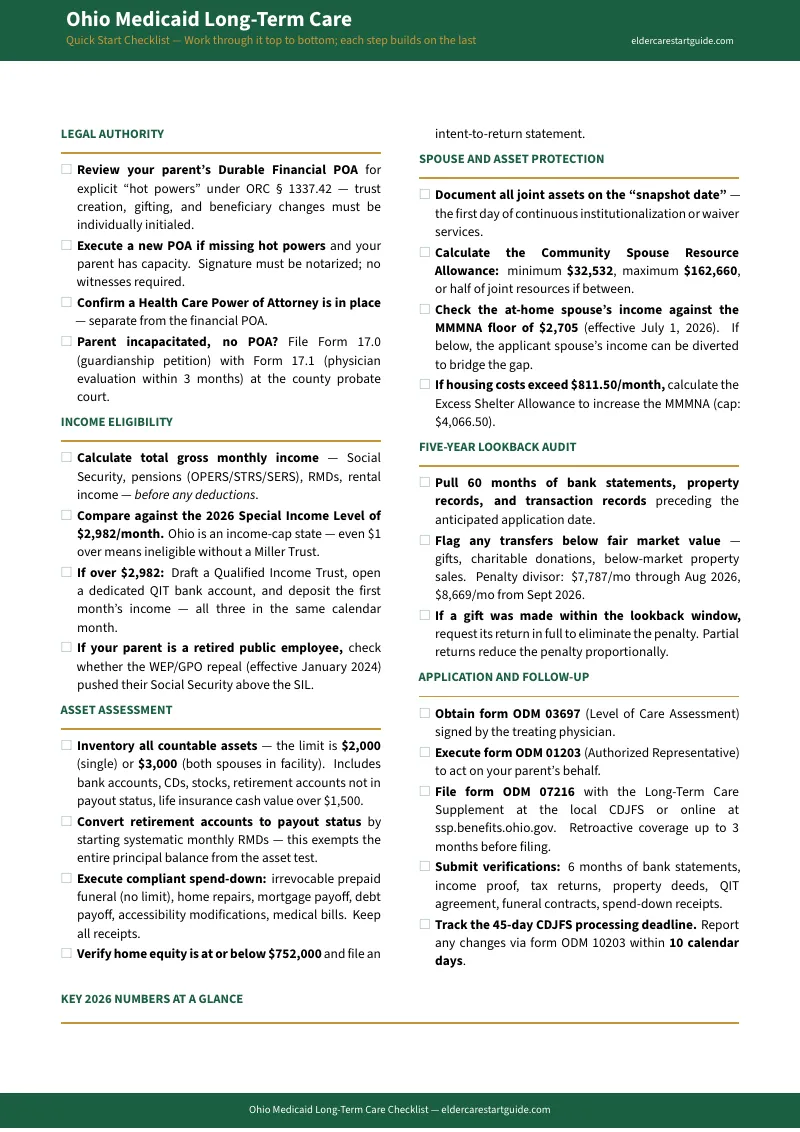
The free checklist gives you the document preparation list — the 60 months of bank statements, the asset inventory, the forms you need to file. That's the administrative layer. But gathering documents without a spend-down strategy is like organizing your tax receipts without knowing which deductions you qualify for. The full guide covers the strategic layer: which assets to convert first, how to structure family caregiver payments so they don't trigger penalties, when a Miller Trust is required and how to set one up, and how to protect the family home from estate recovery.
Families who file without this strategic framework are the ones who get 90-day processing delays because of undocumented transfers, or denial notices because they didn't know Ohio requires a QIT for anyone over the income cap. The county caseworker processes the application — they don't coach you through the preparation.
Your purchase is risk-free
Full refund, no time limit. If the guide doesn't help you navigate Ohio's Medicaid long-term care system, email [email protected] and we'll refund every cent. No forms, no explanation needed.
The free checklist is yours to keep either way — download it now to start organizing your documents while you decide.
Get the Ohio Medicaid Long-Term Care & Asset Protection Guide →