
The hospital says tomorrow. Your parent isn't ready. Neither are you.
A discharge planner just told you your parent is leaving the hospital — maybe tomorrow, maybe the day after. The house isn't set up. The medications haven't been reconciled. Nobody has explained what "observation status" means or why it matters. And the clock is already running on decisions that will determine whether your parent ends up safe at home, in a good rehab facility, or in a financial crisis that drains their savings within months.
The information you need exists — scattered across Medicare.gov, the Ohio Department of Aging, Commence Health's appeal portal, and dozens of county-level agency websites. Pulling it together under a deadline, while stressed, while your parent is lying in a hospital bed, is how families make mistakes that cost thousands.
The Discharge Defense System
This is a complete transition manual — built for Ohio families navigating hospital discharges, rehab placements, and the shift from Medicare-covered care to long-term options. It organizes every federal protection, Ohio-specific waiver program, and managed care rule into a step-by-step system you can follow under pressure.
Where free government resources give you policy language, this guide gives you the sequence: what to do first, what to say to the discharge planner, where to file the appeal, and how to protect your parent's assets while the system processes their case.
What's Inside
- Discharge Appeal Preparation Worksheet — fill-in phone script and caregiver statement for filing with Commence Health before the midnight deadline. You don't draft appeal language under pressure — you fill in the blanks.
- Observation Status Challenge — the printable form for requesting an inpatient conversion under the Two-Midnight Rule, and the Commence Health pathway if the hospital issues an MCSN after the fact. One wrong classification can wipe out Medicare coverage for rehab entirely.
- Facility Evaluation Checklist — a worksheet for comparing three skilled nursing facilities using the Long-Term Care Quality Navigator, with red-flag indicators from state inspection reports and the staffing ratios that predict care quality. Use it during the 24-hour window when you actually have to choose.
- PASSPORT/Waiver Application Document Tracker — the 2026 eligibility rules, income threshold ($2,982/month), asset limit ($2,000), Miller Trust setup, and a check-off list of every CDJFS document so the 45-day clock does not stall. Includes the spousal protections that let a healthy spouse keep up to $162,660 in assets.
- Medicaid Spend-Down Calculator — which assets count, which are exempt, and the permitted ways Ohio families reach the $2,000 threshold — prepaid irrevocable funeral contracts, accessibility home modifications, and a single exempt vehicle. Includes the 60-month lookback and the APPR penalty math.
- Nursing Home Contract Review Checklist — the clauses that turn an adult child into a personal guarantor for their parent's bills, and exactly how to sign as a POA agent without assuming personal financial liability. Includes Ohio's filial responsibility statute (ORC 2919.21(A)(3)) and why it almost never applies.
- Next Generation MyCare Ohio Navigator — prior-authorization tracker, care-coordinator contacts, and appeal deadlines for dual-eligible parents enrolled with Anthem, CareSource, or Molina. Updated for the August 2026 statewide completion.
- Medication Reconciliation Log, Weekly Care Transition Tracker, and Agency Communication Log — DME and follow-up tracking, discharge-vs-home medication comparison, and a dated record of every hospital, SNF, AAA, CDJFS, and MyCare call, plus caregiver training under Ohio's CARE Act (ORC 3727.75–76).
Who This Is For
- Adult children managing a sudden discharge — your parent fell, had a stroke, or was admitted for an acute illness, and the hospital says they're ready to go home before you are
- Long-distance caregivers — you live in another state and need to coordinate a safe transition in Ohio without being physically present
- Families approaching the Medicare cliff — your parent is nearing Day 20 or Day 100 in a skilled nursing facility, and you need to understand what happens when Medicare's coverage window closes
- Asset-preservation planners — you're watching private-pay nursing home costs consume your parent's savings and need a structured path to Medicaid eligibility that protects the family home
Why Free Resources Aren't Enough
The Ohio Department of Aging's website explains PASSPORT eligibility. Medicare.gov describes the appeal process. Commence Health publishes its phone number. None of them tell you what to do first — which document to gather, which phone call to make, which form to sign and which to refuse — when you're standing in a hospital corridor at 9 PM learning that your parent is being released into a home that isn't safe.
Free resources describe the system. This guide gives you the sequence: a chronological, decision-by-decision roadmap built for the specific pressure of an Ohio hospital discharge, from the first 24 hours through the Medicaid application and the long-term care transition.
An elder law attorney charges $300–$500 per hour to explain the same rules. A geriatric care manager bills $75–$250 per hour for in-person coordination. This guide gives you the foundational knowledge to work more efficiently with those professionals — or to handle the transition yourself if your situation is straightforward enough.
Satisfaction Guarantee
Full refund, no time limit. If the guide doesn't help, email [email protected] and you'll get your money back. No forms, no justification required.
The Free Checklist vs. the Full Guide
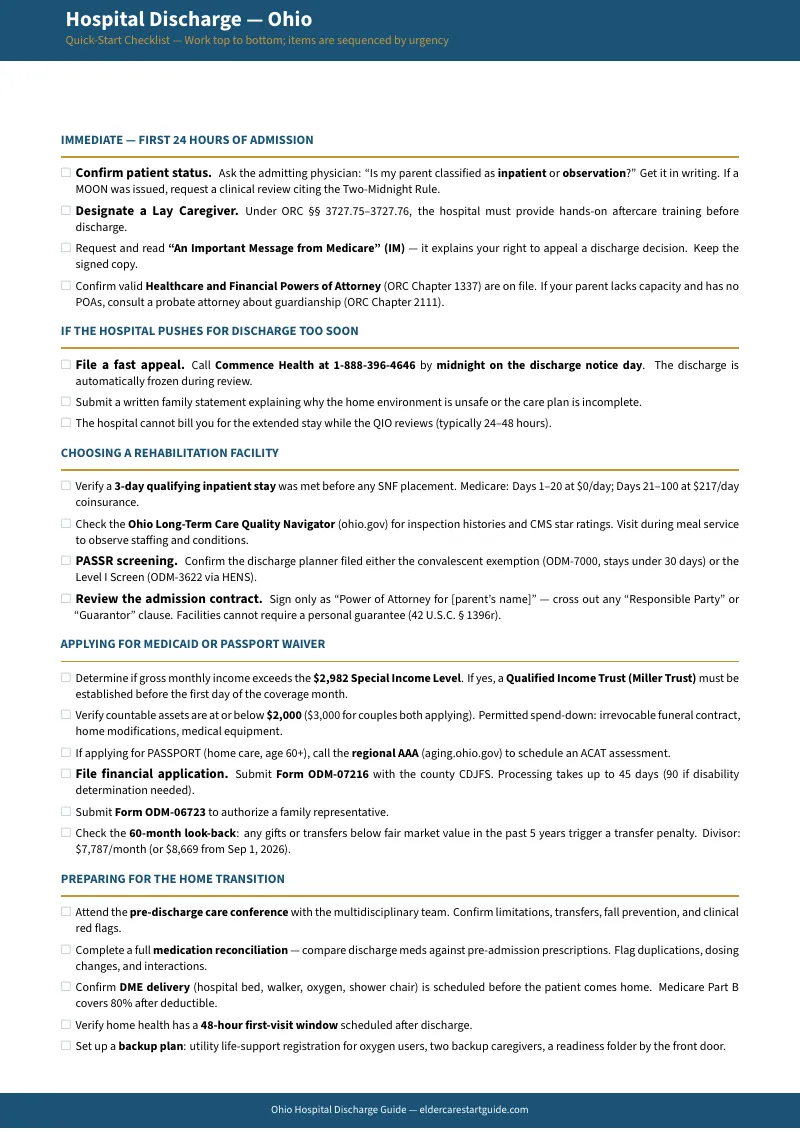
Download the free Ohio Hospital Discharge Checklist to get the step-by-step sequence for managing a discharge. It covers the key actions: verifying inpatient status, filing a QIO appeal, and coordinating the immediate transition.
The full kit goes deeper — the Discharge Appeal Preparation Worksheet, Facility Evaluation Checklist, Medicaid Spend-Down Calculator, Nursing Home Contract Review Checklist, and the Next Generation MyCare Ohio Navigator, plus the home-transition logs. It's the difference between knowing what to do and having the tools to actually do it under a deadline.