
Your Parent Qualifies for More Help Than You Think — But Ohio Won't Tell You That
You're watching your parent struggle at home. Maybe it started with a fall. Maybe the medication errors are piling up. Either way, you know something has to change — and Ohio has programs designed for exactly this moment. The problem? The programs are split across the Ohio Department of Aging, the Ohio Department of Medicaid, 12 regional Area Agencies on Aging that each run intake differently, and a managed care system that's being rebuilt county by county in 2026.
You've already spent hours on the OBLTSS helpline. You've read fragments of PASSPORT waiver rules that reference OAC sections you can't find. You've been told your parent "makes too much" for Medicaid — without anyone mentioning the Qualified Income Trust that legally bypasses that cap. Meanwhile, private home care runs $30 to $35 an hour and your parent's savings won't last the year.
The Ohio Home Care Navigation System
This guide maps every pathway your parent has — from the PASSPORT waiver (Ohio's primary home and community-based services program for seniors 60+, covering up to $14,700 per month in services) to county-funded programs like the Elderly Services Program that have no Medicaid requirement. It gives you the exact forms, phone scripts, and step-by-step sequences so you stop researching and start acting.
What makes this different from Googling "Ohio home care Medicaid": it connects the dots between programs that the state treats as separate silos. It explains how the Next Generation MyCare Ohio rollout in 2026 affects your parent's existing waiver services, which managed care plan to pick if your parent is dually eligible, and how to navigate the provider enrollment moratorium that's limiting available home care agencies through November 2026. The guide shows you how to layer programs so your parent has support from day one — not just after a 90-day approval process.
What's Inside
- PASSPORT Application Roadmap — printable step-by-step roadmap through every stage of the application process, from the Area Agency on Aging intake call through the ACAT in-home assessment, financial verification, and waiver enrollment
- QIT/Miller Trust Setup Worksheet — fillable worksheet for establishing a Qualified Income Trust when your parent earns over $2,982/month, with income source tracking and monthly transfer instructions to maintain eligibility
- Consumer-Directed Care Enrollment Guide — complete enrollment walkthrough for C-HCAS and CD-PCS, the two consumer-directed programs that let adult children get paid for caregiving through the state's financial management service
- MyCare Ohio Plan Comparison Scorecard — side-by-side comparison of the three 2026 managed care plans (Anthem, CareSource, Molina) covering transportation benefits, dental allowances, prior-authorization timelines, and network size
- Estate Recovery Defense Worksheet — asset classification worksheet diagnosing your parent's exposure under Ohio's aggressive post-55 recovery rules and mapping the Caregiver Child Exception, Sibling Exception, and Undue Hardship Waiver pathways
- Home Safety Assessment — room-by-room evaluation checklist with modification priorities and funding sources including the $15,000 Environmental Accessibility Adaptations cap (July 2026 waiver amendment) and USDA Section 504 grants
- Provider Vetting Scorecard — agency comparison scorecard covering BCI/FBI fingerprint background checks, six-database screening requirements under OAC 3701-60-06, and RAPBACK ongoing monitoring status
- AAA Intake Phone Script — phone script with exact phrasing for describing your parent's functional limitations to the regional AAA intake coordinator, designed to prevent an accidental screening denial during the one-shot ACAT assessment
Who This Is For
- Adult children who just received a hospital discharge notice and need to arrange home care within 48–72 hours
- Family caregivers spending 20+ unpaid hours per week and desperate to access paid caregiving through Ohio's C-HCAS or CD-PCS programs
- Families whose parent earns "too much" for Medicaid and don't know a QIT/Miller Trust can fix that
- Dually eligible families confused by the MyCare Ohio transition and unsure which managed care plan to choose
- Anyone paying $30–$35/hour out of pocket for home care who hasn't explored what Ohio's PASSPORT waiver will cover
- Long-distance caregivers coordinating Ohio services remotely
Why Free Resources Leave You Stuck
The state's own websites (aging.ohio.gov, medicaid.ohio.gov) tell you programs exist — then give you a phone number to call. They don't explain that the ACAT assessment is a one-shot evaluation where underdocumented functional decline means a denial you'll have to appeal. They don't mention that you can access levy-funded county programs the same week you start a PASSPORT application. They definitely don't hand you a Miller Trust template or walk you through the consumer-directed payroll enrollment process.
Elder law attorneys will — for $195–$500/hour or flat Medicaid planning packages from $3,000 to $15,000. This guide gives you the same procedural knowledge in a format you can use tonight.
Satisfaction Guarantee
If the guide doesn't help you identify at least one program or pathway you weren't already pursuing, email us for a full refund. No forms, no waiting period.
Start Navigating Ohio's System Today
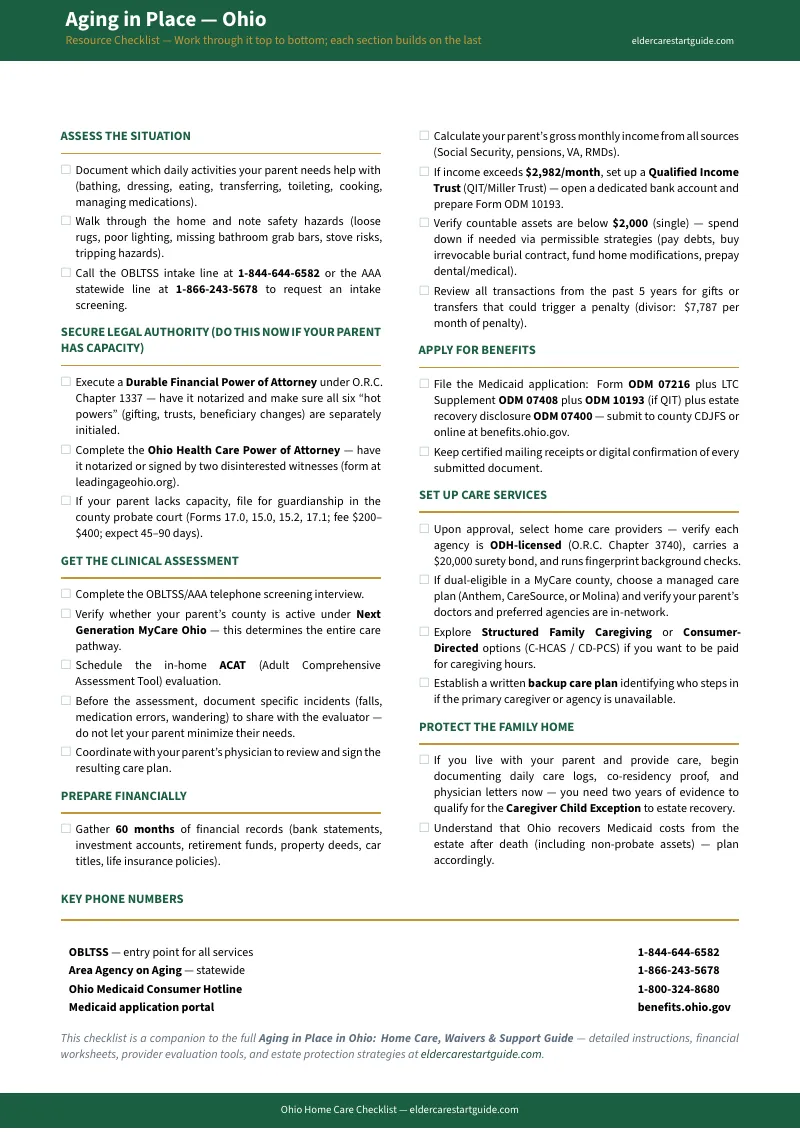
Download the free checklist to get the 20-item action summary — or get the full guide for and have every form, script, template, and calculator you need to secure your parent's home care.