Your Parent Is Probably Paying Medicare Costs North Dakota Will Cover
Every month, $202.90 comes out of your parent's Social Security check for the Part B premium. On a fixed income in North Dakota — where modest Social Security payments are the norm — that deduction is significant. And there is a strong chance the state will pay it for them.
North Dakota's Medicare Savings Programs cover more people than most families realize. The income limits reach higher than the figures that show up on a quick web search, because the state subtracts a $20 general income disregard that eligibility charts rarely mention. A parent earning $1,360 a month in Social Security looks over the QMB limit on paper — but after the disregard, their countable income is $1,340, which is under the threshold.
The problem is that North Dakota's application process is spread across 53 Human Service Zone offices, a centralized Customer Support Center in Bismarck, and an online portal that frustrates anyone who is not comfortable uploading documents through a government website. Families lose weeks sending paperwork to the wrong office or submitting incomplete applications that get held for additional documentation.
The North Dakota Medicare Cost-Help Navigator
This guide consolidates every layer of North Dakota's Medicare cost-assistance system — the Medicare Savings Programs (QMB, SLMB, QI) and Extra Help — into a single, step-by-step workflow. Instead of bouncing between the state eligibility manual, federal portals, and outdated web articles, you follow one document from eligibility check through application, approval, and annual renewal.
It is built specifically for the way North Dakota administers these programs through its Human Service Zone network, not the way national Medicare websites describe them. That distinction matters when you are deciding whether to mail an application to Bismarck or walk it into a county office, or when a caseworker asks for documents that the federal program does not require.
What the Guide Covers
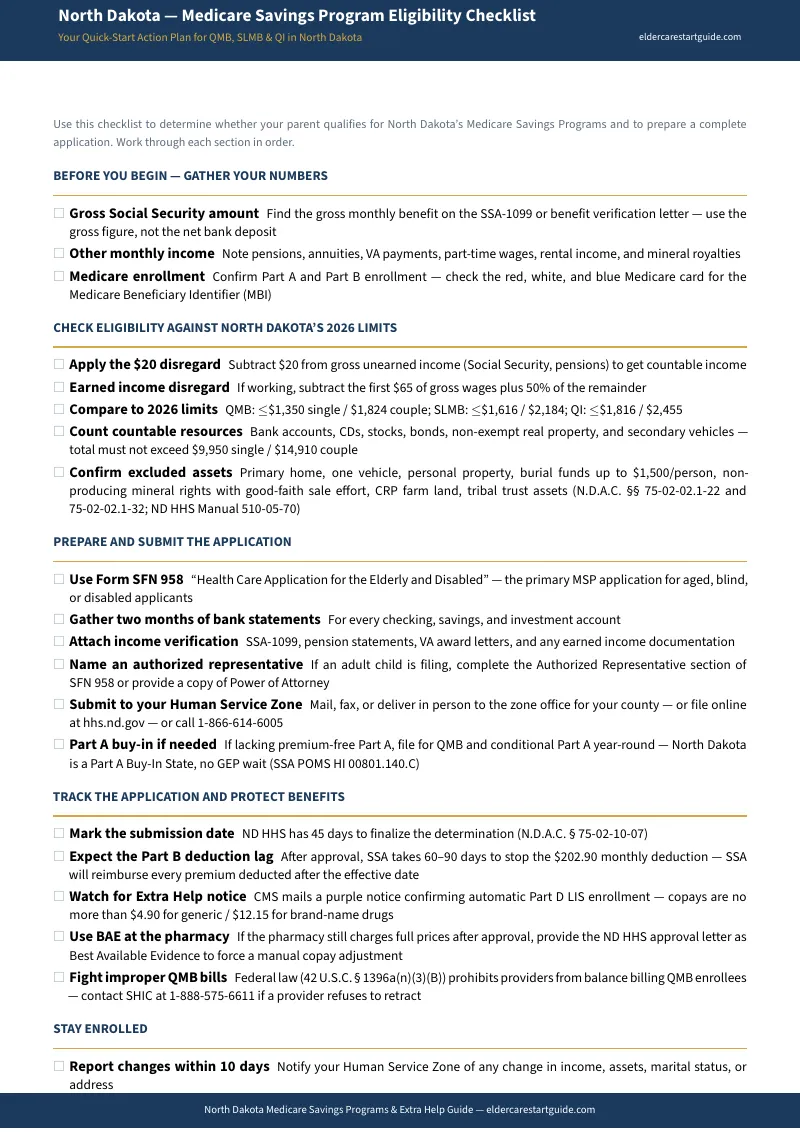
- 2026 income and asset limits with disregards pre-calculated — the actual North Dakota thresholds (QMB up to $1,350/month individual, QI up to $1,816/month), with the $20 general income disregard built into worked examples so you can see whether a parent qualifies without guessing
- Asset exclusion checklist — the primary home, one vehicle, personal property, and $1,500 per person in designated burial funds are all excluded from the $9,950 individual resource limit, but public charts rarely spell this out
- Human Service Zone routing map — which forms go to the local county office and which go to the Customer Support Center in Bismarck, so applications reach the right intake point on the first try
- SFN 958 and SFN 1909 application walkthrough — section-by-section guidance through both state forms, with the document checklist for each submission method (online portal, mail, fax, in-person)
- Part A buy-in procedure — how QMB covers the Part A premium year-round for beneficiaries who lack 40 quarters of work history, including the conditional enrollment sequence with SSA that must happen before the state application
- Post-approval premium adjustment tracking — what happens to the Social Security check after MSP approval, why the Part B deduction keeps appearing for 60 to 90 days, and how to verify the retroactive reimbursement
- QMB billing protections — the federal law that prohibits providers from balance-billing QMB beneficiaries for deductibles, coinsurance, and copays, with a printable dispute escalation card and tracking log when a provider sends a bill anyway
- Extra Help auto-enrollment — how MSP approval automatically triggers the federal Part D Low-Income Subsidy, what it covers for prescription costs, and how North Dakota's lack of a state pharmacy program makes this the only prescription help available
- COLA disregard protection — how North Dakota protects existing MSP recipients during January through March by disregarding the Social Security cost-of-living increase until updated poverty guidelines take effect in April
- Renewal and recertification management — the annual renewal timeline, what the recertification letter asks for, and how to prevent accidental termination from a missed form or an address change
- Fair hearing procedures — how to file form SFN 162 (Request for Hearing) if the application is denied, including deadlines, what to include, and how filing within the appeal window preserves continuous coverage
- Estate recovery clarification — why receiving MSP does not trigger a lien or estate claim on the family home, and how to distinguish MSP asset rules from long-term care Medicaid rules that families often confuse
Who This Guide Is For
- Adult children helping a parent in North Dakota apply for Medicare cost assistance — whether you live in Fargo, Bismarck, out of state, or across the country
- Seniors managing the application on their own and looking for clear, step-by-step instructions that translate the state eligibility manual into plain language
- Families in rural counties or on tribal lands who need to know how to apply by paper when the online portal is not a practical option
- Anyone who was told their parent earns too much or has too many assets — and wants to check whether the $20 income disregard or the asset exclusions change the answer
- Families who have already been approved and need to understand what happens next — premium adjustments, billing protections, Extra Help enrollment, and renewals
Why Free Resources Are Not Enough
North Dakota does have free help available. SHIC counselors through the Insurance Department give reliable Medicare advice by phone, and Legal Services of North Dakota handles urgent cases. But SHIC counselors cannot fill out your application line by line, organize your financial documents, or draft billing dispute letters. And Legal Services operates under strict caseload limits that prioritize emergencies over routine MSP applications.
Meanwhile, the state's own eligibility manual is written for caseworkers, not families. The online forms download as blank PDFs without instructions. And most of what shows up on a web search is either a national resource using generic federal numbers, or an insurance brokerage using "free Medicare help" to funnel your parent into a plan sale.
This guide is not an insurance company. It does not sell plans, collect health data, or earn carrier commissions. It is a self-paced reference that prepares your family to file a complete application, avoid the most common processing mistakes, and manage the ongoing paperwork so the help does not lapse.
What You Get
The download includes the full guide, the eligibility checklist, and eight printable worksheets and tools:
- The full guide — 49 pages covering eligibility across all five MSP tiers, income and asset calculations, the complete application process through Human Service Zones, Part A buy-in, post-approval procedures, QMB billing protections, Extra Help, renewals, fair hearings, estate recovery, and worked examples
- The eligibility checklist — a printable 25-item action list organized in five phases, from gathering documents through submitting the application and managing post-approval follow-up
- Eligibility worksheet — step-by-step income calculation with disregards and the 2026 North Dakota tier limits
- Asset inventory worksheet — map every asset as excluded or countable against the $9,950 / $14,910 threshold
- Application document checklist — every document the Human Service Zone requires, organized by category
- QMB billing protection card — the dispute escalation steps and contacts to stop illegal balance billing
- Billing dispute log — track each improper bill from receipt through resolution
- Premium refund tracker — month-by-month log for the 60–90 day SSA adjustment period
- Renewal calendar — 12-month timeline with deadlines, change reporting, and COLA disregard dates
- Agency communication log — record every call and office visit as evidence for fair hearings or disputes
Satisfaction Guarantee
If the guide does not help your family navigate the process, email [email protected] for a full refund — no time limit, no questions asked.
Your parent may be eligible for help that covers the Part B premium, Medicare deductibles, and prescription costs. The checklist shows you whether they qualify. The full guide shows you exactly how to get it.
Download the free checklist to check eligibility, or get the complete 10-PDF kit with the guide, income and asset worksheets, application document checklist, billing dispute tools, premium refund tracker, and renewal calendar.
Frequently Asked Questions
What if the rules change after I buy?
We update the guide when the rules change. Email us any time, even years later, and we'll send you the current edition free.