Your Parent Is Probably Paying Medicare Costs New York Will Cover
Every month, $202.90 comes out of your parent's Social Security check for the Part B premium. On a fixed income, that is real money — money that could go to groceries, utilities, or prescriptions. And in New York, there is a strong chance the state will pay that premium for them.
New York's Medicare Savings Programs cover far more people than most families realize. The state eliminated the asset test entirely — savings, a home, retirement accounts, none of it counts. And in 2023, New York raised the income limits well above the federal baseline. If your parent's gross monthly income is under $2,494 as an individual, there is a program that can help.
The problem is that the process is scattered across multiple agencies, the rules are different depending on whether your parent lives in the city or upstate, and nearly every national resource you find online publishes the wrong numbers for New York.
The New York Medicare Cost-Help Navigator
This guide consolidates every layer of New York's Medicare cost-assistance system — MSP, Extra Help, and EPIC — into a single, step-by-step workflow. Instead of bouncing between state websites, federal portals, and outdated web articles, you follow one document from eligibility check through application, approval, and annual renewal.
It is built specifically for the way New York administers these programs, not the way the federal government describes them. That distinction matters more than most families realize until they file the wrong form or send it to the wrong office.
What the Guide Covers
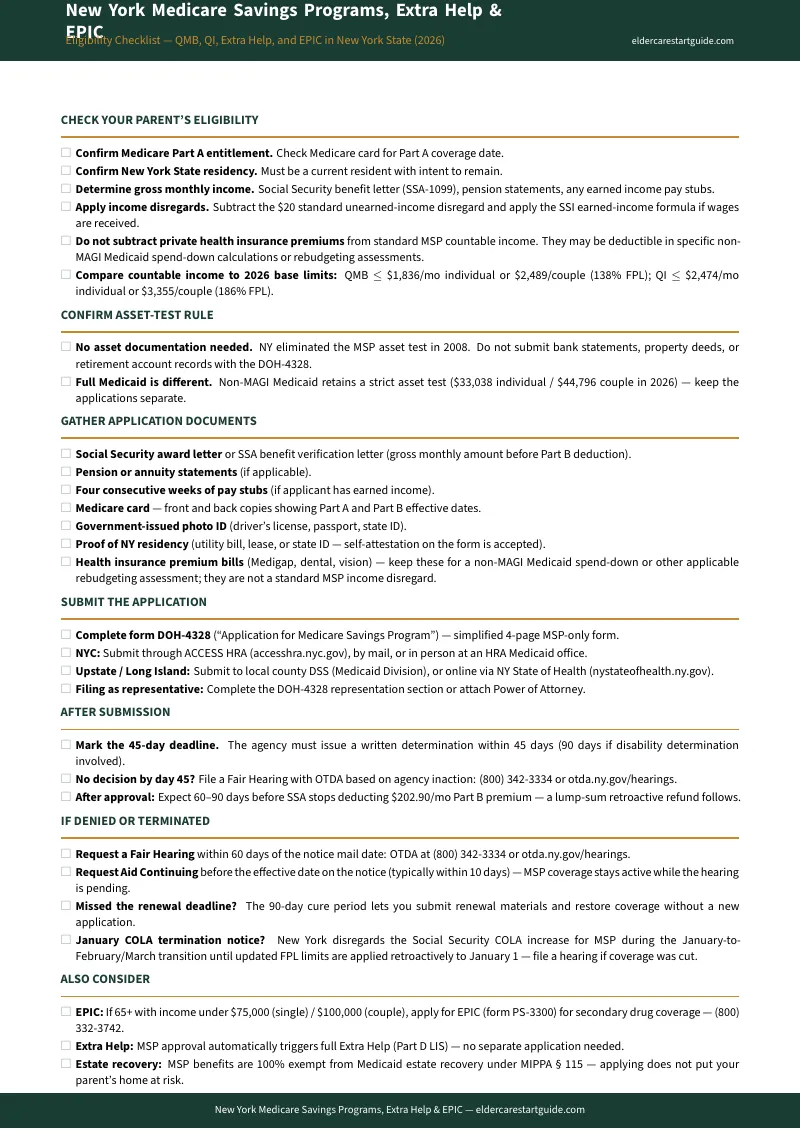
- 2026 income limits with disregards pre-calculated — the actual New York thresholds (QMB up to 138% FPL, QI up to 186% FPL), not the lower federal numbers that Medicare.gov publishes
- The no-asset-test rule — why bank statements, property, and retirement savings are irrelevant for MSP in New York, with the policy citations to push back if a caseworker asks for them
- NYC ACCESS HRA vs. upstate county DSS — separate intake instructions for each pipeline, because the forms, the portals, and the processing norms are different
- DOH-4328 application walkthrough — line-by-line guidance through the simplified MSP application, with the document checklist for both the applicant and an authorized representative
- Part A buy-in procedure — how QMB covers the Part A premium year-round for those who are not automatically entitled to premium-free Part A
- Post-approval premium refund tracking — what happens to the Social Security check after MSP approval, how long the 60–90 day SSA processing window takes, and how to verify the retroactive lump-sum reimbursement
- QMB billing protections — the federal law that prohibits providers from balance-billing QMB beneficiaries for deductibles, coinsurance, and copays, and what to do when a provider sends a bill anyway
- Extra Help auto-enrollment — how MSP approval automatically triggers the federal Part D Low-Income Subsidy, and what it covers
- EPIC coordination — how to stack New York's Elderly Pharmaceutical Insurance Coverage program on top of Part D and Extra Help for the lowest possible prescription costs
- Renewal and recertification management — the annual renewal timeline, MAP-909F form handling, and how to prevent accidental termination from a missed deadline
- Fair hearing procedures — how to request an OTDA hearing if the application is denied or the agency fails to act within 45 days
- Income calculation worksheets — worked examples for both unearned and earned income, including the SSI disregard formulas
Who This Guide Is For
- Adult children helping a parent in New York apply for Medicare cost assistance — whether your parent lives in Manhattan, Buffalo, or anywhere in between
- Seniors managing the application process on their own and looking for clear, step-by-step instructions
- Long-distance caregivers who need to file on behalf of a parent without being physically present at a DSS office
- Families who were told their parent earns too much or has too many assets — and want to check whether that was based on the federal numbers or the actual New York numbers
- Anyone who has already been approved and needs to understand what happens next — premium refunds, billing protections, EPIC enrollment, and renewals
Why Free Resources Are Not Enough
New York does have free help available. HIICAP counselors give excellent advice, and the Medicare Rights Center runs a dedicated helpline. But counselor appointments can take weeks during peak enrollment, and the state's own website publishes eligibility charts without explaining how income disregards work, how to calculate whether a parent actually qualifies, or what to do after approval when SSA keeps deducting the premium.
Meanwhile, most of what shows up on a web search is either a national resource using the wrong income limits and asset thresholds for New York, or an insurance brokerage using "free help" as a way to funnel your parent into a Medicare Advantage plan.
This guide is not an insurance company. It does not sell plans, collect health data, or earn carrier commissions. It is a self-paced reference that prepares your family to file a complete application, avoid the most common processing mistakes, and manage the ongoing paperwork so the help does not lapse.
What You Get
The download includes 8 PDFs — the full guide, the eligibility checklist, and six standalone printable tools:
- The full guide — 49 pages covering eligibility, application, Part A buy-in, post-approval procedures, QMB billing protections, Extra Help, EPIC, renewals, fair hearings, estate recovery, and worked income-calculation examples
- The eligibility checklist — a printable action list you can work through in one sitting to determine eligibility, gather documents, and submit the application
- MSP eligibility worksheet — a step-by-step income calculation form with SSI disregard formulas and the 2026 New York thresholds pre-printed
- Application document checklist — a checkbox tracker for every document the DOH-4328 requires, organized by category with space for dates and notes
- Agency communication log — a landscape-format call and visit tracker for DSS, HRA, SSA, and EPIC contacts, designed as fair hearing evidence
- Premium refund tracker — a month-by-month log for auditing the retroactive Part B refund during the 60–90 day SSA processing window
- Renewal calendar — a 12-month recertification timeline with checkboxes for each renewal milestone and the 90-day cure period deadline
- QMB billing dispute letter — a ready-to-customize letter citing the federal and state statutes that prohibit balance billing, formatted for certified mail to a provider's billing department
Satisfaction Guarantee
If the guide does not help your family navigate the process, email [email protected] for a full refund — no time limit, no questions asked.
Your parent may be eligible for help that covers far more than the Part B premium. The checklist shows you whether they qualify. The full guide shows you exactly how to get it.
Download the free checklist to check eligibility, or get the complete guide with the application walkthrough, income worksheets, billing dispute letter, and renewal calendar.
Frequently Asked Questions
What if the rules change after I buy?
We update the guide when the rules change. Email us any time, even years later, and we'll send you the current edition free.