
Your parent needs help. New York won't let you give it — until you hold the right documents.
The bank won't let you pay your parent's mortgage. The hospital won't share their diagnosis. The nursing home hands you a contract to sign as "Responsible Party" and you don't know what that means. Your parent's savings are draining at $14,000 a month and you can't stop it because you don't have legal authority to act.
New York splits legal authority across three separate instruments — a financial Power of Attorney under the General Obligations Law, a Health Care Proxy under the Public Health Law, and an Article 81 guardianship through Supreme Court when both of those are too late. Each has its own execution requirements, its own witnesses, its own activation rules. Miss one detail and the document is invalid. Wait too long and you lose the option entirely.
The New York Legal Authority Navigation System puts every step of all three pathways into a single manual — written for the adult child standing in the gap between a parent who needs help and a state that won't let you provide it without the right paperwork.
Why free forms and generic templates fail New York families
New York State provides blank POA forms for free. Rocket Lawyer and LegalZoom sell fill-in-the-blank templates. What none of them give you is the execution sequence that makes those documents actually work.
A blank New York Statutory Short Form doesn't tell you that the Modifications section of GOL § 5-1513 is where gifting authority lives — and without it, your parent's agent cannot transfer assets above $5,000 annually, which means no Medicaid spend-down, no home protection strategy, no structured financial planning. A template doesn't warn you that combining a POA and Health Care Proxy on a single form invalidates the proxy under PHL § 2981(5)(e). And no free tool walks you through what happens when your parent can no longer sign anything — the Article 81 court petition, the independent evaluator, the hearing, the $4,500-to-$15,000 attorney bill.
This kit is the order of operations. Which document to execute first. Which witnesses qualify. Which customizations protect assets. And when it's too late for documents and time to prepare for court.
What's inside
- Durable Power of Attorney execution guide — the exact requirements under GOL Article 5, Title 15: principal's signature and initials, notarial acknowledgment in the manner of a real-estate conveyance, two disinterested witnesses (the notary can serve as one), and the Modifications section customization that enables gifting authority and Medicaid planning
- Health Care Proxy and Living Will instructions — the PHL § 2981 execution requirements (two adult witnesses, no notary needed), the prohibition on combined forms, the activation trigger (attending physician's written incapacity determination), and how a Living Will — upheld by New York case law despite having no specific statute — supplements the proxy
- Article 81 guardianship navigation roadmap — the Supreme Court petition process, the "clear and convincing evidence" standard, the court-appointed evaluator's investigation, the "least restrictive alternative" judicial principle, and the distinction between guardianship of the person versus guardianship of property. Includes why Article 17-A (developmental disabilities before age 22) cannot be used for age-related dementia
- Monitor provision and sibling conflict prevention — how to use GOL § 5-1513's optional Monitor designation to give siblings structured transparency over financial transactions, plus a Sibling Care Agreement framework that documents responsibilities before disputes escalate
- Representative Payee process — the SSA does not recognize state-law POAs for managing Social Security benefits. Step-by-step instructions for applying to become a parent's Representative Payee through the federal system
- Social Security Fairness Act verification — the WEP and GPO are fully repealed as of January 2025 (retroactive to January 2024). How to verify automatic adjustments for existing beneficiaries and file new applications for parents who never claimed because the old rules would have zeroed their benefit
- Medicaid long-term care coordination — New York's separate lookback rules (60-month for nursing home, 30-month authorized but unimplemented for community care), the 2026 asset thresholds ($33,038 individual, $162,660 CSRA), regional penalty divisors, home equity exemptions ($1,130,000), Caregiver Child and Sibling transfer exemptions, and Spousal Refusal under SSL § 366(3)(a)
- MLTC and CDPAP enrollment — Managed Long Term Care plan selection, the NYIAP clinical assessment, and Consumer Directed Personal Assistance Program enrollment through PPL (including September 2025 eligibility tightening: three ADLs, or two for dementia patients)
- 7 printable planning tools — capacity assessment worksheet, document execution checklist, pooled trust budget calculator, Medicaid application document tracker, facility evaluation scorecard, sibling care agreement framework, and agency communication log
Who this is for
- Adult children whose parent can still sign documents — your parent has early cognitive decline or has simply never set up legal documents. The window to execute a POA and Health Care Proxy is open but closing. This kit shows you how to do it right the first time.
- Families in crisis with no legal documents in place — your parent is hospitalized, the bank is frozen, and nobody can make decisions. The kit covers whether a POA is still possible, when to file for emergency guardianship, and how long the court process takes.
- The adult child navigating sibling disagreements — your siblings disagree about care. One suspects financial mismanagement. The kit's Monitor provision and Sibling Care Agreement framework establishes transparency before resentment becomes litigation.
- Families protecting assets from nursing home costs — private-pay nursing home care in New York runs $12,000 to $18,000 a month. The kit explains how the POA's Modifications section enables Medicaid planning, and how to use the current community Medicaid lookback delay to protect assets.
Why not just hire an elder-law attorney?
Elder-law attorneys in New York charge $350 to $650 an hour for consultations, and $3,000 to $15,000 for flat-fee Medicaid planning or guardianship work. For complex irrevocable trusts or contested guardianship proceedings, you need one. But most families don't start with complex trusts. They start with confusion — which document do I need? Can my parent still sign? What happens if they can't? What are the Medicaid thresholds?
Attorneys spend their first billable hours answering those questions and gathering five years of financial records. This kit gives you those answers before you sit down with counsel, so you're paying an attorney for strategy — not for explaining how the system works.
Satisfaction guarantee
If the kit doesn't give you a clear, actionable path for securing legal authority over your parent's care in New York, email us for a full refund. No conditions, no time limit.
Get the toolkit — or start with the free checklist
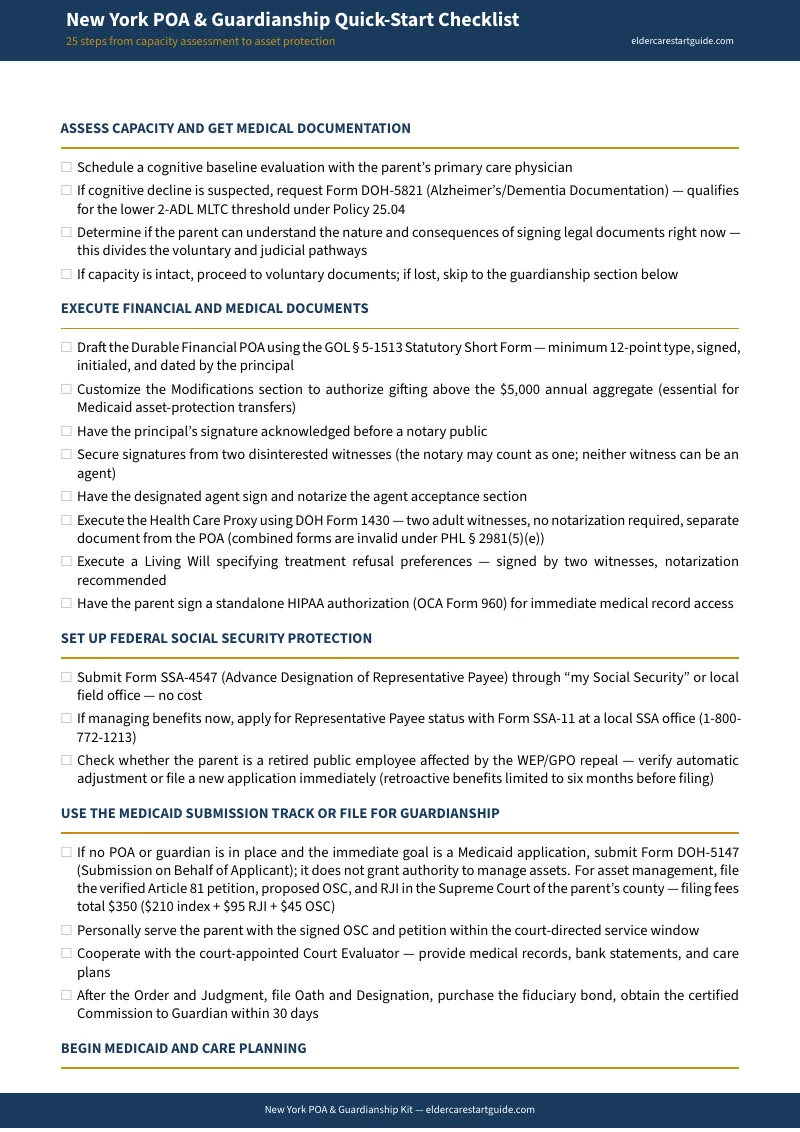
The free Power of Attorney Quick-Start Checklist covers the essential action items at a glance — POA execution requirements, Health Care Proxy witnessing rules, key Medicaid thresholds, and emergency contacts. Download it now and use it tonight.
The full New York Power of Attorney & Guardianship Kit goes deeper — step-by-step instructions for every document, the Article 81 court process, Medicaid coordination, asset protection strategies, and the worksheets that keep the entire process organized. For less than one hour of an attorney's time, you get the complete system.