Your parent has dementia. New York's care system has answers — buried under 600 pages of Medicaid circulars.
You're managing sundowning episodes, medication battles, and the slow erosion of a personality you've known your entire life. Somewhere between the third call to a county social services line that went nowhere and the hospital social worker handing you a discharge deadline, you realized: the help exists, but nobody is going to organize it for you.
New York runs one of the most complex elder care systems in the country. Two separate Medicaid tracks with different look-back rules. A home-care eligibility assessment (NYIAP) whose ADL thresholds tightened in September 2025. A Consumer Directed Personal Assistance Program that just consolidated 600+ providers into one fiscal intermediary. Memory-care facilities that require a specific state certification most families have never heard of. And a monthly income cap so low that a modest pension disqualifies your parent from home care — unless you know how to set up a Pooled Income Trust.
The information is all public. It's scattered across Department of Health policy circulars, county DSS portals, and legal-aid fact sheets written for attorneys, not families. The "free" referral services (A Place for Mom, Caring.com) won't mention most of it because Medicaid-funded programs don't pay referral commissions.
The Dementia Care Action System
This guide translates thousands of pages of New York administrative code into a single afternoon-length action plan. It's built for adult children who need to move — today, this week — and can't afford to spend their first month learning the system by trial and error. Every chapter ends with a concrete deliverable: a completed worksheet, a filled-in template, or a script you can read from during a call.
What's inside
- NYIAP Assessment Preparation Kit (
nyiapp-prep-kit.pdf) — the September 2025 ADL threshold changes mean your parent needs documented supervision with more than one Activity of Daily Living to qualify for home care. The most common denial happens when a parent masks their cognitive decline during the nurse visit. This kit includes a 14-day behavior log and a clinical preparation script so the assessor sees your parent's worst-day reality, not their best-performance front. - Dual Medicaid Roadmap (
medicaid-eligibility-worksheet.pdf) — New York's two Medicaid tracks work by completely different rules. Community Medicaid (home care) currently has no transfer-penalty look-back — a planning window that could close. Institutional Medicaid (nursing homes) enforces a strict 60-month look-back with 2026 regional penalty divisors that vary from $13,765 in Western New York to $15,675 in Rochester. The printable worksheet maps both tracks, side by side, with the exact formulas caseworkers use. - Pooled Income Trust Blueprint (
pooled-trust-expense-log.pdf) — if your parent's monthly income exceeds $1,836 (and most Social Security plus pension combinations do), they're technically over the Community Medicaid cap. A Pooled Income Trust shelters the excess legally. This section includes New York non-profit trust administrators (NYSARC, NAELA-affiliated trusts, Met Council), a monthly expense-submission log, and the surplus math to verify each deposit. - CDPAP Enrollment Navigator (
cdpap-enrollment-tracker.pdf) — the Consumer Directed Personal Assistance Program lets Medicaid recipients hire family members as paid caregivers. Since April 2025, the entire program runs through Public Partnerships LLC (PPL). The printable tracker covers enrollment under the new single-SFI framework, Designated Representative paperwork, Electronic Visit Verification compliance, and a dispute-resolution script for PPL issues. - Legal Authority Safeguard (
legal-authority-checklist.pdf) — lock in decision-making power while your parent still has the capacity to sign. Covers the New York Statutory Short Form Durable Power of Attorney (including the Modifications section and Section (g) gifting language for Medicaid planning — the old Statutory Gifts Rider was eliminated in 2021), the Health Care Proxy, and a capacity-documentation log. If the signing window has already closed, the Article 81 Guardianship walkthrough covers filing, court evaluator appointment, and realistic cost ranges. - Hospital Discharge Defense Kit (
hospital-discharge-defense.pdf) — New York law prohibits discharging a cognitively impaired patient into an unsafe environment. This toolkit includes a fill-in appeal to the Quality Improvement Organization (Commence Health, formerly Livanta), a Patient Bill of Rights reference, and scripts for demanding a formal capacity assessment — so you're not pressured into accepting a discharge plan that puts your parent at risk. - SNALR Memory Care Auditor (
snalr-tour-audit.pdf) — New York doesn't issue a standalone "memory care license." Specialized dementia facilities must hold a Special Needs Assisted Living Residence (SNALR) certification under 10 NYCRR § 1001. The printable tour sheet covers three residences, NYS Health Profiles inspection notes, and the SNALR Voucher Program application process (covers up to 75% of regional costs for eligible non-Medicaid families). - Wandering & Emergency Protocols (
wandering-emergency-protocol.pdf) — New York has no unified state-level Silver Alert system. Coverage is county-by-county: NYC, Suffolk, Nassau, Rockland, Niagara, Erie, and others have enacted local ordinances. The printable sheet is a law-enforcement handout plus a first-15-minutes checklist, with Project Lifesaver and county Silver Alert fields. - Asset Protection Worksheet (
asset-protection-worksheet.pdf) — New York protects primary residences with up to $1,130,000 in equity from the Medicaid asset count. This worksheet maps the spousal transfer, caregiver-child, and disabled-child exemptions — plus the Medicaid Asset Protection Trust (MAPT) timeline and estate-recovery rules — so you know which assets are already safe and which need restructuring.
Who it's for
- The crisis coordinator — your parent was hospitalized, the discharge planner is pushing a timeline, and you need safe placement or emergency home-care hours arranged now. Not next month.
- The burned-out primary caregiver — you've been managing alone and you've hit the ceiling of what informal care can sustain. You need CDPAP hours, MLTC enrollment, or residential placement options with real cost comparisons.
- The proactive pre-planner — your parent is in the early stages and still has the capacity to sign legal documents. Community Medicaid currently has no look-back. You're acting while the window is open.
- The sibling mediator — your family is divided on what to do, and you need objective benchmarks — eligibility thresholds, cost comparisons, legal requirements — to get everyone aligned on one plan.
Why not the "free" options?
State websites publish the rules but never the sequence. They'll tell you the asset limit is $33,038 but not how to execute a legal spend-down, set up a Pooled Income Trust, or prepare for the NYIAP assessment so your parent isn't denied. The Department of Health portal alone runs hundreds of policy circulars — none of them written for families.
National placement services like A Place for Mom are free to you because contracted facilities pay referral commissions (often equivalent to a full month's rent). That business model means they rarely mention CDPAP, the Assisted Living Program, the SNALR Voucher Program, or any option that doesn't generate a referral fee. Submit your information, and the sales calls start.
A New York elder-law attorney at $350–$650 an hour is invaluable for complex trust work and contested guardianships — but much of that billable time goes to organizing paperwork and explaining Medicaid basics. This workbook does the organizing, so a multi-hour engagement becomes a focused one-hour review.
What you get
Your download includes 11 PDFs:
- guide.pdf — 14 chapters covering diagnosis documentation, legal authority, dual Medicaid systems, asset protection, CDPAP enrollment, NYIAP preparation, residential licensing, wandering safety, community support programs, and a step-by-step care-coordination workflow.
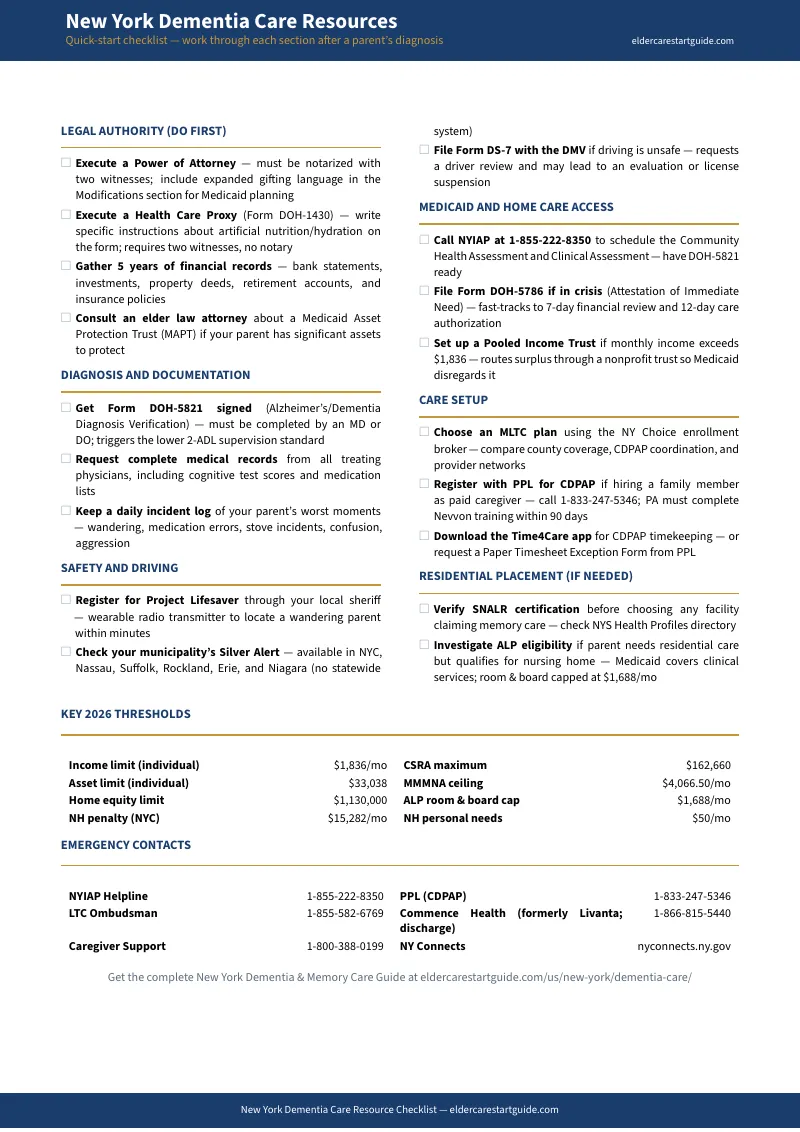
- checklist.pdf — an 18-item action checklist you can work through in one sitting, prioritized by urgency.
- nyiapp-prep-kit.pdf — 14-day behavior log, ADL worksheet, and CHA script.
- medicaid-eligibility-worksheet.pdf — Community vs. Institutional fill-in with 2026 thresholds and regional penalty divisors.
- pooled-trust-expense-log.pdf — monthly surplus deposit and vendor-bill submission log.
- cdpap-enrollment-tracker.pdf — PPL enrollment steps, EVV, and dispute log.
- hospital-discharge-defense.pdf — QIO appeal fill-in and bedside dispute steps.
- snalr-tour-audit.pdf — three-residence SNALR tour scorecard.
- legal-authority-checklist.pdf — POA / Health Care Proxy execution list and capacity log.
- wandering-emergency-protocol.pdf — law-enforcement handout and first-15-minutes card.
- asset-protection-worksheet.pdf — home-equity, transfer, MAPT, and estate-recovery worksheet.
Satisfaction guarantee
If the guide doesn't give you a clearer path forward, email us at any time for a full refund. No forms, no questions, no hoops.
Start navigating New York dementia care with confidence
You've already spent hours searching government portals and sitting on hold with county offices. This guide gives you the complete, unbiased action plan — every checklist, preparation script, and worksheet your family needs — for less than a single hour of professional consultation.
Download the free checklist to see the approach, or get the full guide and start working through it today.