
Your Parent Is Being Discharged Tomorrow. The Plan Feels Wrong.
The discharge planner says your parent is "medically stable." But they can't stand without help, the medication list has changed three times this week, and nobody has explained who's going to manage the wound vac at home. The attending mentioned something about "observation status" — and now you're learning that the entire hospital stay might not count toward Medicare rehab coverage.
You have less than 48 hours. The hospital wants the bed back. And everything you find online is either a 200-page DHHS policy manual or a lead-gen directory trying to steer your parent into a private-pay nursing home at $11,000 a month.
The New Hampshire Discharge Navigation System
This isn't a generic pamphlet about "planning ahead." It's a structured system for the 48-to-72-hour window when you're in the middle of a discharge crisis — built specifically for New Hampshire law, New Hampshire Medicaid rules, and the New Hampshire agencies you'll actually be calling.
The guide gives you the legal framework, decision sequences, and clinical language to advocate for your parent's safety during every transition: hospital to home, hospital to rehab, rehab to skilled nursing, and the Choices for Independence waiver pathway that lets your parent stay home with professional support. It covers Medicaid financial eligibility (the $2,982 income cap, the $7,500 effective asset limit), spousal impoverishment protections, estate recovery under RSA 167:14-a, advance directives under RSA 137-J, and every form you need — organized by the order you'll actually need them.
What's Inside
- The Acentra Health Appeal Protocol — Pre-written language and step-by-step process for filing a fast-track appeal with New Hampshire's BFCC-QIO at 1-888-319-8452. The hospital cannot charge your parent or force them out while the appeal is active — but most families don't know this right exists until the discharge is already happening.
- Observation Status Decision Tree — If your parent was classified "outpatient under observation," Medicare won't cover SNF rehab. This section explains how to identify the misclassification, understand the NOTICE Act requirements, request a physician override, and file an appeal through Acentra Health.
- CARE Act Compliance Checklist — New Hampshire's Senate Bill 187 requires hospitals to designate a family caregiver, notify them before discharge, and provide live clinical instruction on every post-discharge care task. This section gives you the exact statutory references to invoke and what to do if the hospital skips a step.
- SNF Vetting Scorecard and Admission Agreement Guide — A structured framework for comparing facilities using CMS Care Compare data and staffing ratios, plus a clause-by-clause walkthrough of common admission agreement traps. You'll know exactly which paragraphs to sign, which to cross out (the "responsible party" guarantor clause), and which to challenge outright.
- Medicaid Financial Eligibility Worksheets — New Hampshire's Medicaid rules explained in plain language: $2,982 monthly income cap, $7,500 effective asset limit, the five-year look-back period, Community Spouse Resource Allowance of $32,532 to $162,660, and the Minimum Monthly Maintenance Needs Allowance of $2,705 to protect the at-home spouse's income. Includes a spend-down tracker and asset classification guide.
- Estate Recovery Protection Guide — RSA 167:14-a authorizes expanded estate recovery covering non-probate assets, but specific exemptions (caregiver child, surviving spouse, sibling equity interest, disabled child) can shield the family home. This section explains each exemption, the documentation requirements, and the hardship waiver process.
- Choices for Independence Waiver Roadmap — Complete enrollment pathway for New Hampshire's primary Medicaid home-and-community-based waiver. Covers the ServiceLink ADRC assessment, CFI eligibility criteria, covered services (personal care, adult day programs, home-delivered meals, environmental modifications), and the Medicaid application timeline.
- Hospital-to-Home 72-Hour Timeline — Hour-by-hour tracker for the critical first three days at home: medication reconciliation, DME delivery confirmation, home health intake, follow-up scheduling, and the red flags that require immediate medical attention or a return to the emergency department.
- Legal Authority Quick-Start — Durable Power of Attorney for Health Care (RSA 137-J), financial power of attorney (RSA 564-E), and the guardianship petition process under RSA 464-A. New Hampshire requires proof beyond a reasonable doubt for guardianship — a higher standard than most states — making advance planning far cheaper and less uncertain than waiting for a crisis.
- Dispute Resolution and Escalation Guide — What to do when Medicare denies coverage, a facility attempts involuntary discharge during Medicaid pending, or a Medicaid redetermination goes wrong. Covers the NOMNC appeal process through Acentra Health, the Jimmo v. Sebelius maintenance therapy standard, state fair hearing rights, and the Long-Term Care Ombudsman program (603-271-4375).
- Medication Reconciliation Worksheet — Side-by-side comparison form tracking every medication change during hospitalization — pre-admission, hospital changes, and discharge prescriptions — with space for pharmacist notes on interactions and dosing conflicts.
- Emergency Contacts Reference Sheet — One-page printable with every critical number: Acentra Health, DHHS Bureau of Adult and Aging Care, ServiceLink, Long-Term Care Ombudsman, SHIP counselors, and fill-in fields for your family's contacts.
Who This Is For
- Adult children in New Hampshire managing a parent's hospital discharge — especially if the timeline feels rushed or the plan feels incomplete
- Families who need to halt an unsafe discharge and don't know they have the legal right to appeal
- Caregivers comparing rehab, skilled nursing, and home care — and unsure which Medicare or Medicaid programs apply
- Anyone starting the Choices for Independence waiver process through ServiceLink and unsure what to expect
- Families navigating Medicaid financial eligibility and worried about losing the family home to estate recovery
Why Not Just Use Free Resources?
The DHHS website has the policy manuals. Medicare.gov has the forms. ServiceLink offers free options counseling. But during a medical crisis, you don't need raw policy — you need a decision framework that tells you what to do first, what to say when you call, and which mistakes will cost your family thousands.
Free resources don't tell you that hospitals are financially incentivized to discharge quickly under DRG flat-rate payments, that observation status quietly eliminates your rehab coverage, or that signing a nursing home admission agreement as "responsible party" can make you personally liable for tens of thousands of dollars. ServiceLink counselors explain the rules and connect you to programs, but they can't advise you on asset spend-down strategy or coach you through a discharge appeal in real time. And lead-gen directories that offer "free senior living guidance" are paid referral commissions by the facilities they recommend — which is why they never mention Choices for Independence, your right to appeal, or the protections available during Medicaid pending.
This guide organizes New Hampshire-specific rules into actionable steps you can follow under pressure — from the first notification of discharge through the Medicaid application and beyond.
The Alternative Is Expensive
An elder law attorney in New Hampshire charges $300 to $500 per hour, with full Medicaid planning engagements running $5,000 to $12,000. A private geriatric care manager charges $100 to $200 per hour. A single day of uncovered SNF care runs $350 to $500. This guide doesn't replace legal counsel for complex asset protection — but it prevents the common mistakes that make legal counsel necessary, and gives you the structure to handle the first 72 hours yourself.
Satisfaction Guarantee
If the guide doesn't give you a clearer path forward within the first 24 hours of your parent's discharge, email us for a full refund. No hoops, no forms.
— Less Than One Hour of Professional Advocacy
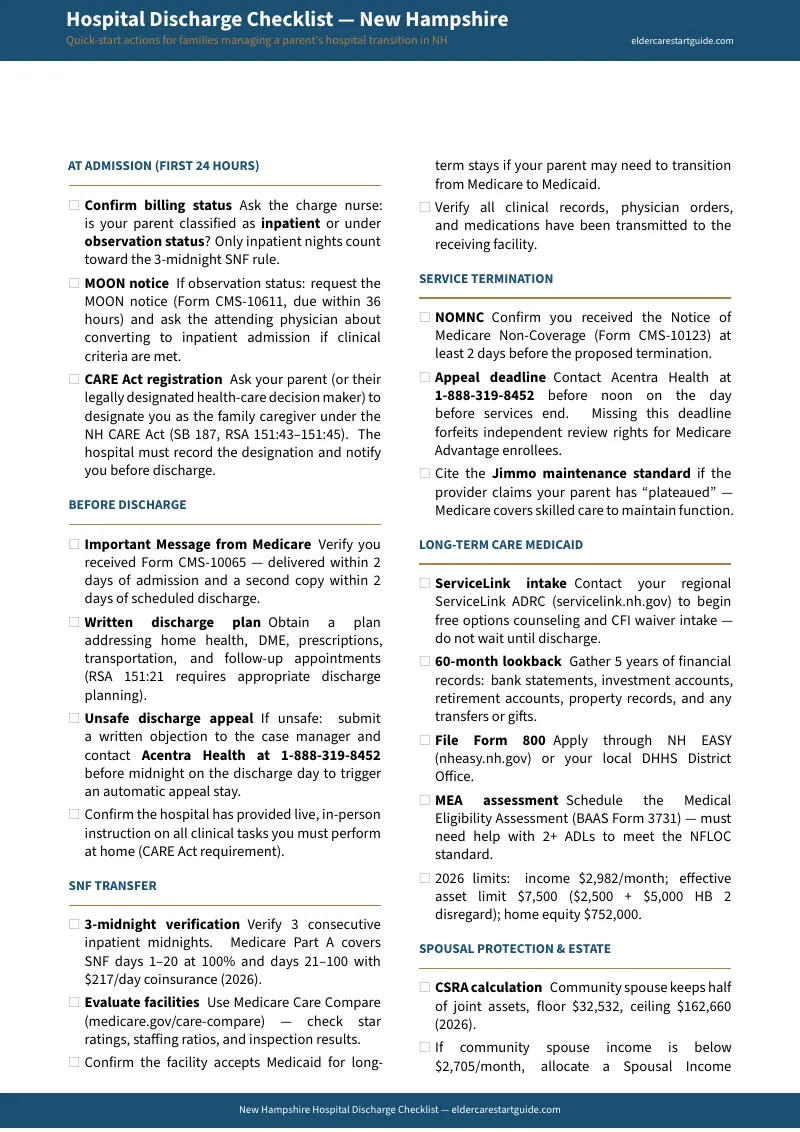
For a fraction of what a single consultation costs, you get the complete system: Acentra Health appeal worksheet, observation status decision tree, CARE Act compliance checklist, SNF vetting scorecard, Medicaid financial worksheets, estate recovery protection steps, Choices for Independence waiver roadmap, and every template you need to navigate your parent's transition safely.
Download the free one-page checklist to see the framework, or get the full guide with all 13 chapters plus standalone printable tools — the discharge appeal worksheet, facility comparison checklist, admission agreement review guide, Medicaid asset inventory worksheet, medication reconciliation grid, 72-hour timeline tracker, agency communication log, and emergency contacts reference sheet.