
Your parent needs help at home. The system that's supposed to help has a waitlist, a clinical assessment you can fail, and asset rules nobody explains clearly.
New Hampshire's Choices for Independence Waiver is the state's main pathway to Medicaid-funded home care — personal care aides, homemaker services, adult day programs, emergency response systems, and home modifications. It exists to keep your parent out of a nursing facility that costs over $10,000 a month. But qualifying means navigating a financial eligibility wall, a one-shot clinical assessment, and a capped program that can have a waitlist.
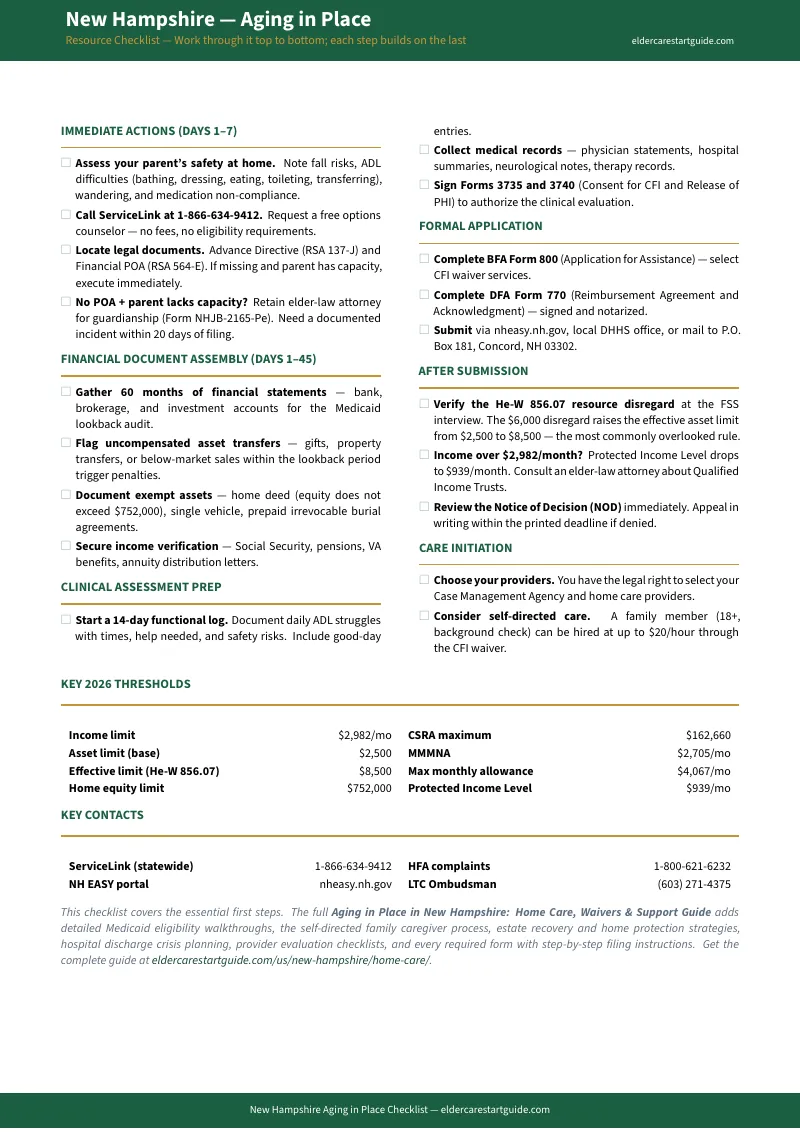
The financial rules alone stop most families cold. The official asset limit is $2,500 — but New Hampshire's resource disregard under He-W 856.07 (RSA 167:4-f) raises the effective categorical limit to $8,500, and most denial letters don't mention it. The income cap is $2,982 per month. The primary residence is exempt up to $752,000 in equity, but families who don't understand the 60-month look-back period make transfer mistakes that trigger penalties. And if your parent has a spouse, the spousal impoverishment protections (Community Spouse Resource Allowance up to $162,660, Minimum Monthly Maintenance Needs Allowance of $2,705) determine whether one parent's care ruins the other's finances.
Then there's the clinical gate. Acentra Health conducts the Medical Eligibility Assessment — a face-to-face evaluation where your parent must demonstrate they need hands-on help with at least two Activities of Daily Living. Parents with cognitive decline routinely "mask" during the visit, acting fully functional for the 45 minutes the assessor is watching while struggling every other day. One bad assessment means a denial, and the family starts over.
The CFI Navigation System — Every Rule, Threshold, and Form in Execution Order
The Aging in Place in New Hampshire Guide is a complete administrative playbook for the adult child coordinating a parent's home-care transition. It organizes the dense rules of the Bureau of Elderly and Adult Services, the NHEasy portal, ServiceLink, and Acentra Health into the chronological sequence you'll actually follow — from the first ServiceLink call through the MEA, the financial application, the care plan, and the legal documents you need signed before capacity is lost.
This is not a summary of programs you could find on the DHHS website. It's the execution order, the document preparation templates, the assessment strategies, and the decision framework that turns thousands of pages of state policy into a step-by-step system.
The Financial Eligibility Workbook
Every 2026 threshold organized for self-assessment in the printable 2026 Financial Eligibility Workbook: the $2,982 income cap, the $2,500 base / $8,500 effective categorical asset limits, the $752,000 home equity exemption, spousal protections (CSRA and MMMNA), and the 60-month look-back period. The Document Preparation Checklist maps the application packet — Social Security cards, 60 months of statements, deeds, vehicle registration, income letters, medical records, Forms 800 / 770 / 3735 / 3740 — so you submit a complete file the first time instead of triggering administrative delays.
The Acentra Health MEA Preparation Kit
The Medical Eligibility Assessment is a one-shot evaluation. Print the 14-Day Functional Care Log and document your parent's real daily struggles with ADLs — because what the assessor sees in a ~45-minute visit rarely reflects what you see the other 23 hours. Assessment-day strategies in the guide help you present this log to the nurse without causing your parent embarrassment or triggering the "masking" reflex that leads to under-scored evaluations.
The Self-Directed Care Enrollment Path
New Hampshire's CFI Waiver allows families to hire a trusted family member or friend as a paid caregiver at up to $20 per hour through a fiscal management service. The Self-Directed Care Enrollment Checklist walks the sequence: requesting self-direction through your Case Management Agency, selecting a fiscal agent, confirming spousal hiring eligibility with DHHS DLTSS, and managing payroll and background checks — a genuine alternative when agency staffing shortages (the core issue in the Fitzmorris v. Weaver litigation) leave authorized hours unfilled.
The ServiceLink and NHEasy Navigation Guide
ServiceLink is the statewide front door — free options counseling across all 10 counties. But they can't act as your project manager, provide legal advice, or structure assets. The guide maps each county office, explains what ServiceLink can and cannot do, and walks through the NHEasy online application step by step — including the submission sequence that, done out of order, adds weeks of delay.
The Non-Medicaid Safety Net Map
When Medicaid isn't the right path yet — or the CFI waitlist is full — the Non-Medicaid Safety Net Tracker maps every alternative: Title XX Social Services Block Grant home care (income limit $1,645/month for 2026), the National Family Caregiver Support Program (no income test), USDA Section 504 home repairs for rural seniors, GSIL home modifications, Meals on Wheels logistics, and the three layers of senior transportation (aging-network rides, ADA paratransit, Medicaid NEMT).
The Legal Authority Checklist
The Durable Financial Power of Attorney, Durable Healthcare Power of Attorney, and HIPAA authorization your parent needs to sign while they still have capacity — tracked on the Legal Authority Checklist. The guide explains what happens when a parent hasn't signed — the administrative stoppage when banks and state agencies refuse to talk to you — and the guardianship petition through NH Probate Court that becomes your only option if capacity is lost first.
The Estate Recovery Protection Guide
New Hampshire pursues Medicaid estate recovery, but only against the estate after the recipient's death — never during their lifetime for CFI at home. The Estate Recovery Worksheet walks the statutory deferrals (surviving spouse, child under 21, blind or disabled child, qualifying sibling) and what to check before anyone notarizes DFA Form 770.
The Provider Evaluation Checklist
CFI participants have the legal right to choose their Case Management Agency and home care providers. Print the Provider Evaluation Checklist and score licensing by the Health Facilities Administration, specialized care experience (especially dementia), current staffing capacity, and credential verification — because the workforce shortage that triggered the Fitzmorris litigation means not every agency can actually deliver the hours they promise.
The rest of the printable kit
The download also includes the CFI Application Tracker (the 23-step clock from ServiceLink through annual redetermination) and the Hospital Discharge Action Card (the sequence to run when the hospital is talking days, not weeks). The free New Hampshire Aging in Place Resource Checklist is included for paid buyers as well.
Who This Guide Is For
- The adult child whose parent just fell — and now the hospital is talking discharge within days, not weeks. The guide gives you the exact sequence to follow against a discharge clock, instead of the nursing facility placement the hospital will default to.
- The family member providing unpaid care — who's running out of leave, savings, or both. The self-directed care section shows how to get paid for the work you're already doing.
- The adult child whose parent's assets seem too high — but who doesn't know about the resource disregard, the home equity exemption, or the legitimate spend-down strategies the state approves.
- The family trying to avoid a $15,000 elder-law retainer — by organizing financial records and understanding thresholds first, so attorney time is spent on strategy, not paperwork collection.
- The sibling coordinating care from out of state — who needs every phone number, portal, and deadline mapped so they can manage remotely.
- The caregiver whose parent has early-stage dementia — who needs legal documents signed before capacity is lost and assessment strategies that counter the masking problem.
Why Free Resources Fall Short
ServiceLink provides excellent, unbiased options counseling — but they cannot act as your family's project manager, provide legal advice, or structure assets. The DHHS website publishes official program guidelines — in dense bureaucratic language, scattered across multiple bureaus, often with outdated financial figures. Medicaid Planning Assistance maintains up-to-date eligibility data for all 50 states — but without New Hampshire's specific community resources, document templates, or the execution sequence that determines whether an application succeeds or stalls.
The gap isn't information. The information is public. The gap is organization — knowing what to do first, what documents to have ready, how to prepare for the assessment, and which programs to use while waiting for the one you actually applied for.
The Guide Pays for Itself Before You Open It
Private-duty home care agencies in New Hampshire charge $35 to $50 per hour out of pocket. Elder-law consultations run $200 to $500. Comprehensive Medicaid planning retainers range from $6,000 to $15,000. A nursing facility costs over $10,000 per month. This guide costs less than one hour of home care — and it shows you how to access programs that can fund thousands of hours.
If your parent's situation is straightforward, the guide helps you self-file with ServiceLink assistance and save the legal fees entirely. If it's complex, the guide helps you organize everything so the attorney hours you do need cost a fraction of what they'd cost if you walked in cold.
100% Satisfaction Guarantee
Download the guide. Work through the financial eligibility section. If it doesn't clarify your parent's situation within the first chapter, email [email protected] for a full refund — no forms, no conditions.
Start Here
Download the free New Hampshire Aging in Place Resource Checklist — a one-page action-item reference with every key phone number, portal, and deadline. When you're ready for the full system — every threshold, every form, every strategy — get the complete guide.
Get the Complete NH Aging in Place Guide
For , you get the same information families pay thousands to learn from elder-law attorneys — organized in the order you'll actually need it.