Your Parent Qualifies for Help With Medicare Costs. Nevada Just Makes It Hard to Find.
Every month, $202.90 disappears from your parent's Social Security check before they see a dime. That's the Medicare Part B premium — and for a senior living on $1,200 to $1,500 a month, it's the difference between paying the electric bill and choosing which medications to skip.
Nevada's Medicare Savings Programs exist to eliminate that deduction. For the lowest-income tier (QMB), the state also wipes out every Medicare deductible, copayment, and coinsurance charge. Combined with Extra Help for prescriptions, a qualifying senior can save over $2,400 a year on Part B premiums alone — and thousands more in out-of-pocket medical costs.
The problem isn't eligibility. It's the process.
The Nevada DWSS Navigation System
Applying for an MSP in Nevada means dealing with the Division of Welfare and Supportive Services — an agency that processes Medicaid, SNAP, and TANF applications on the same phone lines and the same portal. Hold times run 30 minutes to an hour. The Access Nevada website times out mid-session. The general medical assistance application runs for pages, and nothing tells you which sections apply to an MSP.
If you're an adult child trying to help from out of state, DWSS won't even discuss the case with you unless you've filed Form 2525-EE — a representative authorization form that the portal doesn't explain and the agency website buries.
The Nevada Medicare Savings Programs & Extra Help Guide is a step-by-step navigation system built for exactly this process. It doesn't replace DWSS or Nevada MAP. It organizes what they give you into a sequence you can follow — from eligibility math to approval to keeping coverage active — without calling the agency twelve times to figure out what happens next.
What Makes This Different From Free Information
Nevada MAP (the state's free Medicare counseling program) is excellent for plan comparisons — which Part D plan to choose, whether Medicare Advantage makes sense. The guide directs you there for those questions. But MAP counselors can't serve as your ongoing representative, can't monitor your application through DWSS processing, can't file an appeal on your behalf, and don't provide billing dispute scripts when a doctor sends a bill they legally can't collect from a QMB enrollee.
Insurance broker websites publish income limit tables — then funnel you into a phone call with a licensed agent trying to sell a Dual Special Needs Plan. Your contact information becomes a sales lead.
This guide sells you the process once, for a flat fee. No calls. No leads. No plan recommendations. No recurring charges.
What's Inside the Guide
- The three MSP tiers decoded — what QMB, SLMB, and QI actually cover, what they don't, and how the "Plus" dual-eligible variants work, explained without Medicaid jargon
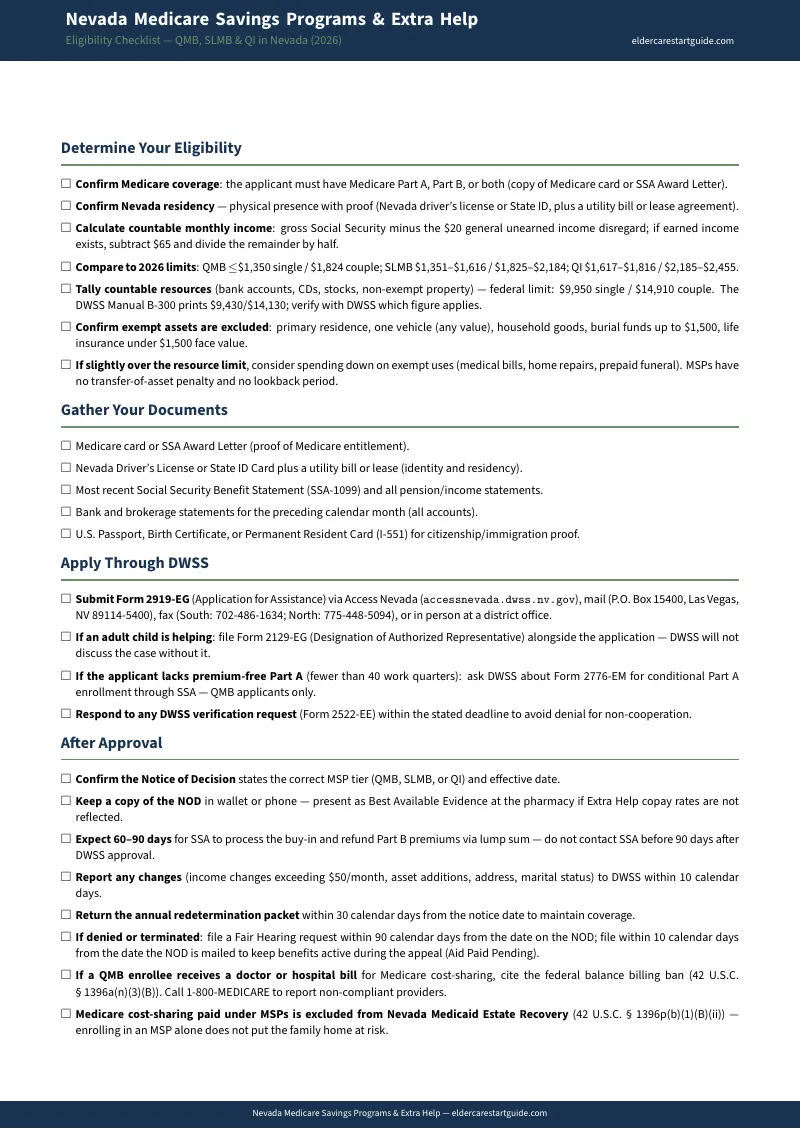
- Income eligibility math with the disregards that change the answer — the $20 unearned income disregard, earned income rules, and a worked example showing how a parent with $1,370 in gross Social Security can still qualify for QMB at $1,350 countable income
- The resource test — what counts and what doesn't — including the discrepancy between the federal standard ($9,950 individual) and what the DWSS manual prints, and how to handle it
- Application walkthrough — Access Nevada portal, paper application, the MAABD form section by section, what to complete and what to skip for an MSP-only application
- Form 2525-EE representative authorization — how an adult child gets legally recognized by DWSS to manage their parent's case, including submission methods that actually work (hint: the direct email intake is faster than the portal)
- Decision timelines and the premium refund lag — the 45-day processing window, the 60-to-90-day gap before SSA stops deducting Part B premiums, and how retroactive reimbursement works
- Part A conditional enrollment — the step-by-step path for parents without 40 work quarters who need QMB to cover their Part A premium, including what to tell the Social Security office
- Extra Help and Part D — how MSP approval automatically triggers the Low-Income Subsidy, the $5.10/$12.65 copay caps, and what replaced Nevada's closed Senior Rx program
- QMB billing protections — the federal anti-balance-billing law (42 CFR 447.15) that prohibits providers from charging QMB enrollees for Medicare cost-sharing, plus a dispute letter template and phone script for when a provider bills anyway
- Renewals and redeterminations — how to track deadlines, what to report between renewals, and how to prevent a coverage gap from missed paperwork
- Appeals and fair hearings — the 90-day filing window, how to request a hearing, and how to keep benefits active during the appeal
- Worksheets and contacts — income calculation worksheet, document preparation checklist, and every DWSS office, MAP counselor line, and legal aid number you need
Who This Guide Is For
- Adult children managing a Nevada parent's Medicare costs from anywhere — the guide covers remote application, representative authorization, and document submission for out-of-state caregivers in California, Utah, Arizona, and beyond
- Seniors applying on their own — if the Part B premium is taking a large bite out of a small Social Security check and you want to know whether you qualify without calling a broker
- Families dealing with a denial, a confusing DWSS notice, or a provider bill they shouldn't have received — the guide includes notice interpretation, appeal steps, and billing dispute tools
What This Guide Is Not
This is process navigation, not insurance advice. The guide never recommends a specific Part D, Medigap, or Medicare Advantage plan — for plan comparisons, it directs you to Nevada MAP at 1-800-307-4444, which is free and unbiased. It is not affiliated with CMS, SSA, the Division of Welfare and Supportive Services, or any state agency. "Medicare" describes the topic; it does not brand the product.
The Guarantee
Full refund, no time limit. If the guide doesn't help, email [email protected] and we'll refund every penny. No forms, no waiting period, no questions.
Frequently Asked Questions
Will applying for an MSP let the state put a claim on my parent's house?
No. Medicare Savings Programs pay Medicare premiums and cost-sharing. Federal and state law explicitly exclude MSP-only benefits from Nevada Medicaid Estate Recovery. The family home is protected. Estate recovery applies only to long-term care Medicaid, which is a separate program with separate eligibility.
My parent's income is right at the edge of the limit. Is it worth applying?
Yes. Most families self-reject because they compare gross Social Security to the published limit without applying the $20 unearned income disregard. The guide walks through the exact math — including earned income disregards — so you can determine countable income before you apply. If it's close, you apply and let DWSS make the determination. The application is free.
How is this different from the free checklist?
The free checklist gives you the eligibility requirements, the documents you need, and the basic application steps — enough to confirm whether the MSP is worth pursuing. The full guide covers the entire process: detailed income math with worked examples, Form 2525-EE representative authorization, the Access Nevada portal walkthrough, Part A conditional enrollment, Extra Help and Part D coordination, QMB billing protections with dispute templates, renewal tracking, appeals, and the worksheets that tie it all together.
Does this guide tell me which Medicare plan to choose?
No. Plan comparisons — Part D, Medigap, Medicare Advantage — are handled by Nevada MAP counselors, who are trained and unbiased. The guide focuses on the cost-help programs (MSP and Extra Help) that reduce what you pay regardless of which plan you're on. It directs you to MAP for plan selection.
What if my parent has already been denied?
The guide covers the appeals process, including the 90-day fair hearing request window, how to request continued benefits during the appeal, and a worksheet for organizing the hearing submission. If the denial was based on income or assets, it also covers the disregard rules that DWSS may not have applied correctly.
Is the information current for 2026?
Yes. All income limits, resource thresholds, premium amounts, and copay figures reflect 2026 values. The guide also notes the DWSS manual discrepancy on resource limits and explains the Social Security Fairness Act's repeal of GPO and WEP, which affects income calculations for public-sector retirees.
Frequently Asked Questions
What if the rules change after I buy?
We update the guide when the rules change. Email us any time, even years later, and we'll send you the current edition free.