
Your Parent Needs Help — And Missouri's System Is Designed to Confuse You
The hospital says your parent can't go home. Your sister says assisted living, your brother says hire someone, and the discharge planner keeps asking for a "plan" by Friday. Meanwhile, nobody has explained why Missouri runs elder care through two separate agencies — one for clinical assessment, one for financial eligibility — or what happens if you pick the wrong care setting before you file the right paperwork.
You're not overwhelmed because you're failing. You're overwhelmed because Missouri's system splits every decision across the Division of Senior and Disability Services (DSDS), the Family Support Division (FSD), and a maze of waiver programs and licensing categories that even social workers mix up. Get the sequence wrong and you burn through savings that could have been protected, miss a 10-day appeal deadline, or trigger a transfer penalty that disqualifies your parent from Medicaid for months.
The Missouri Care Triage System
This is the guide we wished existed the night the hospital called. Choosing Care in Missouri takes the entire maze — clinical assessments, care levels, legal authority, Medicaid eligibility, asset protection, and facility vetting — and turns it into a clear, sequential plan built on Missouri statutes, 2026 financial thresholds, and the actual forms caseworkers use.
No 40-page government manuals written in bureaucratic language. No $300-per-hour elder-law attorney's clock ticking while you ask a basic question. Just the calculators, templates, and step-by-step decisions that let you move fast and get it right — before you spend thousands on professionals or make an irreversible mistake.
What's Inside — And the Problem Each Part Solves
- The InterRAI Pre-Assessment Worksheet — Missouri uses a computerized 18-point scoring system to determine if your parent qualifies for home care services. The problem: aging parents routinely "show-time" during the assessor's visit — acting more capable than they really are. This worksheet shows you the exact categories the DSDS caseworker will score and helps you document your parent's worst-day reality so the assessment captures what's actually happening. Solves: "They scored my mom too high and she lost her home care."
- The Dual-Agency Intake Tracker — Missouri requires you to apply to two agencies simultaneously: DSDS for clinical eligibility and FSD for financial eligibility. Miss one track and the other stalls. This tracker maps the exact forms, phone numbers, and portals for both tracks, with the sequence that gets both applications moving on the same day. Solves: "I didn't know I had to file with two agencies."
- The Care Level Matching Framework — Missouri licenses four distinct care levels: Residential Care Facilities, Assisted Living Facilities, Intermediate Care, and Skilled Nursing. The critical distinction most families miss: standard ALFs and RCFs require residents to self-evacuate within 5 minutes. If your parent can't, they need a specialized ALF** license facility or a nursing home — and the cost difference can be $3,000 per month. Solves: "We chose the wrong facility type and had to move her again."
- The Medicaid Spend-Down Calculator — Built around Missouri's specific 2026 thresholds: $6,068.80 single asset limit, $12,137.55 married, $752,000 home equity exemption, and the Community Spouse Resource Allowance range of $32,532 to $162,660. Walk through your parent's exact financial position to see when Medicaid becomes viable and how much must be spent down — legally. Solves: "Will we have to sell the house?"
- The RSMo § 461.300 Asset Protection Audit — Missouri families routinely assume a beneficiary deed or transfer-on-death deed protects the home. It doesn't. Under State v. Knight (2009), Missouri's Cost Recovery Unit can reach non-probate transfers to recoup Medicaid costs. This section walks you through the actual legal risk and the timing rules for safer alternatives before the 60-month lookback window closes. Solves: "I thought the beneficiary deed made us safe."
- The Consumer Directed Services Employer Kit — If your parent qualifies for CDS, they become the legal employer of their own caregiver — including a son, daughter, or friend (but never a spouse). This kit covers background check protocols, Family Care Safety Registry enrollment, E-Verify requirements, timesheet templates, and the fiscal agent payment process. Solves: "Can I get paid to care for my own parent?"
- The Facility Vetting Checklist — How to read Missouri's Statement of Deficiencies, decode federal Scope and Severity ratings (G and above means actual harm), check state Class I/II/III violations, verify CMS 5-star staffing metrics, and use the "Show Me Long-Term Care" portal to research any facility's inspection history before signing. Solves: "How do I know if this place is actually safe?"
- The Hospital Discharge Defense Template — If a hospital is pushing for discharge before your parent is ready, you have the right to a free, immediate evaluation by the state's Quality Improvement Organization (QIO). This template shows you how to trigger that review and halt the discharge — without an attorney. Solves: "They said she has to leave by Monday or we pay out of pocket."
Who This Is For
- Adult children in Missouri deciding between keeping a parent at home, moving to assisted living, or placing in a nursing home
- Families facing a hospital discharge deadline who need to understand their rights and options within 24–72 hours
- Long-distance children managing a Missouri parent's care remotely — needing checklists, directories, and templates they can act on from anywhere
- Proactive planners who see early decline and want to get legal documents, financial positioning, and care preferences organized before a crisis forces their hand
- Siblings who disagree about care — needing an objective framework with real numbers and real rules, not opinions
Why Not Just Use the Free Resources?
Because "free" has a hidden cost. The official guidance from DHSS and DSDS is authoritative — and deliberately fragmented across hundreds of technical manual pages written in administrative language. The state will tell you the rules. It will not tell you the strategy: which forms to file first, how to document a "show-timing" parent's real needs, how to protect assets legally before the lookback window opens, or when assisted living costs more than a nursing home after you account for the room-and-board gap.
The alternative is an elder-law attorney at $195 to $500 per hour, or a Medicaid planning firm charging $5,000 to $10,000. For families with straightforward estates, this guide covers the same ground those professionals walk you through — the same statutes, the same financial thresholds, the same forms — so that if you later need a professional, you arrive knowing precisely what to ask and what you no longer need them for.
A Simple Promise
If this guide doesn't give you a clearer, calmer path through Missouri's care system than anything you've found for free, email us and we'll refund you — no forms, no arguments. We built this for families in one of the hardest seasons of their lives, and we won't keep your money if it didn't help.
Start Now — Two Ways
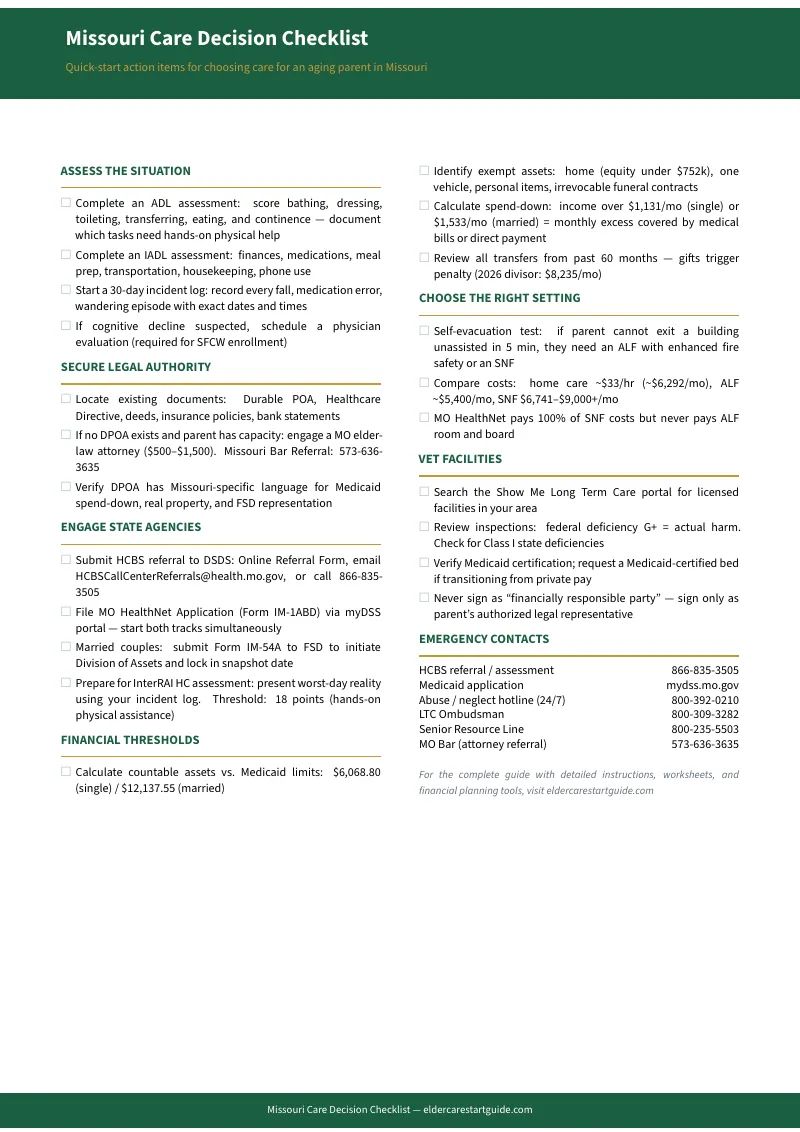
Not ready to buy? Start with the free Missouri Care Decision Checklist — a one-page action plan covering the first critical steps: ADL assessment, legal authority check, agency intake, and financial thresholds.
Ready to navigate the whole thing? Get the complete Choosing Care in Missouri guide — the InterRAI worksheet, the spend-down calculator, the full template library, and the step-by-step plan — for , a fraction of a single hour with an elder-law attorney.