
Mississippi Is an Income-Cap State — And Nobody Tells You What That Means Until Your Parent's Medicaid Application Is Denied
Your parent has been diagnosed with dementia in Mississippi, and you've just discovered that their Social Security check is too high for Medicaid. Not too high by thousands — too high by a few hundred dollars. In a spend-down state, they could simply pay the difference. But Mississippi doesn't allow spend-down for long-term care. If your parent earns one dollar over the income cap, they are categorically ineligible for every Medicaid-funded memory care program in the state — unless you know about the Qualified Income Trust.
Meanwhile, you're trying to figure out which facilities can actually handle Stage II or Stage III Alzheimer's disease. Mississippi doesn't issue a standalone "memory care license." A personal care home might market itself as a memory care community, charge $4,679 per month, and still lack the designated Alzheimer's Disease/Dementia Care Unit printed on its state license — the one that legally requires 3.0 nursing hours per resident per day and at least two staff on duty at all times. Without that designation, your parent's care level has no regulatory floor.
The Mississippi Dementia Care Navigation System
This guide maps Mississippi's specific dementia care landscape — the income cap rules, the waiver programs, the licensing designations, and the estate protection strategies — into a single chronological sequence. From establishing legal authority under the Mississippi Uniform Durable Power of Attorney Act, through the LTSS clinical assessment, QIT setup, waiver enrollment, facility verification, and estate recovery protection. Every dollar amount, office contact, and legal citation is Mississippi-specific and current for 2026.
What makes this different from MSDH portals and national caregiving directories: it connects the systems Mississippi treats as separate bureaucracies. Your parent's LTSS assessment score determines their E&D Waiver eligibility. Their waiver enrollment determines which home care services Medicaid funds. Their income relative to the cap determines whether a QIT is required. Their QIT setup must happen before the Medicaid application or the application is denied. And their estate recovery exposure depends on how the family home is titled and whether you've triggered the 60-month look-back penalty. These are not independent decisions — the guide shows how each one flows into the next so you sequence them correctly.
What's Inside
- The Complete Guide (13 chapters) — covers Mississippi's dementia care system from legal authority and advance directives, through Medicaid income-cap rules and QIT setup, E&D Waiver and Assisted Living Waiver enrollment, memory care facility licensing and verification, wandering prevention and Silver Alert protocols, crisis workflows, and estate protection strategies including the Stinson v. Medicaid homestead precedent
- Mississippi QIT Setup Worksheet — the 2026 income cap ($2,982/month), step-by-step instructions for establishing a Qualified Income Trust, which Mississippi banks accept QIT accounts, required trust language, and how to route income properly each month
- Medicaid Financial Worksheet — countable vs. exempt assets, the $4,000 asset limit, spousal impoverishment protections (Community Spouse Resource Allowance), 60-month look-back audit, and a fillable asset inventory with calculations
- LTSS Assessment Prep Sheet — how Mississippi's Long Term Services and Supports assessment tool evaluates your parent's clinical eligibility, the nursing-facility-level-of-care threshold, ADL scoring, and documentation to prepare before the assessment
- Facility Verification Checklist — how to confirm a facility holds the active A/D Unit designation on its state license, staffing ratio questions, personal care home vs. nursing home rules, Stage II ambulatory requirement, and discharge criteria
- Estate Recovery Worksheet — Mississippi's estate recovery rules, the Stinson v. Medicaid precedent protecting the family home, homestead exemptions, and asset titling strategies to limit recovery exposure
- Safety Planning Fridge Sheet — Mississippi Silver Alert activation (House Bill 664), MedicAlert + Safe Return enrollment, Project Lifesaver tracking through local sheriff departments, Missing Persons Reporting Act (no 24-hour wait), and home safety modifications
- Crisis Contacts Sheet — all 30 Mississippi Division of Medicaid regional offices, 10 Area Agencies on Aging mapped by county, Mississippi Access to Care Network (844-822-4622), Alzheimer's Mississippi (601-987-0020), Long-Term Care Ombudsman (1-888-844-0041), and Adult Protective Services
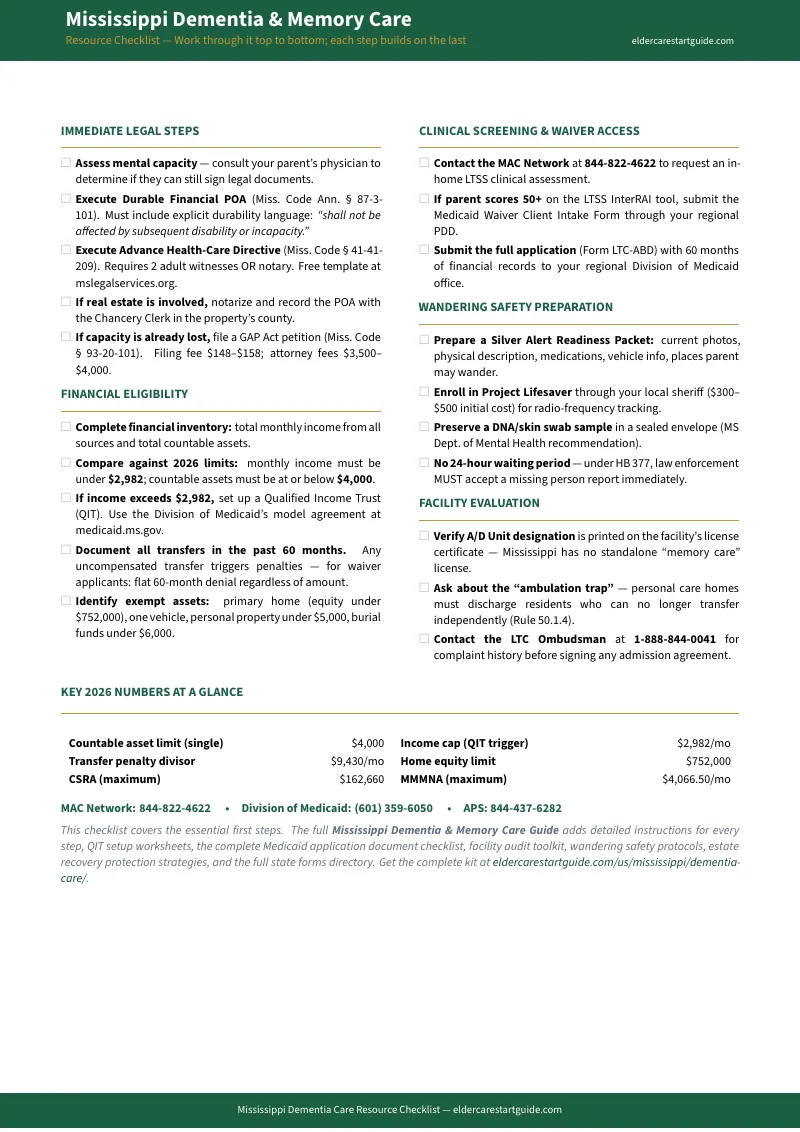
- 20-Item Dementia Care Checklist (free lead magnet) — the essential actions from legal authority through waiver enrollment, facility verification, and safety planning in a single printable page
Who This Is For
- Adult children managing a parent's dementia diagnosis in Mississippi who need to understand the state's income-cap Medicaid rules and Qualified Income Trust requirements
- Families facing a hospital discharge crisis where the parent cannot return home and a memory care placement must happen within days
- Caregivers whose parent is burning through savings at $4,000 to $9,600 per month on private-pay care who need to transition to Medicaid-funded programs before the money runs out
- Anyone preparing for an LTSS assessment who needs to document their parent's real daily deficits accurately
- Families trying to protect the family home from Medicaid estate recovery after a parent passes
- Out-of-state adult children coordinating care remotely who need Mississippi-specific agency contacts, program names, and application pathways
Why Free Resources Leave You Stuck
The Mississippi Division of Medicaid publishes eligibility rules and application forms on medicaid.ms.gov. But those documents are written by compliance staff to define program boundaries, not to help families qualify for benefits. You'll find the income limit number but not the QIT workaround. You'll find the E&D Waiver mentioned but not how the LTSS assessment determines clinical eligibility or which of the 30 regional offices handles your parent's county.
National placement services like A Place for Mom will connect you with facilities — the ones that pay referral commissions. They won't mention the smaller personal care homes that charge thousands less per month, they won't flag which facilities actually hold the A/D Unit designation, and they have no incentive to help you navigate the Medicaid application that would eliminate their commission.
Elder law attorneys provide essential legal counsel for complex asset protection — at $195 to $500 per hour in Mississippi. For QIT drafting and irrevocable trust strategies, professional counsel is necessary. But you shouldn't be paying attorney rates to learn what a QIT is, understand the difference between the E&D Waiver and the Assisted Living Waiver, or figure out which office processes your parent's application. Using this guide to organize documentation and understand the system before your first consultation saves hours of billable time spent on basic discovery.
Satisfaction Guarantee
If the guide doesn't help you identify at least one program, eligibility pathway, or protection strategy you weren't already aware of, email us for a full refund. No forms, no waiting period.
Navigate Mississippi Dementia Care with Confidence
Download the free checklist to get the essential action items — or get the full toolkit for and have all PDFs: the 13-chapter guide, QIT setup worksheet, Medicaid financial worksheet, LTSS assessment prep, facility verification checklist, estate recovery worksheet, safety planning fridge sheet, crisis contacts sheet, and the printable checklist.