
Your Parent Needs Long-Term Care in Minnesota — and the Clock Is Already Running
Medicare's short-term rehab window is closing. The nursing facility wants financial disclosures. Your siblings are arguing about what to do. And every month without Medical Assistance approval costs the family $11,869 in private-pay charges.
You start researching — and hit a wall of 200,000-word state policy manuals, national websites recommending Miller Trusts that Minnesota doesn't accept, and elder law attorneys quoting $4,000 retainers before they'll tell you anything useful.
You don't need more information. You need the right sequence, built for Minnesota's rules.
The Minnesota MA-LTC Roadmap: From Crisis to Coverage in the Right Order
The Minnesota Medicaid Long-Term Care & Asset Protection Guide is a sequential execution blueprint — not a summary of regulations you could eventually find on mn.gov, but a step-by-step action plan that tells you what to do, in what order, with which forms, starting from wherever your family is right now.
It's built around the specific ways Minnesota differs from every other state's Medicaid system: the 209(b) spend-down pathway instead of income caps, MnCHOICES assessments instead of generic clinical screenings, and an expanded estate recovery program that reaches assets most families assume are protected.
What's Inside the Guide
- The Legal Authority Audit — Minnesota's Statutory Short Form Power of Attorney has three traps (the durability clause, Clause H for gift transactions, and the Section Third self-gifting barrier) that invalidate most generic POAs. The guide walks you through each one before you discover the gap at the county office.
- MnCHOICES Assessment Preparation — the certified assessor's visit determines clinical eligibility for every publicly funded program. You get the exact ADLs and cognitive markers they score, how to document your parent's worst days accurately, and the 20-calendar-day scheduling deadline the county must meet.
- The Spend-Down Execution Checklist — Minnesota doesn't recognize Miller Trusts. This chapter covers the Medically Needy spend-down pathway step by step: the six-month community spend-down versus monthly long-term care spend-down, the Designated Provider Option, exempt asset conversions (homestead debt payoff, irrevocable burial contracts, home accessibility modifications, vehicle replacement), and formal Caregiver Agreements that protect payments from lookback penalties.
- Spousal Protection Worksheets — calculate the Community Spouse Resource Allowance (up to $162,660), the monthly income shift (up to $4,066.50), and the excess shelter allowance. The guide includes the step-by-step arithmetic so you walk into the county's asset assessment already knowing your numbers.
- Elderly Waiver vs. Alternative Care Decision Tree — which program fits your parent, how the 135-day calculation works for Alternative Care eligibility, what services each program covers in assisted living versus at home, and how case mix classification sets the monthly budget.
- Five-Year Lookback Audit — how the county uses the Account Validation Service to trace five years of electronic financial records, how the penalty divisor of $11,869 per month calculates ineligibility periods, and which transfers are exempt (spouse, disabled child, caretaker child who lived in the home two-plus years).
- Estate Recovery Defense — Minnesota's expanded estate definition reaches life estates, joint tenancies, living trusts, and Transfer on Death Deeds. The guide covers the 15-working-day TODD clearance process, Form DHS-5893, and the 30-day hardship waiver window so heirs are not caught off guard.
- Application Filing Blueprint — every document you need (five years of bank statements, the asset assessment form DHS-3340, medical records), the three-month retroactive coverage window you must not waste, and the county processing timelines you can hold the system accountable to.
Who This Guide Is For
- The adult child managing a parent's hospital-to-nursing-home transition — Medicare coverage is ending, the facility wants private-pay commitments, and you need Medical Assistance approval before the bills become catastrophic
- The family protecting an at-home spouse — your parent is entering care and you need to ensure the community spouse keeps the house, the car, and enough savings and income to live on
- The caregiver exploring home-based alternatives — you want to understand whether the Elderly Waiver or Alternative Care can fund care at home or in assisted living instead of a nursing facility
- The family planning ahead — your parent is still independent but declining, and you want to position assets and legal authority correctly before a crisis forces rushed decisions during the five-year lookback window
Why the State Website Isn't Enough
Minnesota's Department of Human Services publishes everything — the Health Care Programs Manual, the Eligibility Policy Manual, county-specific forms and procedures. It's thorough, it's accurate, and it's written in dense regulatory language across thousands of pages with no sequential action plan.
County eligibility workers are legally prohibited from giving you strategic advice. They can tell you what form to fill out, but they cannot tell you whether to spend down assets before applying, how to structure a Caregiver Agreement that survives lookback scrutiny, or when the Alternative Care program makes more financial sense than immediate Medical Assistance.
National Medicaid planning websites are worse — they routinely recommend Miller Trusts for Minnesota (which triggers an automatic denial), quote outdated figures, and still reference the Senior LinkAge Line under its old name instead of Minnesota Aging Pathways.
This guide translates the state's own regulations into a decision-and-execution sequence that a stressed, time-pressed family can actually follow.
Full Refund, No Time Limit
If the guide doesn't help your family navigate Minnesota's Medicaid system, email [email protected] for a full refund. No time limit, no questions about when you bought it.
Get Started Now
Your parent's long-term care costs are accumulating at the private-pay rate right now. Medical Assistance can be backdated only three months — every month you wait is a month of coverage you cannot recover.
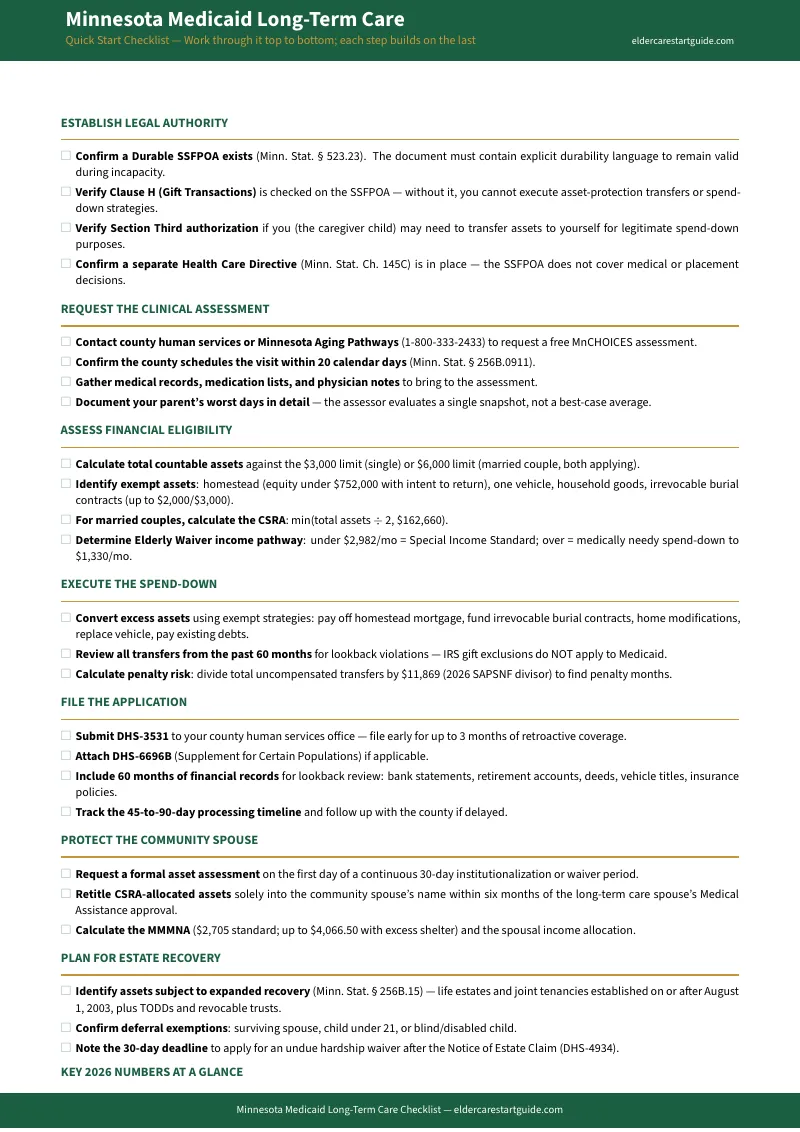
Download the free Minnesota Medicaid Eligibility Checklist to see the full action sequence at a glance. When you're ready for the complete guide with worksheets, calculations, and step-by-step instructions, get the full toolkit — for less than one day's share of a nursing home bill.