Your Parent Qualifies for Medicare Cost Help in Minnesota — but the System Isn't Going to Tell Them
Your parent's Social Security check arrives, and Medicare immediately takes $185 back for the Part B premium. Then come the 20% coinsurance charges, the Part D deductibles, the specialist copays. On a fixed income in Minnesota, Medicare is supposed to help — but it feels like it's taking more than it gives.
You've heard there are programs that pay the premium. You search online and land on MNsure, which sends you in a loop because it handles ACA marketplace coverage, not Medicare. You try medicare.gov, which shows federal asset limits that are a third of what Minnesota actually uses. You call the county, and they mail you a form with no instructions. Meanwhile, your parent is paying $2,434 a year in Part B premiums alone — money that could stay in their pocket if someone would just show you the correct path through Minnesota's system.
The programs exist. The eligibility rules are more generous than most families realize. What's missing is a clear way through.
The Minnesota Medicare Cost Recovery System: From "Probably Eligible" to Approved and Protected
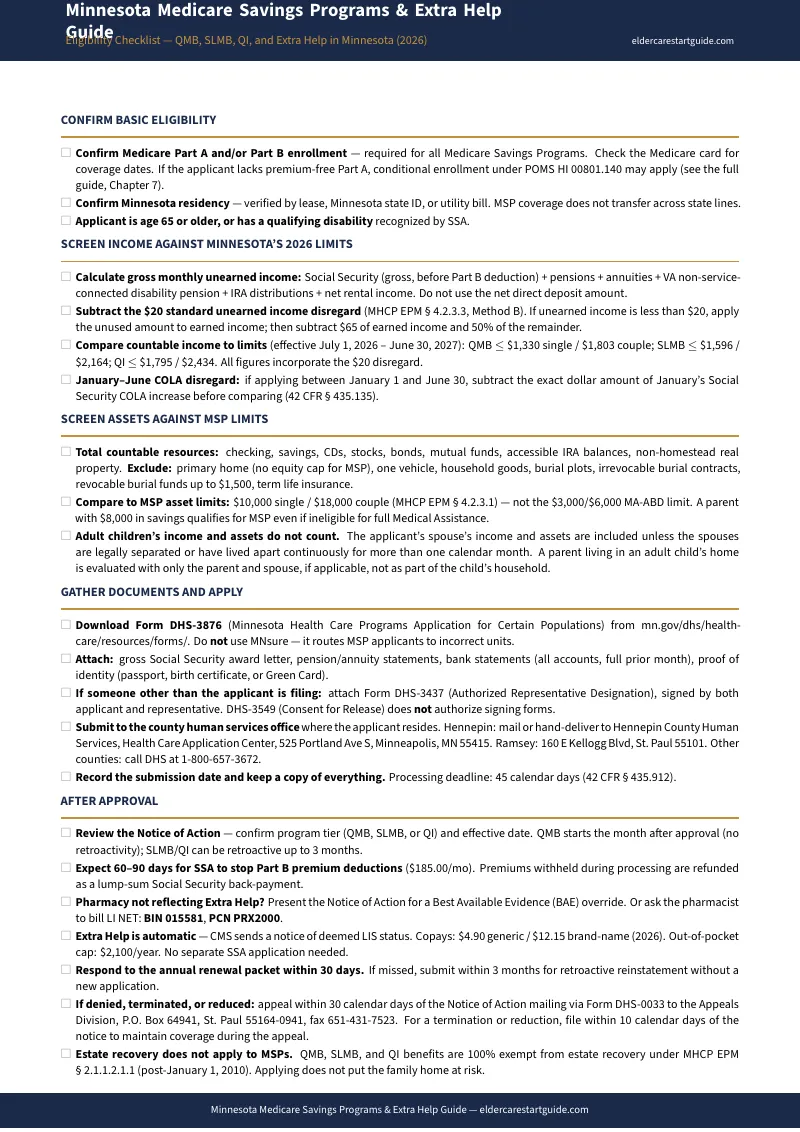
The Minnesota Medicare Savings Programs & Extra Help Guide is not a summary of what the programs are — it's a sequential action plan that takes your family from a first eligibility check through a completed application, premium recovery, billing protections, and annual renewal. Every step is built around how Minnesota specifically administers these federal programs: its Method B income calculation with the $20 unearned disregard, its $10,000/$18,000 asset limits (not the $3,000 limit that applies to full Medical Assistance), and its county-based application routing through Form DHS-3876.
It's the difference between knowing the programs exist and actually getting your parent enrolled.
What's Inside the Guide
- The Income Math That Actually Determines Eligibility — Minnesota uses Method B budgeting, which applies a $20 standard disregard and other deductions that the official tables don't show. The guide includes two worked examples (single widowed parent, married couple) that walk through the exact arithmetic so you can see whether your parent qualifies before filling out a single form.
- DHS-3876 Application Completion and County Routing — the right form, the right office, the documents to attach, and how to avoid the MNsure dead end that sends Medicare beneficiaries in circles. Includes county-specific submission routes for metro and rural Minnesota, plus the 45-day processing timeline you can hold the county to.
- Representative Authority Setup — how to complete Form DHS-3437 (Authorized Representative Designation) so you can handle your parent's application from anywhere, and why the DHS-3549 release form is not a substitute — a common mix-up that delays applications by weeks.
- Part A Buy-In Protocol — if your parent doesn't have premium-free Medicare Part A, QMB can still enroll them through a conditional enrollment protocol at any time of year, outside the normal enrollment periods. The guide walks through each step of that process with SSA.
- Extra Help Automatic Trigger — how MSP approval in Minnesota triggers automatic enrollment in Extra Help (the Part D Low-Income Subsidy), what it covers, and what to do at the pharmacy when the system hasn't updated yet.
- QMB Billing Protection Protocol — federal and state law prohibit providers from balance billing QMB enrollees for deductibles, coinsurance, and copays. But billing departments send these bills routinely. The guide includes a four-step dispute protocol with the specific legal citations and a pre-drafted dispute letter template.
- Renewal System and Reinstatement Safety Net — how automatic renewals work, when the renewal packet arrives, the response deadline, and the 3-month reinstatement window that lets you reopen a lapsed case without starting a new application.
- Estate Recovery Exemption — under Minnesota DHS policy, Medicare Savings Programs received on or after January 1, 2010 are completely exempt from Medicaid estate recovery. The guide explains the policy, the transition to long-term care Medicaid (where recovery does apply), and what families need to know about their parent's home.
Who This Guide Is For
- The adult child helping a parent on a fixed income in Minnesota — you're watching the Part B premium eat into your parent's Social Security check and want to know whether the state will cover it
- The out-of-state caregiver managing a parent's benefits remotely — you need to establish representative authority, route the application to the right county office, and handle renewals without being physically present
- The family dealing with illegal medical bills — your parent was approved for QMB but still gets charged deductibles and coinsurance by providers who either don't know or don't care about the billing protections
- The senior navigating the process alone — you want a plain-language walkthrough of the income calculation, the asset rules, the application steps, and what happens after approval, without having to decode the DHS Eligibility Policy Manual
Why the Free Resources Aren't Enough
Minnesota Aging Pathways (the state SHIP program) offers free phone counseling — and their volunteers are knowledgeable. But they cannot fill out your forms, walk you through the income calculation with your parent's actual numbers, or write a billing dispute letter when a clinic sends an illegal bill. They answer questions; they don't project-manage the process.
The DHS website publishes the Eligibility Policy Manual — thousands of pages of regulatory language with no sequential action plan. It tells you what the rules are. It does not tell you what to do first, or what to do when a provider ignores the rules.
National Medicare websites are worse. They quote federal asset limits ($9,950 individual) when Minnesota uses its own higher limits ($10,000). They don't mention Method B income disregards. They don't know that MNsure can't process MSP applications. They treat all 50 states the same, which means they get Minnesota wrong on the details that determine whether your parent gets approved.
This guide fills the gap between knowing the programs exist and actually getting your parent enrolled and protected.
Full Refund, No Time Limit
If the guide doesn't help your family navigate the Medicare Savings Programs in Minnesota, email [email protected] for a full refund. No time limit, no questions about when you bought it.
Get Started Now
Every month your parent pays the Part B premium out of pocket is $185 that could stay in their Social Security check. QMB also eliminates deductibles and coinsurance — the total annual savings can reach well beyond the premium alone.
Download the free Minnesota Medicare Savings Program Eligibility Checklist to run the numbers tonight. When you're ready for the complete system — income worksheets, application instructions, billing protections, and renewal tracking — get the full guide for less than two months of the savings your parent could recover.
Frequently Asked Questions
What if the rules change after I buy?
We update the guide when the rules change. Email us any time, even years later, and we'll send you the current edition free.