
Your parent is losing the ability to manage their own affairs. Minnesota law says you can't step in without the right paperwork.
The bank won't let you access their accounts. The hospital won't tell you what's happening. The nursing home needs a signature you're not authorized to give. And every day you wait, the legal options narrow — because once your parent loses capacity, the simple, affordable documents are off the table and you're looking at a court petition that costs thousands.
The Minnesota Legal Authority Navigator gives you the complete process for securing financial and medical decision-making power — whether your parent can still sign documents or whether you need to go through probate court.
What's Inside the Kit
- Capacity Assessment Protocol — how to evaluate whether your parent can still sign legal documents, with a physician letter template to create a contemporaneous record that protects the POA from future challenges
- Statutory Short Form POA Execution Guide — step-by-step instructions for completing Minnesota's legislature-approved financial power of attorney (Minn. Stat. § 523.23), including the durability clause that most families miss
- Health Care Directive Walkthrough — Minnesota combines the medical power of attorney and living will into one document under Chapter 145C. The kit covers witness requirements, agent designation, and how to coordinate with POLST forms
- Bank Acceptance Strategy — the "two-document solution" that pairs the Minnesota statutory form (protected by § 523.20 liability provisions) with a general durable POA that national banks actually accept, plus a pre-drafted compliance demand letter for institutions that refuse
- Guardianship & Conservatorship Roadmap — the full court petition process when no POA exists, including required forms (GAC503/GAC505/GAC507), service of process rules, evidentiary standards, and the emergency appointment pathway for crisis situations
- Fiduciary Compliance Guide — how to meet your annual reporting obligations through the MyMNGuardian and MyMNConservator portals, including the Conservator Account Auditing Program (CAAP) requirements
- MnCHOICES & Benefit Integration — how legal authority documents connect to Minnesota's long-term care programs (Elderly Waiver, Alternative Care, MSHO), asset limits, spousal protections, and the 60-month Medicaid lookback period
- Financial Exploitation Protection — the new § 609.2334 protection order process for freezing accounts when a vulnerable parent is being financially exploited, including the emergency ex parte pathway
Who This Is For
- Adult children who need to manage a parent's bank accounts, real estate, insurance, or tax filings — and the bank is asking for documentation
- Families who just received a dementia or Alzheimer's diagnosis and realize there's a closing window to get documents signed
- Caregivers already managing a parent's care who have no formal legal authority and are hitting institutional walls
- Families whose parent has already lost capacity and need to understand the guardianship process without paying $3,000+ in attorney fees for a standard case
- Anyone preparing for a MnCHOICES assessment who needs legal documents in place before the county evaluation
Why Free Resources Fall Short
Minnesota's court website provides the forms. The Attorney General's office publishes a probate handbook. County agencies offer phone consultations. But none of them tell you how to actually get the documents accepted.
The state's Statutory Short Form POA is four pages of legal language — and if your parent doesn't initial the durability clause correctly, the document terminates the moment it matters most. Large banks routinely reject the state form and demand their own proprietary documents. County assessors schedule MnCHOICES appointments without explaining what legal authority you need to have in place first.
Free resources give you the what. This kit gives you the how — the execution sequences, the bank compliance demand letter, the capacity documentation protocol, and the court filing timelines that connect the pieces into a process you can actually follow.
The Cost of Waiting
A durable Power of Attorney costs nothing beyond a notary fee when your parent has capacity. The same legal authority secured through probate court after capacity is lost starts at $310 in filing fees — before attorney retainers that typically run $1,500 to $3,000 for an uncontested case, and $5,000 to $10,000+ when family members object.
For less than the notary fee on a single document, this kit gives you the complete process for both paths — so you can act while the affordable option is still available.
100% Satisfaction Guarantee
If the kit doesn't give you what you need, email us and we'll refund your purchase. No forms, no waiting period.
Get Started Today
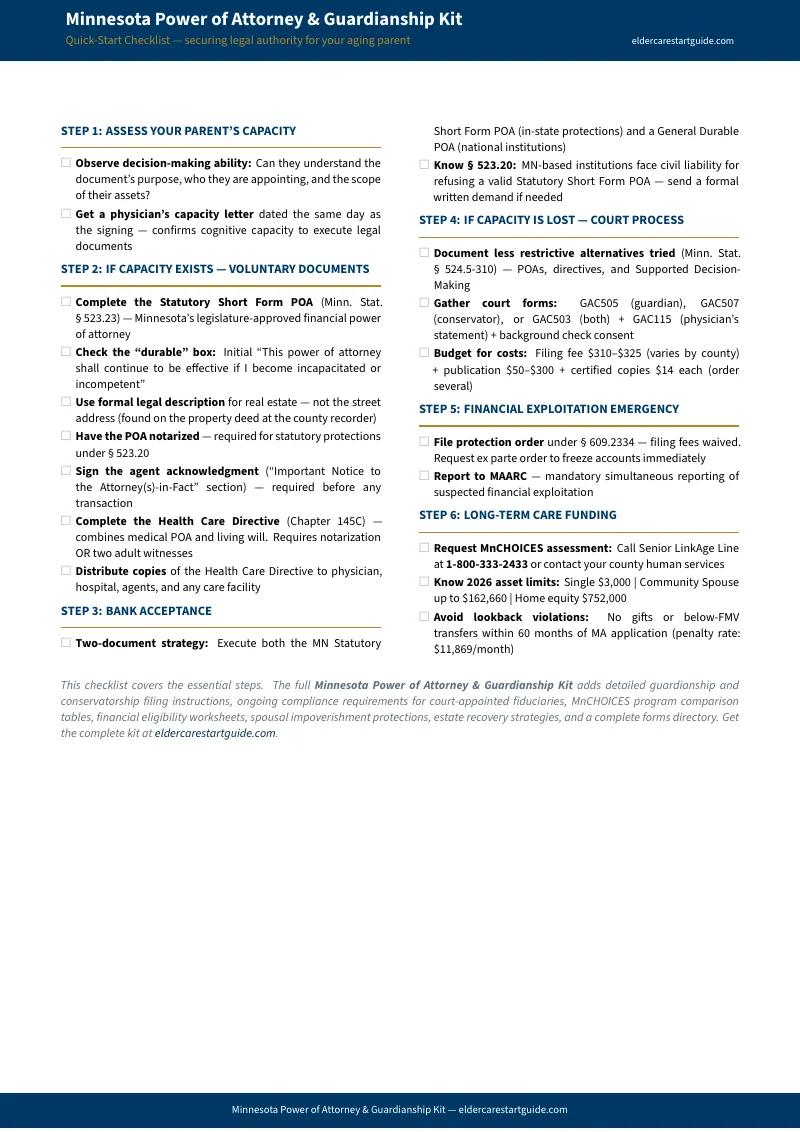
Download the free Minnesota Power of Attorney Quick-Start Checklist for a high-level overview of the process. When you're ready for the complete guide — with execution checklists, bank acceptance strategies, court filing roadmaps, and benefit integration — upgrade to the full kit.