
Your Parent Has Dementia. Minnesota's Care System Has Answers — Buried Under 1,000 Pages of Policy Manuals.
You already know the diagnosis. What you don't know is which county office to call first, what the MnCHOICES assessor is actually evaluating, whether the family home is safe from Medicaid estate recovery, or how to stop private-pay memory care bills from draining everything your parent spent a lifetime building.
Minnesota runs one of the most comprehensive dementia care systems in the country — Elderly Waiver, Alternative Care, Community First Services and Supports, Minnesota Senior Health Options — but the rules are scattered across hundreds of pages of administrative legalese written for county caseworkers, not for a family member trying to keep their parent safe while holding down a job and raising kids.
The Minnesota Dementia Care Navigator is a step-by-step system that translates the entire state bureaucracy into a sequential process you can actually follow. It tells you what to do first, what to file next, and which financial thresholds determine whether your parent qualifies — with every 2026 dollar figure, statute citation, and agency phone number in one place.
What's Inside the Guide
- The Legal Protection Sequence — Minnesota's Statutory Short Form Power of Attorney (§ 523.23) and Health Care Directive (§ 145C) must be executed while your parent still has cognitive capacity to sign. The guide gives you the execution requirements, notary rules, and durability language, plus what happens when the window has already closed and guardianship becomes the only option.
- MnCHOICES Assessment Preparation — The county's certified assessor conducts a face-to-face interview that determines your parent's clinical eligibility for every publicly funded program. The guide walks you through what the assessor evaluates, how to document care needs so nothing is understated, and the statutory timeline for receiving your Coordinated Services and Supports Plan.
- The 2026 Medicaid & Elderly Waiver Qualification Framework — Asset limits, income thresholds, the 60-month look-back period, spousal impoverishment protections, and the exact rules for exempt versus countable assets. Instead of paying an attorney hundreds per hour to explain the basics, you work through a structured checklist that inventories your parent's financial picture against the current eligibility standards.
- Memory Care Facility Evaluation Under Minnesota Law — The 2021 Assisted Living Licensure Law (Chapter 144G) created two license tiers. The guide explains what distinguishes a standard Assisted Living Facility from an Assisted Living Facility with Dementia Care, what consumer protections apply under the Assisted Living Bill of Rights, and how to use the state's Assisted Living Report Card to compare facilities.
- The Alternative Care Bridge — Not yet Medicaid-eligible? Minnesota's state-funded Alternative Care program lets families whose assets can't cover 135 days of nursing home care access home and community services anyway. The guide maps the eligibility path and explains how to coordinate AC with the Elderly Waiver transition.
- Self-Directed Care and Family Caregiver Compensation — Community First Services and Supports (CFSS) replaced PCA and the Consumer Support Grant. The guide explains both models — Agency and Budget — and shows how to use the Budget Model to employ family members as paid caregivers while a Financial Management Services provider handles payroll and taxes.
- Wandering Protocols and Emergency Response — Brandon's Law, the BCA Endangered Missing Person Alert, Project Lifesaver in participating counties, and the home modifications that reduce wandering risk before a crisis happens.
- Estate Recovery Protection — Minnesota's expanded estate recovery program targets non-probate assets like joint tenancy and living trusts. The guide explains the legal exemptions — including the Caretaker Child Exception — and the documentation required to protect the family home.
Who This Guide Is For
Adult children in Minnesota who are coordinating a parent's dementia care — whether you are planning ahead after an early diagnosis or scrambling to catch up after a hospital discharge, a wandering scare, or a sudden cognitive decline.
You do not need a legal background or financial planning experience. The guide is designed for families handling this process themselves, step by step, using the same state programs and legal instruments that elder law attorneys charge hundreds per hour to explain.
Why Not Just Use Free Online Resources?
You absolutely can. The Minnesota Department of Human Services publishes the Community-Based Services Manual. The Health Care Programs Eligibility Policy Manual covers Medicaid rules. County websites list MnCHOICES assessment procedures. The information is technically public.
It is also scattered across dozens of state agency sites, written in dense administrative language designed for county workers, and organized by program — not by the order a family actually encounters these decisions. You can spend weeks reading policy manuals and still not know whether your parent qualifies for the Elderly Waiver or Alternative Care, what the spousal impoverishment protections actually mean for your family, or how to prepare for the MnCHOICES interview so the assessor captures the true severity of your parent's needs.
This guide takes that same publicly available information and organizes it into a single sequential process — with the 2026 financial thresholds, the forms, the phone numbers, and the step-by-step checklists that tell you what to do in what order. It costs less than a single hour of an elder law attorney's time, and it covers the foundational rules that most families can handle without hiring one.
The Free Checklist vs. the Full Guide
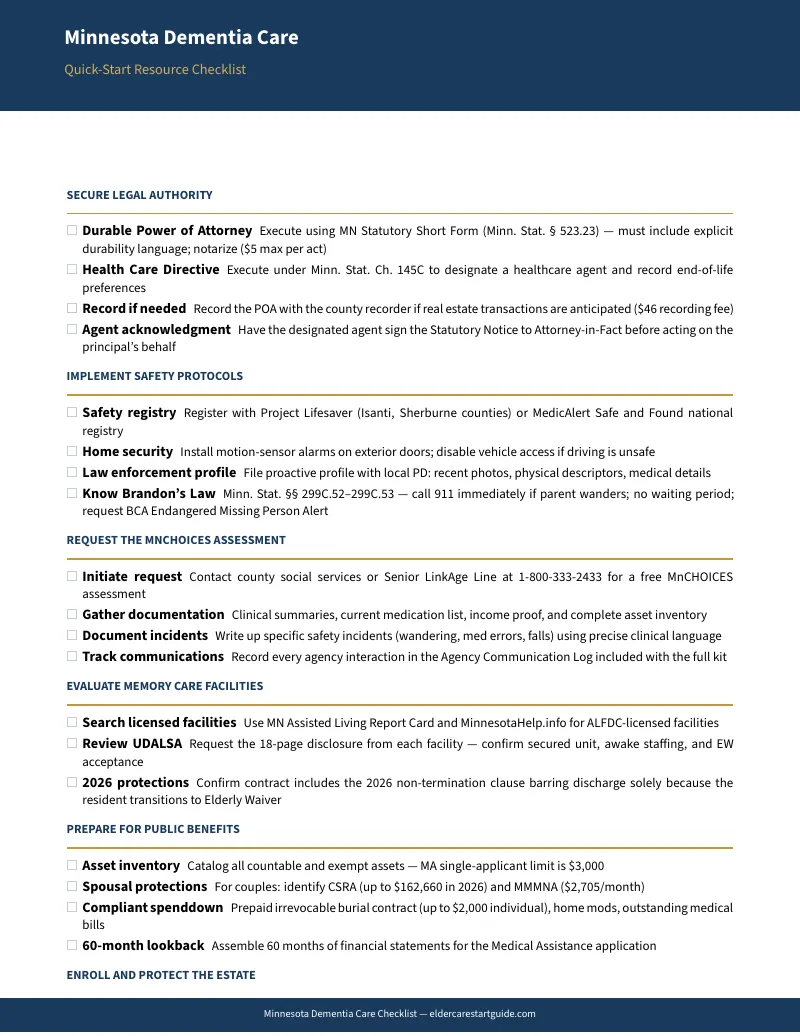
The free Minnesota Dementia Care Resource Checklist gives you the action items — a compressed list of what to do. Download it now and start working through it tonight.
The full guide explains how each step works, why it matters, and what can go wrong. It includes the Medicaid qualification framework, the facility evaluation criteria, and 6 printable worksheets — MnCHOICES assessment preparation, agency communication log, financial inventory, facility comparison, monthly care cost tracker, and caregiver self-assessment — that turn scattered decisions into a structured process.
Start with the free checklist. If you need the full picture, the guide is here — for a fraction of what one consultation with an elder law attorney would cost.
100% Satisfaction Guarantee
If the guide does not give you a clearer understanding of your parent's options in Minnesota, email us for a full refund. No forms, no waiting period, no questions asked.
Get Started Now
Download the free checklist to see the action items. When you are ready for the full system — the legal sequences, the Medicaid qualification framework, the MnCHOICES preparation guide, and everything else — the complete guide is available for .