
Your Parent Is Being Discharged — And Nobody Handed You a Plan
The discharge planner says your parent can leave tomorrow. Maybe they mentioned a skilled nursing facility, or home health, or rehab — but nobody explained how any of it gets paid for, what happens when Medicare's 100-day coverage window closes, or whether the family home is at risk if your parent needs Medicaid.
You're not a hospital administrator. You're not an elder law attorney. You're someone's adult child, standing in a hospital corridor in Michigan, trying to figure out the right next step before the discharge clock runs out.
The Michigan Discharge Roadmap — One System for Every Stage of the Transition
This isn't a generic overview of discharge planning. It's a Michigan-specific decision system that covers the entire arc: from challenging an unsafe discharge in the first 24 hours, through navigating Medicare and Medicaid eligibility, to protecting the family home from estate recovery years down the road.
Michigan makes post-hospital transitions harder than most states. There is no automatic next-of-kin medical decision-making authority — if your parent didn't execute a Patient Advocate Designation before the crisis, you may need an emergency guardianship petition. The MI Choice Waiver has capped enrollment and regional waitlists. Nursing homes average $10,000 to $15,000 per month. And the state recovers Medicaid costs through a probate-only estate recovery program that catches families who didn't plan ahead.
This guide translates those Michigan-specific rules into a step-by-step sequence you can follow from the hospital bed to the kitchen table.
What's Inside
- Discharge appeal scripts — word-for-word language for filing a fast appeal through Commence Health (Michigan's BFCC-QIO, 1-888-524-9900) to halt an unsafe discharge while an independent medical review is conducted
- Observation status defense — how to verify your parent's admission classification, understand the Medicare Outpatient Observation Notice (MOON), and use the new retrospective appeal rights under the Medicare Change of Status Notice (MCSN) effective February 2025
- MI Choice Waiver enrollment guide — 2026 financial limits, the hospital-to-home priority pathway that bypasses waitlists, the Self-Determination Option that lets you hire and pay family members as caregivers, and how to connect with your regional Area Agency on Aging
- PACE program overview — how the Program of All-inclusive Care for the Elderly bundles medical, home-care, and social services under one capitated plan for dual-eligible seniors
- Level of Care Determination (LOCD) playbook — the 8-door clinical assessment that determines eligibility for Medicaid long-term care, MI Choice, and PACE, with preparation strategies for each door's look-back period
- Medicaid eligibility workbook — the $9,950 single-applicant asset cap, the $2,982 income cap, spousal impoverishment protections (up to $162,660 CSRA), and the medically needy spend-down pathway
- 60-month look-back and penalty calculator — how Michigan calculates divestment penalties using the 2026 divisor of $12,216.30, and which transfers are exempt
- MERP estate protection checklist — Lady Bird Deeds, jointly held assets, the probate-only recovery rule, the $752,000 home equity exemption, and the hardship waiver process
- SNF selection and contract defense — how to evaluate facilities using LARA inspection reports and CMS Five-Star ratings, and a contract review checklist that identifies and strikes "Responsible Party" and guarantor clauses
- Patient Advocate Designation guide — Michigan's strict witness restrictions under MCL 700.5506, activation requirements, and the guardianship alternative
- MI Coordinated Health (MICH) transition briefing — the new HIDE SNP program replacing MI Health Link, its capitation tiers, and what dual-eligible families need to know
- Worksheets and planning tools — medication reconciliation forms, asset inventory worksheets, DME delivery checklists, and follow-up scheduling templates
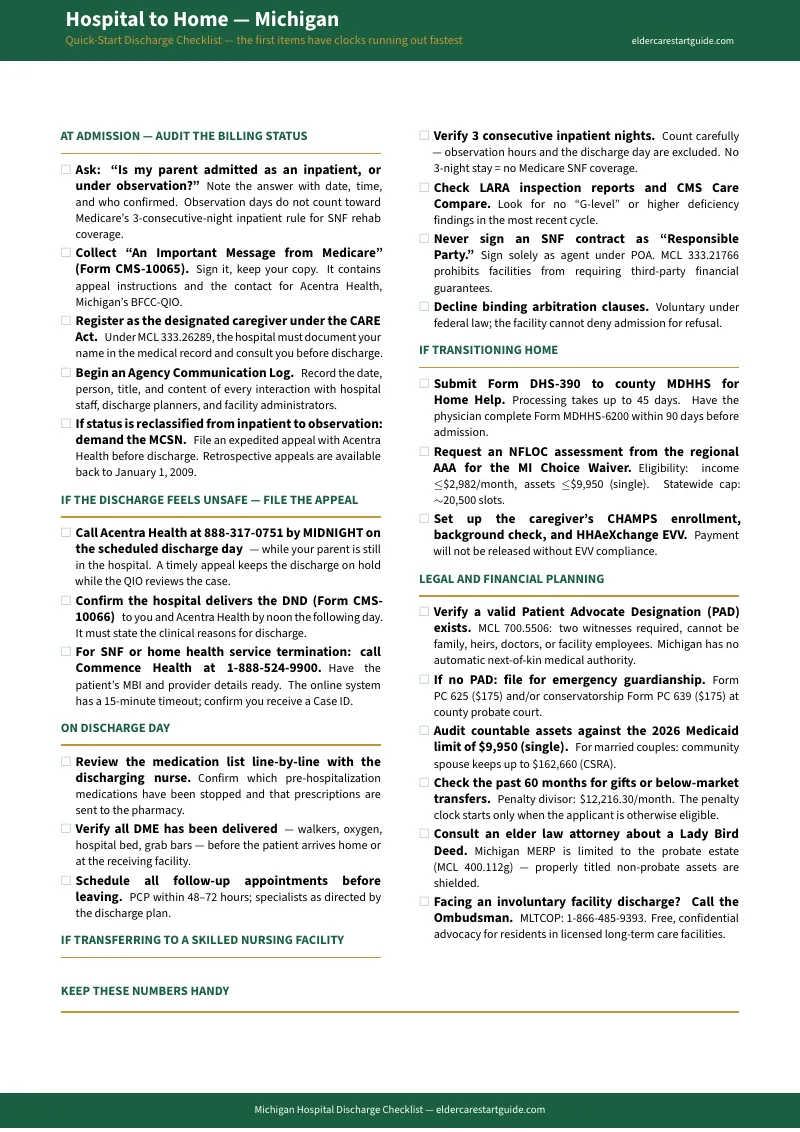
- First 72 hours checklist — the free download that covers the immediate post-discharge window, included in the full toolkit
Who This Is For
- Adult children in Michigan managing a parent's hospital discharge — whether it's the first time or the fifth, whether the parent is going to a SNF, home health, or back to their own kitchen
- Out-of-state family members coordinating a parent's care remotely from across the country, trying to understand Michigan-specific rules from a distance
- Families hit by the observation status surprise who just learned that Medicare won't cover rehab because their parent's hospital stay was classified as outpatient observation
- Families approaching the Medicaid cliff — rehab is winding down, savings are dropping, and nobody has explained the $9,950 asset limit or what happens when the money runs out
- Families who discovered the decision-making gap — Michigan doesn't grant automatic next-of-kin medical authority, and the parent never signed a Patient Advocate Designation
Why Free Resources Don't Solve This
The information exists — scattered across hundreds of pages of the Michigan Bridges Eligibility Manual, Medicare.gov notices, MDHHS policy bulletins, and regional waiver agency websites. You could spend days piecing it together. The problem isn't that the rules are secret. The problem is that they're scattered, written in administrative language, and organized by agency rather than by what a family actually needs to do next.
Free senior placement agencies like A Place for Mom are funded by facility commissions — often 50% to 100% of the first month's rent. They help you find a bed. They don't help you challenge a discharge, apply for the MI Choice Waiver, protect the family home from estate recovery, or avoid signing a nursing home contract that creates personal liability.
Elder law attorneys charge $300 to $500 per hour — and you'll spend the first two hours of that explaining your parent's situation if you walk in without organized records. This guide doesn't replace an attorney. It prepares you to use one efficiently, saving potentially thousands in billable hours by helping you arrive with your parent's clinical history mapped, their asset structure organized, and the right questions already identified.
What You Get
A 45-page guide covering every stage of Michigan's hospital-to-home transition, plus 9 standalone printable worksheets: discharge appeal scripts, an SNF contract review checklist, a facility comparison worksheet, a Medicaid financial eligibility worksheet, a 60-month look-back penalty calculator, a MERP estate protection checklist, an LOCD assessment preparation tool, an agency communication log, and the first 72 hours checklist. Download all 10 PDFs immediately after purchase — no login, no account, no waiting. The full toolkit is yours to keep, print, and share with family members and caregivers coordinating your parent's care.
Full refund, no time limit. If this isn't what your family needs, email [email protected] and we'll refund you — no questions, no deadline.
Get the Michigan Hospital Discharge Toolkit →
The free checklist covers the immediate 72-hour window. The full guide covers everything that comes after — from the first discharge notice through Medicaid eligibility, estate protection, and long-term care coordination.