Your parent needs long-term care in Kansas. The bills start next month. Where does the money come from?
A nursing home in Kansas runs $7,200 to $9,000 a month. Medicare covers skilled rehabilitation for up to 100 days — and then it stops. The discharge planner is asking you to pick a facility and sign a private-pay agreement, the KanCare Clearinghouse phone tree keeps routing you to a voicemail, and the Area Agency on Aging told you to bring five years of bank statements to a screening appointment nobody explained.
Meanwhile, your parent's monthly Social Security and pension income is $3,400 — and someone told you that is too high for Medicaid. That person was wrong. Kansas has no income cap for long-term care Medicaid. But the rules your parent does need to follow — the medically needy spend-down, the $2,000 asset limit, the 60-month lookback, the expanded estate recovery program — those are buried across 1,200 pages of KanCare administrative manuals, scattered between the KDHE, KDADS, and three different Managed Care Organizations.
The Kansas Medicaid Long-Term Care & Asset Protection Guide is the KanCare Compliance Playbook — a single manual that puts every eligibility threshold, every spend-down strategy, every spousal protection formula, and every application step into the order you actually need them. Built for the adult child doing the coordination, not the elder law attorney billing $300 to $500 an hour.
What's Inside
The Medically Needy Spend-Down Pathway — Kansas's No-Cap Income System
Kansas does not require a Miller Trust. Unlike neighboring income-cap states where a single dollar over the limit triggers automatic disqualification, Kansas lets your parent qualify regardless of monthly income. The excess is paid to the facility as patient liability — Medicaid covers the rest. The guide walks through the exact calculation, the $62/month Personal Needs Allowance, and how to minimize the patient liability amount so the community spouse keeps more.
The Compliant Spend-Down Worksheet — How to Get Under $2,000 Without Triggering Penalties
The countable asset limit is $2,000 for a single applicant. The guide gives you a sequenced, penalty-free spend-down plan: pay off debts, prepay an irrevocable funeral trust up to $12,440, make home accessibility modifications, purchase a replacement vehicle, and set up a Medicaid-compliant Personal Care Agreement to compensate a family caregiver — all documented so every dollar passes the KanCare Clearinghouse's 60-month audit.
Spousal Protection Calculator — CSRA and MMMNA for Kansas
When one spouse enters a nursing facility, the community spouse can retain between $32,532 and $162,660 in countable assets under the Community Spouse Resource Allowance. The guide includes the Snapshot Date calculation, the Minimum Monthly Maintenance Needs Allowance ($2,705 to $4,066.50/month from 7/1/2026), the Excess Shelter Allowance formula, and the administrative hearing process for requesting a higher income allocation when the standard formula falls short.
The 60-Month Lookback Defense — What the Clearinghouse Actually Audits
The KanCare Clearinghouse reviews five years of bank statements and flags every uncompensated transfer. The penalty divisor is $308.25 per day. The guide explains which transfers are exempt (spouse, disabled child, caretaker child), why the IRS $19,000 gift-tax exclusion is irrelevant to Kansas Medicaid, and what happens when a family member was paid for caregiving without a written Personal Care Agreement.
Home Protection Blueprint — Estate Recovery Under K.S.A. 39-709(e)
Kansas runs an expanded Medicaid Estate Recovery Program. Under K.A.R. 129-6-150, the state can pursue reimbursement through joint tenancy, transfer-on-death deeds, life estates, and trusts — traditional estate planning tools often fail. The guide maps which ownership structures are vulnerable, which exemptions actually work (surviving spouse, caretaker child, disabled child), and how to file an undue hardship waiver.
Frail Elderly Waiver Navigation — Home Care Through KanCare's MCOs
Keeping a parent at home through the FE waiver means clearing two separate agencies: financial eligibility through the KanCare Clearinghouse and functional eligibility through a CARE assessment at the local Area Agency on Aging. Once approved, services are coordinated through one of three Managed Care Organizations — Sunflower, Aetna Better Health, or UnitedHealthcare. The guide covers the CARE assessment preparation, the MCO enrollment process, covered services (personal care, homemaker, adult day, home modifications, PERS), and the self-directed care option for paying family caregivers.
The Application Walkthrough — KanCare Clearinghouse Step by Step
From requesting the CARE assessment through submitting form KC1500 at the KanCare self-service portal, responding to the 12-day document request deadline, monitoring the 45-to-90-day processing window, and filing a State Fair Hearing within the 33-calendar-day limit if the application is delayed or denied. Every step with contacts, deadlines, and the exact documentation required.
Plus: The Eligibility Checklist
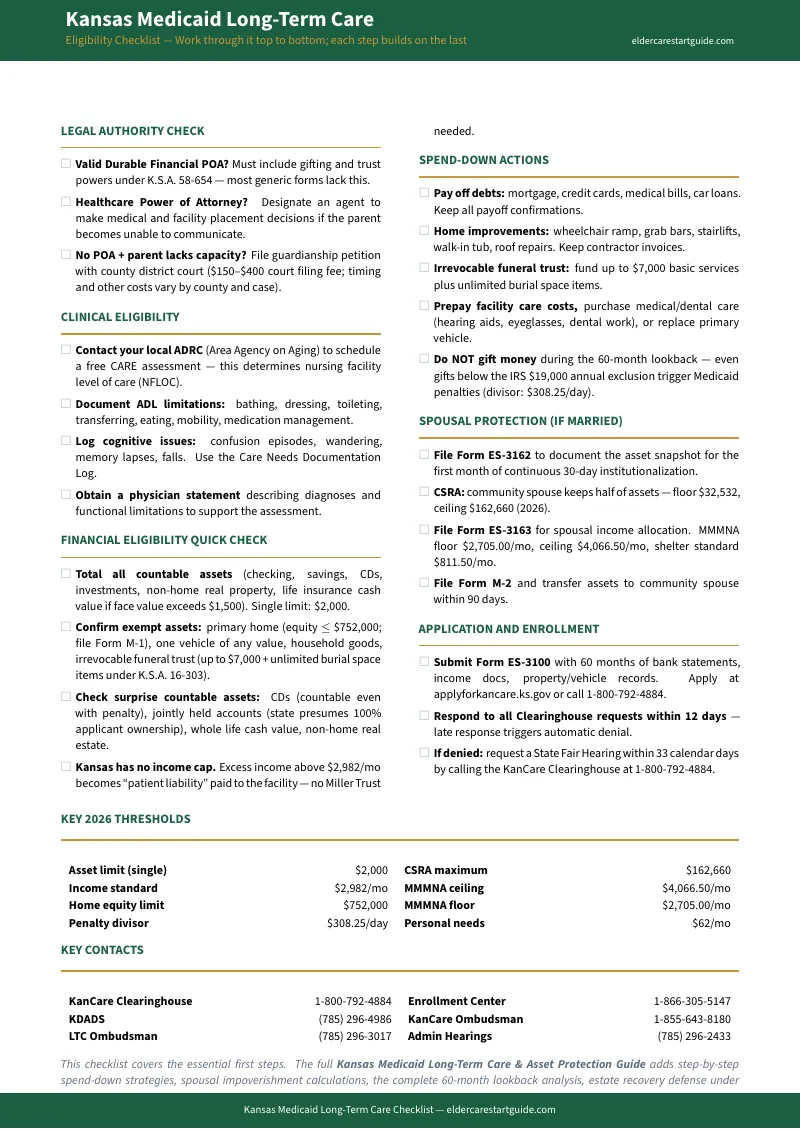
Every critical action item in a printable two-page reference — from establishing legal authority through gathering 60 months of financial records, preparing for the CARE assessment, and filing with the KanCare Clearinghouse. Every threshold, phone number, and deadline at a glance.
Who This Is For
- The adult child whose parent is being discharged from the hospital — Medicare's skilled nursing benefit is running out and you need to figure out who is paying $8,000 a month starting next week.
- The family who was told their parent makes too much for Medicaid — Kansas has no income cap. The guide explains the medically needy spend-down and why a Miller Trust is never needed here.
- The spouse trying to avoid impoverishment — your parent's partner is entering a nursing home and you need to know exactly how much the community spouse keeps under the CSRA and MMMNA formulas.
- The family trying to keep a parent at home — the Frail Elderly waiver funds home care but navigating the MCO system, the CARE assessment, and the dual-track eligibility requires a step-by-step map.
- The sibling who has been providing unpaid care — without a Medicaid-compliant Personal Care Agreement, the KanCare Clearinghouse treats payments to family caregivers as uncompensated transfers that trigger penalties.
Why Not Free Resources?
The KanCare website gives you the rules. The Area Agency on Aging gives you a phone number. The KDHE gives you a policy manual. None of them gives you a sequence.
Government portals explain the $2,000 asset limit but do not walk you through a compliant spend-down that passes the 60-month audit. AAA staff are legally prohibited from advising on asset protection strategies. Elder law attorneys charge $300 to $500 per hour — and for a straightforward estate (a home, a car, modest savings), a structured spend-down does not require complex legal trusts.
The guide translates 1,200 pages of KanCare administrative manuals into a step-by-step afternoon read. You get the exact sequence of actions, downloadable worksheets, and tracking templates to execute a compliant spend-down — organized so you can act tomorrow morning, not after six billable hours.
Satisfaction Guarantee
If the guide does not give you a clear path forward for your parent's care situation, email [email protected] and we will make it right.
Get Started Now
Download the free checklist to see the format and key thresholds. When you are ready for the complete spend-down strategies, spousal protection formulas, and application walkthrough, get the full guide — instant download, printable PDF, for less than half an hour of an attorney's time.