
Your parent's bank just froze you out. The hospital won't share records. The clock is running.
You have been managing your parent's care for months — sorting medications, coordinating appointments, fielding calls from providers. Then the bank teller asks for a durable power of attorney. You don't have one. The hospital discharge planner needs someone to sign consent forms, but HIPAA says they cannot tell you what is happening. You are the person doing everything, and you have the legal authority to do nothing.
This is where Kansas families break down. Not over the caregiving itself, but over the discovery that verbal trust and a lifetime of family history carry zero weight with banks, hospitals, and government agencies.
The Kansas Legal Authority System
The Kansas Power of Attorney & Guardianship Kit is a complete, state-specific system for establishing legal authority over an aging parent's healthcare and finances. Every instruction, every workflow, and every document walkthrough is built around Kansas statutes — the Kansas Power of Attorney Act (K.S.A. 58-650 to 58-665), the Healthcare DPOA rules under K.S.A. 58-625, the 2026 Uniform Guardianship Act that replaced the old guardianship framework on January 1, and the KanCare Frail Elderly waiver pipeline that changed again with the July 6, 2026 waitlist.
Where free government forms give you a blank PDF and no context, this kit gives you the step-by-step sequence: what to fill in, how to execute the document without voiding it, and what to say when a bank or managed care organization pushes back.
What's Inside
- Durable Financial POA Walkthrough — covers the mandatory durability clause (Kansas does not assume durability by default), the notary requirement under K.S.A. 58-652, the designee-signing option when a parent is physically unable to sign, and the "hot powers" — gifts, trusts, beneficiary changes — that must be explicitly authorized or they do not exist in the document at all
- Healthcare POA & Living Will Guide — the separate signing rules under K.S.A. 58-625 (notary or two disinterested witnesses — different from the financial POA), who is prohibited from serving as the healthcare agent, and why a living will alone is not enough for long-term cognitive decline because Kansas law does not classify dementia or persistent coma as a terminal condition
- Capacity Evaluation Checklist — a structured home-use tool for assessing whether your parent meets the functional capacity standard for signing. Kansas uses a "moment of signing" test, not a diagnosis-based one — a parent with early dementia can still sign on a clear day, and this checklist helps you evaluate that window with confidence
- Supported Decision-Making Agreement Guide — Kansas's 2026 SB 84 alternative to guardianship, which lets a parent with mild-to-moderate impairment designate trusted supporters who assist with gathering information, evaluating choices, and communicating decisions — without any court involvement
- 2026 Guardianship & Conservatorship Process — the full court-supervised path under KUGCOPAA (K.S.A. 59-30,101 et seq.), including the substituted judgment mandate, the least-restrictive alternative rule, the mandatory care plan you must file at petition time, court-appointed counsel for the respondent, the medical evaluation, and post-appointment obligations (bonds, training, annual reporting)
- KanCare FE Waiver Navigation — the complete pipeline from ADRC intake through Liberty Healthcare, Maximus's level-of-care functional assessment, KanCare Clearinghouse financial eligibility, and the waitlist that took effect July 6, 2026 — with instructions for preparing a crisis exception request when standard wait times are not safe for your parent
- SSA Representative Payee Setup — Social Security does not recognize any state-issued power of attorney. This section covers the formal SSA-11 application, dedicated fiduciary bank account titling, federal record-keeping requirements, and annual reporting
- KanCare Administrative Forms Guide — how to use KC-6100 (Medical Representative Authorization) and KC-6200 (Facilitator Authorization) to manage a parent's Medicaid case when no formal DPOA or guardianship is in place
- Dispute Resolution & Advocacy — MCO grievance procedures, administrative fair hearings, the Long-Term Care Ombudsman, the KanCare Ombudsman, and how to file a complaint when a facility or agency is not cooperating
Who This Is For
- The crisis caregiver — your parent was just hospitalized and the discharge planner is demanding decisions you have no authority to make
- The proactive planner — you can see the cognitive decline starting and the window to get documents signed while your parent still has capacity is closing
- The KanCare navigator — you need to apply for the Frail Elderly waiver or manage your parent's Medicaid case and cannot get past the intake process without the right authorization forms
- The family coordinator — you are the sibling doing the work and you need structured, legally documented tools to bring the rest of the family into the planning process before disagreements escalate
Why Free Tools Fall Short
The Kansas Judicial Council provides blank legal forms at no cost. Those forms do not tell you that Kansas requires explicit durability language — without it, your power of attorney self-destructs the moment your parent becomes incapacitated, which is exactly when you need it most. They do not warn you that high-risk powers like making gifts of your parent's property must be enumerated individually, or that a general grant of financial authority is legally insufficient. And they say nothing about what to do when your parent has early-stage dementia and you are not sure whether they can still sign.
National template sites generate documents that technically satisfy Kansas statutory format. But they do not explain the 2026 guardianship reform, the KUGCOPAA care plan you now must file at the start of a petition, or the KanCare FE waiver waitlist. The administrative pipeline is where Kansas families actually get stuck — not the blank form itself.
What It Costs to Wait
A Kansas elder law attorney charges $300 to $500 per hour. A comprehensive estate plan runs $2,500 to $4,500. An uncontested guardianship typically costs several thousand dollars when you add up filing fees, mandatory medical evaluations, the court-appointed attorney the 2026 act now requires for every respondent, and your own counsel. Contested cases run far higher. That is the path you are on if capacity is lost before voluntary documents are signed — and the new law makes the process longer, not shorter, because it rightly prioritizes the respondent's autonomy.
This kit costs a fraction of a single hour with an elder law attorney. It gives you the same Kansas-specific information an attorney would use — presented as a step-by-step system you can execute independently for straightforward situations, or bring to a consultation so you pay for legal strategy, not basic education.
Satisfaction Guarantee
If the kit does not give you what you need to establish legal authority for your parent in Kansas, email us and we will refund you — no conditions, no hoops.
Get Started Now
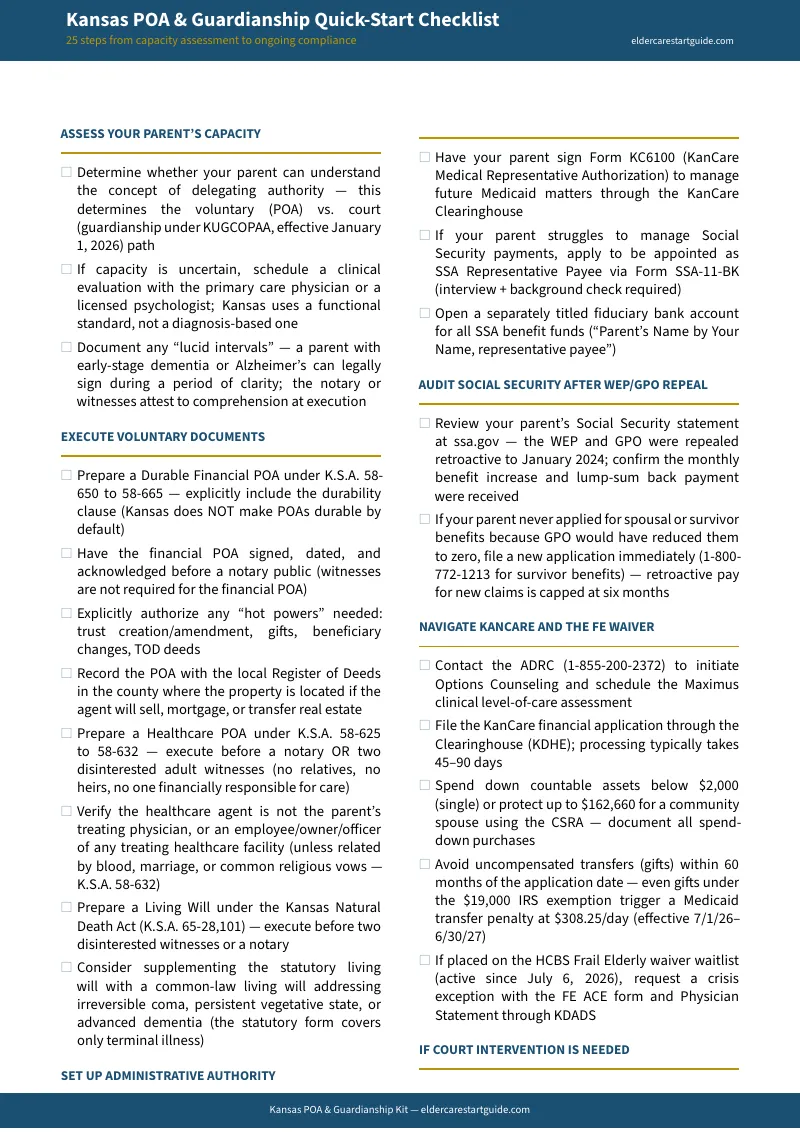
Download the free Kansas — Power of Attorney Quick-Start Checklist to see the overview. When you are ready for the complete system — every document walkthrough, every execution checklist, every state-specific workflow — get the full kit.