Your Parent Is Probably Paying Medicare Costs That Indiana Will Cover
Every month, $202.90 comes out of your parent's Social Security check for the Part B premium. On a fixed income in Indiana, that is a significant chunk of a monthly budget that was already stretched to cover groceries, utilities, and prescriptions.
Here is what most families do not know: Indiana runs one of the most generous Medicare cost-help programs in the country. The income limits are far higher than what Medicare.gov or any national website publishes. A single senior earning $2,400 per month would be told they do not qualify by every national resource — but they fall well within Indiana's QI limit.
The problem is that nobody puts it all together. The FSSA Benefits Portal handles applications but does not explain income disregards. Indiana SHIP gives excellent advice but cannot file on your behalf or manage your portal uploads. National websites publish the wrong numbers. And insurance brokers use "free Medicare help" as a funnel to sell Advantage plans, not to help with state premium assistance.
The Indiana Medicare Cost-Help Navigator
This guide consolidates every layer of Indiana's Medicare cost-assistance system — the Medicare Savings Programs (QMB, SLMB, QI), Extra Help, and HoosierRx — into a single process you can follow from eligibility check through application, approval, and annual renewal. It is built for the way Indiana actually administers these programs through the Division of Family Resources, not the way the federal government describes them on Medicare.gov.
If you are an adult child managing this from out of state, or a senior doing it yourself, this is the reference that replaces the scattered state websites, outdated web articles, and confusing DFR notices with one organized workflow.
What the Guide Covers
- 2026 Indiana income limits with disregards pre-calculated — the actual Indiana thresholds (QMB at 150% FPL, SLMB at 170%, QI at 185%), not the lower federal numbers that most websites publish, with worked income-calculation examples for earned and unearned income
- Asset limit rules with exemptions — what counts, what is exempt (primary home, one vehicle, burial contracts), and how Indiana's automated Asset Verification System screens financial accounts
- FSSA Benefits Portal application walkthrough — step-by-step instructions for creating an account, uploading documents, and tracking your application status through DFR
- Authorized representative setup — how to file State Form 55651 so an out-of-state adult child can manage the entire process remotely through the portal
- Part A buy-in procedure — how Indiana's buy-in state status lets a senior without 40 work quarters enroll in Part A year-round through QMB, without waiting for the General Enrollment Period or paying late-enrollment penalties
- Premium refund tracking after approval — the 60–90 day timeline for Social Security to stop deducting the Part B premium, process the state buy-in file, and issue a retroactive reimbursement, with a month-by-month tracker to verify the back pay arrives
- QMB billing protections — the federal law that prohibits providers from billing QMB beneficiaries for deductibles, coinsurance, and copays, plus a ready-to-customize dispute letter for when a provider sends a bill anyway
- Extra Help auto-enrollment — how any MSP approval automatically triggers the federal Part D Low-Income Subsidy, eliminating a separate application
- HoosierRx coordination — Indiana's pharmacy assistance program that pays up to $70 per month toward a Part D plan premium, including who qualifies (seniors denied full Extra Help due to excess assets), who is excluded (full LIS recipients), and how to apply
- Renewal and redetermination management — the annual verification timeline, what DFR notices mean, and the two critical deadlines every family must know (33-day appeal window and 90-day document reinstatement grace period)
- HIP-to-Medicare transition at 65 — the mandatory DFR data-gathering interview when Healthy Indiana Plan coverage ends, the timeline for scheduling it, and how to avoid a gap in coverage
- Estate recovery exemption — why MSP-only benefits are statutorily exempt from Indiana's Medicaid estate recovery program under Indiana Code IC 12-15-9, and where the exemption ends
Who This Guide Is For
- Adult children helping a parent in Indiana apply for Medicare cost assistance — whether you live in-state or are managing everything remotely
- Seniors in Indiana handling the application process on their own and looking for clear, step-by-step instructions instead of dense policy manuals
- Families who were told their parent earns too much — and want to check whether that assessment used the federal numbers or Indiana's actual, higher limits
- Anyone helping a parent transition from the Healthy Indiana Plan to Medicare at age 65 who needs to know exactly when and how to schedule the DFR interview
- Families dealing with a DFR closure notice or denial who need to understand the 33-day appeal deadline and 90-day reinstatement window
- Caregivers looking to stack every available dollar of help — MSP premium coverage, Extra Help for prescriptions, and HoosierRx for Part D premiums
Why Free Resources Are Not Enough
Indiana does have free help available. SHIP counselors provide unbiased advice, and DFR caseworkers process applications. But SHIP appointments fill up during peak enrollment periods, and volunteers cannot act as formal authorized representatives to manage portal uploads on your behalf. DFR caseworkers process forms but do not coach families on income disregards, SSA back-pay timelines, or QMB billing disputes.
Meanwhile, a web search for "help paying Medicare Part B in Indiana" mostly returns insurance broker landing pages designed to capture your contact information and sell Medicare Advantage plans. They will not help you file a state MSP application, dispute a QMB balance bill, or apply for HoosierRx.
This guide is not an insurance company. It does not sell plans, collect health data, or earn carrier commissions. It is an independent, self-paced reference that prepares your family to file a complete application, avoid the processing mistakes that cause delays, and manage the ongoing paperwork so the help does not lapse.
What You Get
The download includes 8 PDFs — the full guide, the eligibility checklist, and six standalone printable tools:
- The full guide — 46 pages covering eligibility, income disregards, the FSSA Benefits Portal application, authorized representative setup, Part A buy-in, post-approval premium refunds, QMB billing protections, Extra Help, HoosierRx, renewals, appeals, the HIP-to-Medicare transition, estate recovery, and key contacts
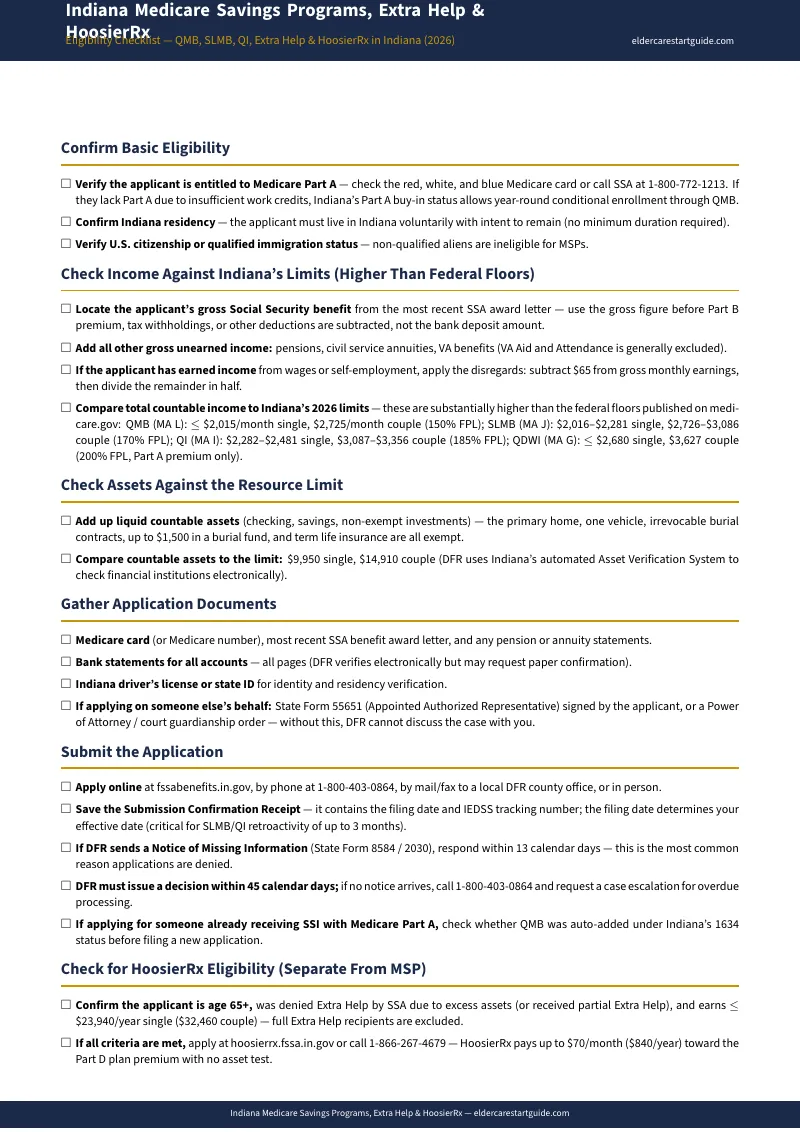
- The eligibility checklist — a printable 2-page action list you can work through in one sitting to determine eligibility, gather documents, and submit the application
- MSP eligibility worksheet — a fillable income and asset calculation using Indiana's disregards and actual limits for QMB, SLMB, and QI
- Premium refund tracker — a month-by-month log for tracking the retroactive Part B refund during the SSA processing window
- QMB billing dispute letter — a ready-to-customize letter citing federal law to stop illegal balance billing from medical providers
- Appeal deadline calendar — maps the 13-day and 33-day deadlines from a DFR notice, with a hearing preparation checklist
- Renewal calendar — a 12-month renewal timeline with change reporting log and safety-net deadlines
- Agency communication log — a printable log for recording every interaction with DFR, SSA, and providers
Satisfaction Guarantee
If the guide does not help your family navigate the process, email [email protected] for a full refund — no time limit, no questions asked.
Indiana's Medicare Savings Programs can recover thousands of dollars a year in premiums and cost-sharing. The checklist shows you whether your parent qualifies. The full guide shows you exactly how to get it done.
Download the free checklist to check eligibility, or get the complete 8-PDF kit with the application walkthrough, income worksheets, billing dispute letter, premium refund tracker, appeal calendar, renewal calendar, and agency communication log.
Frequently Asked Questions
What if the rules change after I buy?
We update the guide when the rules change. Email us any time, even years later, and we'll send you the current edition free.