
Your parent's bank just froze you out. The hospital won't talk to you. Now what?
You have been managing your parent's care for months — driving to appointments, sorting through medications, fielding calls from providers. But the moment you try to access their bank account to pay the mortgage, the teller asks for a durable power of attorney. You don't have one. The hospital discharge planner is pushing for a nursing home placement by Friday, but they can't share your parent's records with you because of HIPAA. You are the person doing everything, and you have the authority to do nothing.
This is the gap that destroys families. Not the caregiving itself, but the moment you discover you cannot legally act — and every institution you need cooperation from knows it.
The Indiana Legal Authority System
The Indiana Power of Attorney & Guardianship Kit is a complete, state-specific system for establishing and using legal authority over an aging parent's healthcare and finances. It is not a generic template with Indiana's name swapped in. Every document, instruction, and workflow is built around Indiana Code — the post-July 2024 execution requirements, the Healthcare Representative Appointment that replaced the old "medical POA" terminology in 2023, and the PathWays for Aging managed care program that now governs long-term Medicaid services for seniors.
Where free government forms give you a blank PDF and no instructions, this kit gives you the step-by-step sequence: what to fill in, how to execute the document without voiding it, and what to say when a bank or facility pushes back.
What's Inside
- Durable Financial Power of Attorney Walkthrough — covers the specific powers you need to include under Ind. Code § 30-5-5-1, the notary-vs-witness execution rules updated July 1, 2024, and the "interested witness" trap that can void the entire document if a named agent signs as a witness
- Healthcare Representative Appointment Guide — step-by-step instructions for Indiana's Advance Directive for Health Care Decisions under Ind. Code § 16-36-7, the instrument that now appoints a Health Care Representative, including who can serve as a witness, when notarization is required, and how this designation interacts with the Proxy Decision Maker hierarchy when your parent is unconscious
- Capacity Evaluation Checklist — an objective, home-use tool for evaluating whether your parent still has the contractual capacity to sign voluntary documents, so you can move forward with confidence on a good day instead of assuming a dementia diagnosis means court is the only option
- Supported Decision-Making Agreement — Indiana's less restrictive alternative to guardianship under Ind. Code § 29-3-14, for parents with mild-to-moderate impairment who can still participate in decisions with structured support
- Adult Guardianship Petition Prep — when capacity is already lost and no POA exists, this section walks you through the probate court process under Ind. Code § 29-3, from the initial petition through the mandatory physician evaluation to biennial reporting requirements
- Medicaid & Indiana PathWays Navigation — the 2024 program split explained plainly, with instructions for completing the Authorized Representative Form (State Form 55366), preparing for the Area Agency on Aging level-of-care assessment, and understanding what happens between the waitlist and active service coordination
- Qualified Income Trust (Miller Trust) Guide — how to set up and administer the trust that allows your parent to qualify for Medicaid when their monthly income exceeds the state's cap
- HIPAA Authorization & Medical Records Guide — Indiana-specific release requirements including the 180-day expiration rule, the 30-day provider response deadline, and the statutory copying fees hospitals are allowed to charge (covered within the healthcare chapters)
Who This Is For
- The crisis caregiver — your parent was just hospitalized and the discharge planner is demanding decisions you don't have authority to make
- The proactive planner — you can see the cognitive decline starting and you know the window to get documents signed while your parent still has capacity is closing
- The Medicaid navigator — you need to apply for PathWays for Aging or long-term care Medicaid and cannot get past the eligibility caseworker without an Authorized Representative form
- The family coordinator — you are the sibling doing the work and need structured tools to bring the rest of the family into the planning process without turning it into a fight
Why Free Tools Fall Short
You can download blank power of attorney forms from Indiana court websites for free. Those forms do not tell you which specific powers to include so your bank will actually honor the document. They do not warn you that having your brother — the successor agent — witness the signing voids the POA under Indiana's interested-witness rule. They do not explain what "durable" means in Indiana (it's the default — your document survives incapacity — but most people don't know that and add language that accidentally limits it). And they say nothing about what to do when your parent has early dementia and you are not sure if a power of attorney is still an option.
National template sites like Nolo and LegalTemplates generate documents that technically comply with Indiana's statutory format. But they cannot tell you how to navigate Indiana PathWays for Aging, how to complete the FSSA Authorized Representative form, or what happens in Marion County probate court versus Hamilton County. The administrative context is where families get stuck — not the blank form itself.
What It Costs to Wait
An uncontested adult guardianship in Indiana typically runs $3,000 to $5,000 in attorney fees alone — contested cases can exceed $10,000. Filing fees are $177. Add mandatory physician evaluations at $50 to $300, potential bond premiums if assets are involved, and biennial accounting requirements that last as long as the guardianship is active. That is the path you are on if capacity is lost before documents are signed.
This kit costs a fraction of a single hour with an Indiana elder law attorney. It gives you the same information an attorney would use to prepare your documents — presented as a step-by-step system you can execute independently for straightforward situations, or bring to an attorney consultation so you pay for strategy, not education.
Satisfaction Guarantee
If the kit does not give you what you need to establish legal authority for your parent in Indiana, email us and we will refund you — no conditions, no hoops.
Get Started Now
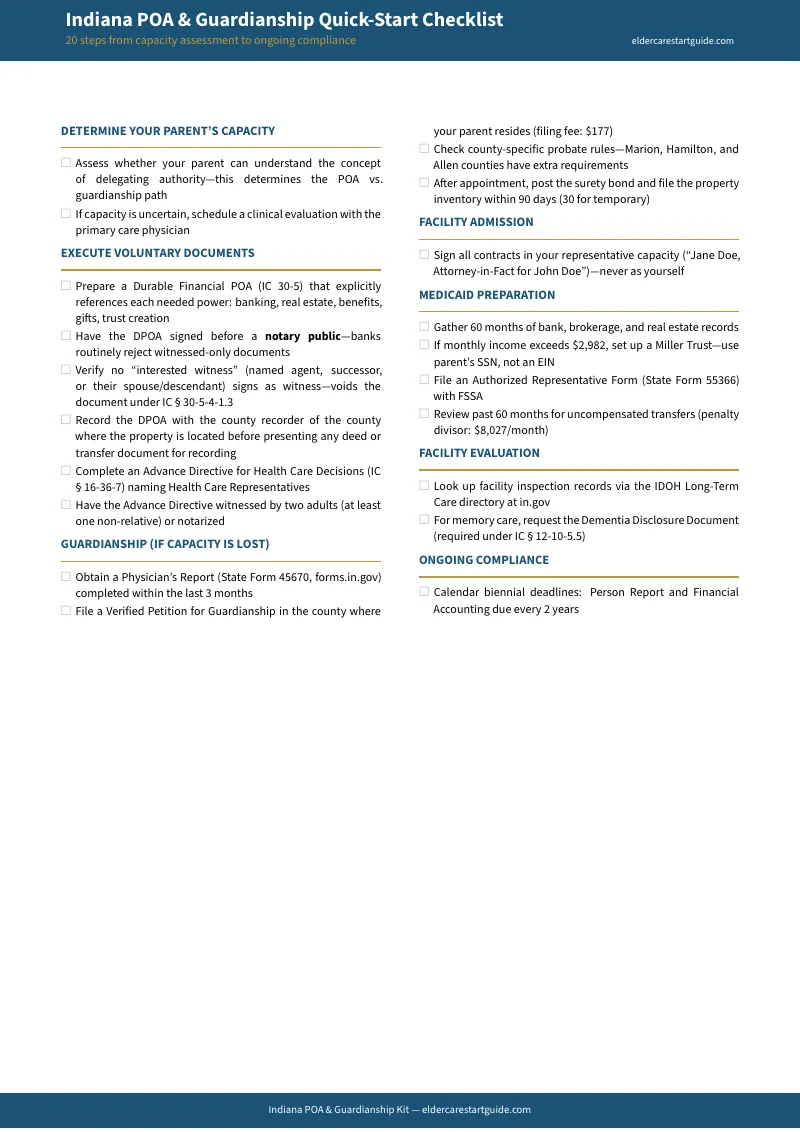
Download the free Indiana Power of Attorney Quick-Start Checklist to see the overview. When you're ready for the complete system — every document walkthrough, every execution checklist, every state-specific workflow — get the full kit.