The Hospital Says Your Parent Is Going Home. You Know They Can't.
The discharge planner just told you your parent is leaving tomorrow. But they can barely stand. They haven't walked unassisted in a week. Nobody has mentioned who will manage the wound vac, the new medications, or the fact that your parent lives alone on the second floor of a walkup.
You're googling "hospital discharge rights Illinois" at 11pm, trying to figure out whether you can stop this, whether Medicare covers rehab, and what a "skilled nursing facility" actually means versus "nursing home." Meanwhile, a clock is ticking — and nobody at the hospital seems to care that your parent isn't ready.
The Illinois Discharge Navigation System
This isn't a pamphlet about your rights. It's a tactical operations manual for the 72-hour window between "we're discharging your parent" and "where do they go next" — built specifically around Illinois law, Illinois agencies, and the Illinois-specific programs that most families don't learn about until it's too late.
It covers two parallel tracks: blocking an unsafe discharge (the Acentra Health appeal, the CARE Act violation, the observation status challenge) and securing post-hospital care (SNF transitions, the Community Care Program, the Medicaid waiver pathway through your regional CCU). Both tracks are time-sensitive. Both have Illinois-specific rules that differ from federal defaults.
What's Inside
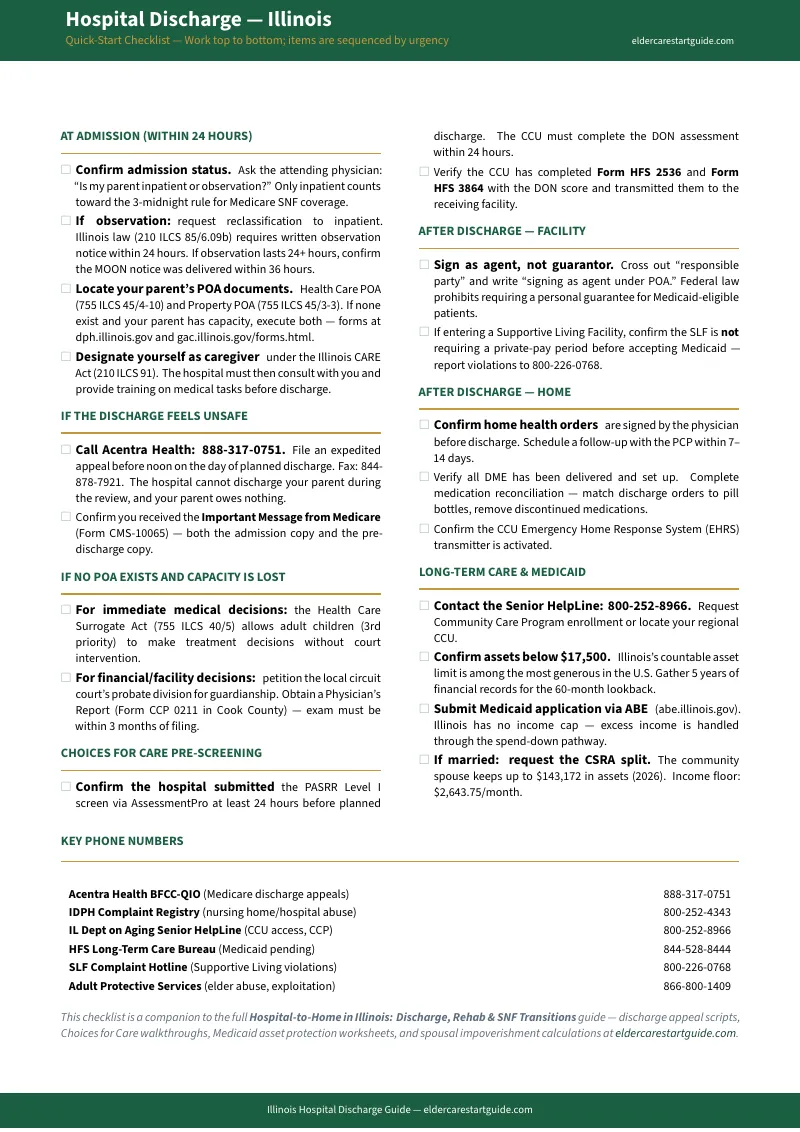
The kit includes a 10-chapter guide, a discharge-readiness checklist, and 8 standalone printable worksheets — covering every decision point from hospital admission to the first week at home or in a facility:
- Observation Status Defense — How to verify your parent's admission classification, trigger the Illinois Hospital Licensing Act 24-hour disclosure requirement, and challenge an observation designation that would disqualify them from Medicare-covered rehab. The three-midnight rule, the MOON notice, and what to do when the clock is already running.
- Discharge Appeal Protocol — The exact steps to file an expedited appeal with Acentra Health (Illinois BFCC-QIO) before midnight on the day of the discharge notice. While the appeal is pending, the hospital cannot force discharge and Medicare continues to pay. Includes the phone number, the timeline, and what to say.
- Illinois CARE Act Enforcement — Your legal right to be designated as the family caregiver, recorded in the medical chart, and trained on all post-discharge medical tasks before your parent leaves. What to do when the hospital skips this step — and why skipping it may constitute an unsafe discharge under state law.
- SNF Selection and Admission Playbook — How to evaluate skilled nursing facilities during a 24-hour decision window. The Medicare 100-day benefit structure, copay escalation schedule, and how to avoid signing yourself as a personal guarantor on admission paperwork (a trap that can make you liable for tens of thousands in unpaid bills).
- Community Care Program (CCP) Access — Illinois's non-Medicaid program for residents aged 60+ who need in-home support. Covers homemaker services, adult day care, and emergency response — without the asset tests of Medicaid. How to contact your regional Care Coordination Unit and what the Determination of Need scoring threshold actually means.
- Medicaid Waiver Pathway — The Persons who are Elderly HCBS Waiver for those who do qualify for Medicaid. The 2026 asset limits ($17,500), the home equity cap ($752,000), the 60-month look-back, and how spousal impoverishment protections let the at-home spouse retain up to $143,172 in countable assets.
- Legal Authority Quick-Start — What to do when you don't have Power of Attorney and the hospital is discharging in 48 hours. Healthcare surrogate designation under the Illinois Health Care Surrogate Act, temporary guardianship petition timeline, and the HIPAA authorization that gets you access to the medical record today.
- First 72 Hours Protocol — The hour-by-hour checklist for the first three days after discharge — whether home, SNF, or rehab facility. Medication reconciliation, fall risk assessment, follow-up appointment scheduling, and the specific warning signs that indicate a readmission risk.
- Financial Protection Toolkit — Estate recovery rules, real estate lien triggers (120 consecutive nursing home days), and the specific asset transfers that will disqualify your parent from Medicaid during the look-back period. How to avoid the most common financial mistakes families make under time pressure.
- Advocacy Contact Directory — Every phone number, office, and filing address you need: Acentra Health, the Senior HelpLine, your regional CCU, the Illinois Long Term Care Ombudsman, and the Department on Aging. Organized by urgency — what to call first when the discharge is happening tomorrow.
Who This Is For
- Adult children who just got a discharge notice and need to know whether they can stop it — tonight
- Families whose parent is stuck in observation status and facing full financial responsibility for rehab
- Caregivers trying to decide between sending a parent home (with what support?) or to a skilled nursing facility (at what cost?)
- Anyone navigating the CCU screening process and trying to understand what the "Determination of Need" score means for their parent's options
- Families who need to set up legal authority (POA, surrogate, guardian) under extreme time pressure
- Adult children worried about signing nursing home admission paperwork and accidentally becoming personally liable for their parent's care bills
Why Not Just Call the Hospital Social Worker?
You should. But understand what the social worker's job actually is: clearing the bed for the next patient. They will give you a list of skilled nursing facilities with available beds. They will not:
- Tell you that observation status just disqualified your parent from Medicare-covered rehab — or how to challenge it
- Explain that signing as "responsible party" on the SNF admission form can make you personally liable for $8,000-$11,000/month in care bills
- Walk you through the CCP application that could provide 20+ hours per week of in-home support without requiring Medicaid eligibility
- Mention that you have until midnight to file an appeal that legally prevents the discharge from proceeding
The social worker works for the hospital. This guide works for you.
Satisfaction Guarantee
If this guide doesn't give you a clearer path forward within the first hour of reading, email [email protected] and we'll make it right.
— Less Than One Hour of a Geriatric Care Manager's Time
A private geriatric care manager in Illinois charges $150-$300/hour to coordinate hospital transitions. An elder law attorney charges $300-$500/hour to explain Medicaid planning. This guide delivers the same structured, step-by-step process — the appeal deadlines, the program eligibility thresholds, the financial traps to avoid — for a fraction of one professional consultation.
Your parent's discharge clock is already running. The decisions you make in the next 48 hours will determine their care options for months.