
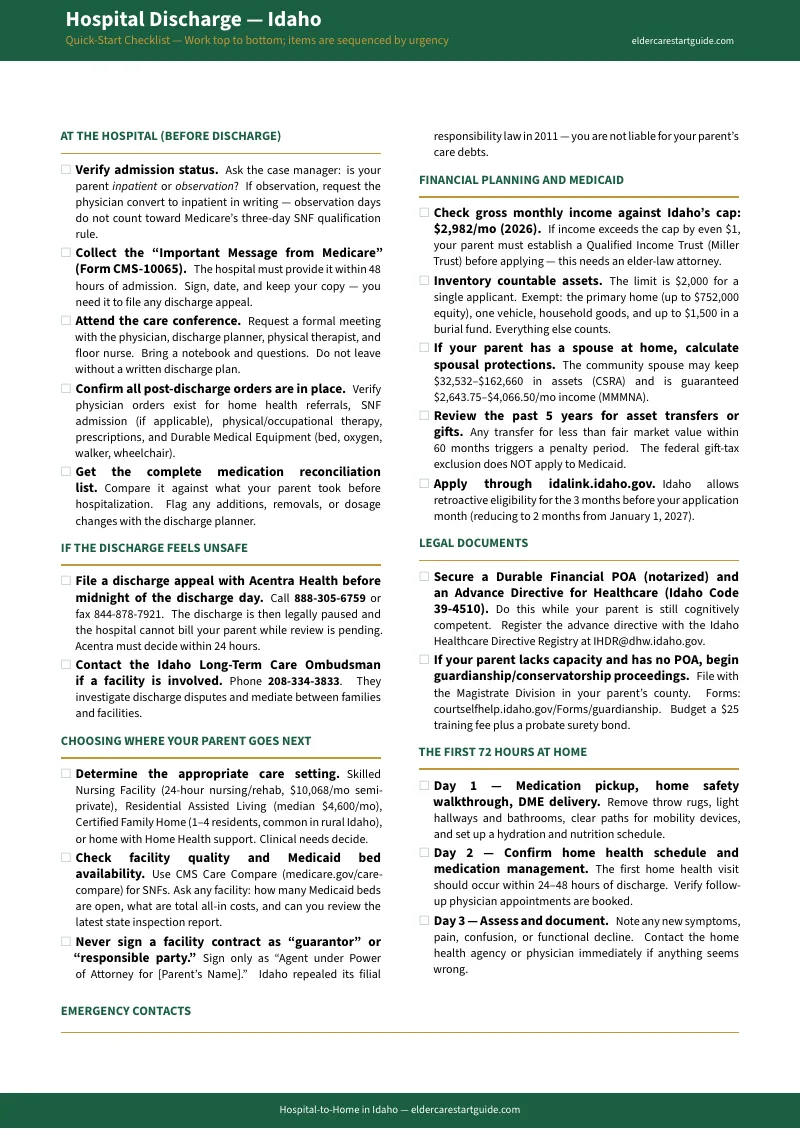
The Hospital Says Your Parent Is Ready to Leave. Are You?
Your parent was just hospitalized in Idaho — a fall, a stroke, a sudden decline. The discharge planner says they're leaving tomorrow. Maybe the day after. And suddenly you're the one who has to figure out what happens next.
Where do they go? Will Medicare cover rehab? What's observation status, and why does the nurse keep mentioning it? Can the hospital really send them home when nobody's set up the house? What if they need a nursing home — how do you even begin to pay for that?
Hospital social workers are helpful but stretched thin, and they're legally prohibited from recommending specific facilities or managing your family's financial planning. State portals give you regulatory definitions, not action plans. Elder law attorneys charge $300–$500 per hour. And the national "senior living advisor" sites? They're lead-generation funnels that route your phone number to paid placement services.
The Idaho Discharge Navigation System
This toolkit replaces the panic with a step-by-step system built specifically for Idaho families. Not generic Medicare overviews. Not national directories. Idaho-specific procedures, Idaho agency contacts, Idaho Medicaid thresholds, and Idaho facility licensing rules — the kind of detail you can only get from an elder law attorney's office or weeks of calling around.
It's built for the adult child who just became the family's care coordinator overnight — whether you're in Boise, out in Clearwater County, or managing everything from another state.
What's Inside
Discharge Rights and Appeal Scripts
The exact process to challenge an unsafe discharge through Acentra Health (Idaho's Medicare Quality Improvement Organization), including the midnight filing deadline, the automatic stay that pauses the discharge while your appeal is reviewed, and the word-for-word scripts for care conferences with hospital staff. You don't have to accept a discharge plan you believe is dangerous.
The Observation Status Trap — and How to Escape It
If your parent spent three nights in a hospital bed but was classified as "observation" rather than "inpatient," Medicare won't cover a single day of skilled nursing rehab. With Idaho SNF costs averaging over $10,000 per month, this classification can turn a recovery into a financial emergency. This section explains how to verify status, request conversion, and file the right appeal before you lose coverage.
Idaho Care Placement Comparison
A clear breakdown of every post-hospital option: Skilled Nursing Facilities, Residential Assisted Living Facilities (RALFs under IDAPA 16.03.22), Certified Family Homes (CFHs under IDAPA 16.03.19 — small family-style settings for 1–4 residents, vital in rural Idaho), and home health agencies (operating solely under federal CMS certification since Idaho's 2025 Streamlined Facilities Licensing Act). Costs, licensing, what each covers, and how to choose.
Idaho Medicaid Eligibility Workbook
Idaho is an income-cap state with a hard eligibility cliff at $2,982/month. Exceed it by a dollar and you're denied — unless you establish a Miller Trust (Qualified Income Trust). This section walks you through the income test, the $2,000 asset limit, exempt vs. countable resources, spousal impoverishment protections (CSRA up to $162,660, MMMNA up to $4,066.50/month), the five-year look-back, and transfer penalty calculations using Idaho's daily divisor of $363.37.
UAI Preparation Worksheet
The Uniform Assessment Instrument determines whether your parent qualifies for Medicaid long-term care. Most families fail this assessment because they describe their parent on a good day. This fillable worksheet helps you document activities of daily living, mobility limitations, and cognitive function the way the Regional Medicaid Services reviewer needs to see them — on the worst days, not the best.
Facility Admission Contract Protection
Nursing homes and assisted living facilities routinely pressure families to sign admission agreements as a "responsible party" or "guarantor." If you sign in your personal capacity, you may be assuming personal liability for care costs exceeding $10,000 per month. This section shows you exactly how to sign as an agent under Power of Attorney — and reminds you that Idaho repealed its filial responsibility law in 2011 (SB 1043), meaning you cannot be held civilly liable for your parent's care debts.
Idaho Resource Directory
Every contact you'll need: all six regional Area Agencies on Aging with direct phone numbers and counties served, the Idaho Long-Term Care Ombudsman, Idaho 211 CareLine, the DHW Financial Recovery Office, the Idaho Healthcare Directive Registry, and Acentra Health's appeal line. Plus local DME provider information for Norco Medical's Idaho branch network.
First 72 Hours at Home Survival Guide
The highest-risk window for medication errors, falls, and readmission. A day-by-day checklist covering prescription pickup and verification, home safety modifications, DME delivery confirmation, follow-up appointment scheduling, and when to call for emergency help.
Who This Is For
- Adult children in Idaho managing a parent's hospital discharge — first time or fifth time, the system is equally overwhelming
- Out-of-state family members coordinating care remotely for a parent in Boise, Idaho Falls, Coeur d'Alene, Twin Falls, Pocatello, or rural Idaho
- Longtime caregivers facing a new crisis that changed the level of care your parent needs
- Families approaching Medicaid who need to understand Idaho's income cap, Miller Trust requirement, and asset rules before savings run out
Why Free Tools Don't Cover This
National sites like A Place for Mom and Caring.com maintain comprehensive facility directories — but their business model depends on routing you to phone sales advisors who earn commissions from facility placements. They won't tell you how to file a Medicare appeal, prepare for the UAI assessment, or avoid signing as a financial guarantor.
Medicare.gov and AARP explain federal discharge rights accurately — in abstract, non-actionable language that never connects to Acentra Health's Idaho phone number, your regional AAA, or the specific Medicaid thresholds that apply in Idaho.
Idaho's state portals (DHW, Idaho Commission on Aging) contain detailed regulatory information — fragmented across dozens of pages written in bureaucratic language that is nearly impossible to parse when you're sitting in a hospital hallway deciding where your parent will sleep tomorrow night.
This toolkit connects those fragmented pieces into a single action plan with the Idaho-specific details filled in.
Satisfaction Guarantee
If the toolkit doesn't give you the clarity and confidence you need to manage your parent's transition, email us for a full refund. No forms, no hoops, no time limit.
— Less Than a Single Hour of Professional Help
An Idaho elder law attorney charges $300–$500 per hour. A geriatric care manager runs $150–$250 per hour. Guardianship proceedings cost $5,000–$10,000. This toolkit handles the procedural and administrative work you can do yourself — and tells you exactly when it's time to bring in a professional.
Download the free Idaho Hospital Discharge Checklist to start, or get the complete toolkit with the full guide, worksheets, scripts, and Idaho resource directory.