
Your Parent Needs Long-Term Care in Hawaii. The Bills Are Devastating. The Rules Are Invisible.
You just found out that Medicare doesn't cover custodial care. Your parent's nursing home is charging $14,000 to $18,000 per month. At that rate, the family savings — the retirement account, the home equity, everything — will be gone in under two years.
You've tried reading the Med-QUEST website. You've called the eligibility office and gotten voicemail. You've searched online and found ten contradictory answers about income limits, asset tests, and something called a "lookback period" that apparently means the birthday money your mom gave your kids three years ago could disqualify her from help.
Meanwhile, the discharge planner is asking where your parent is going next week.
The Med-QUEST Navigation System — Every Hawaii Rule in One Place
The Hawaii Medicaid Long-Term Care & Asset Protection Guide is a 48-page diagnostic roadmap that replaces scattered research with a single, step-by-step system built entirely around Hawaii's Med-QUEST rules. Not federal guidelines. Not generic "Medicaid tips." Hawaii — where there's no Miller Trust requirement, where estate recovery only touches probate assets, and where Community Care Foster Family Homes can cut care costs by 75% compared to a nursing home.
This isn't a pamphlet that tells you to "consult an attorney." It's the preparation tool that helps you understand what applies to your family, organize the paperwork, and either apply on your own or walk into an elder law meeting with a clean file — saving hours of billable time.
What's Inside the Guide
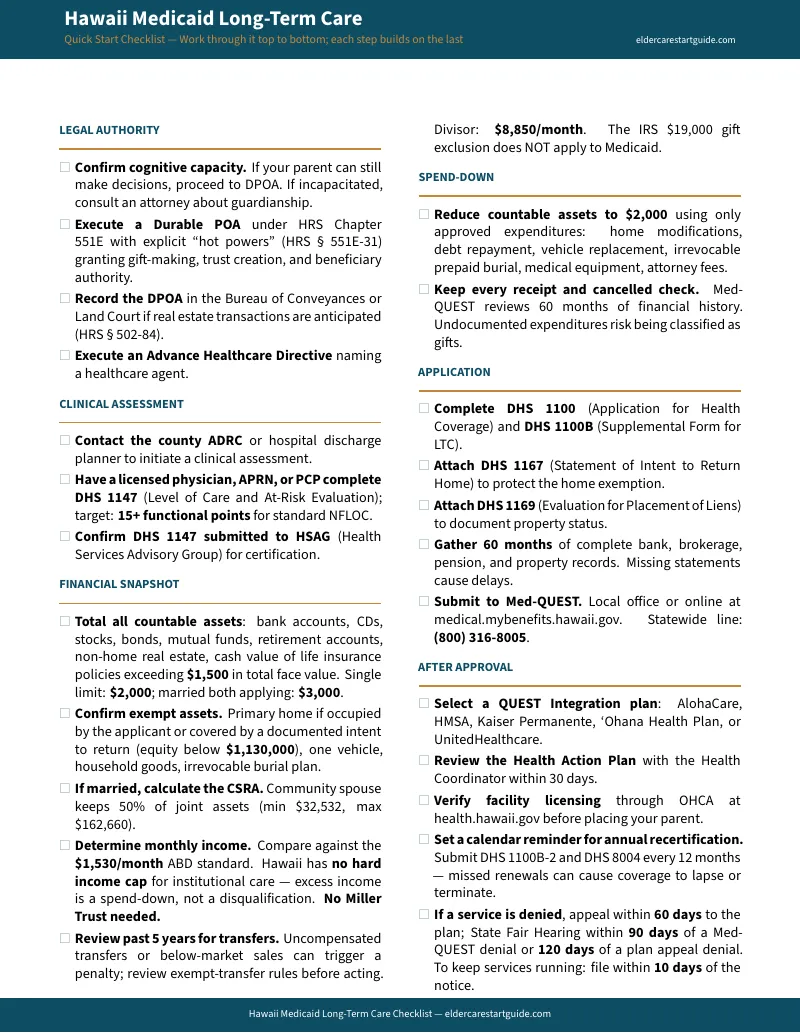
- The Med-QUEST eligibility breakdown — Hawaii uses a $2,000 asset limit and a medically needy spend-down for income, which means no hard income cap and no Qualified Income Trust. The guide maps exactly what counts as a "countable asset" and what's exempt, with Hawaii's specific exemption amounts.
- The 60-month lookback explained without legal jargon — every transfer your parent made in the last five years will be reviewed. The guide identifies which transfers trigger penalties, how Hawaii calculates the penalty period using its own divisor, and the narrow circumstances under which a penalty can be cured. It flags the mistakes families make without realizing it — adding a child to a bank account, gifting money at weddings, selling property to a family member below market value.
- Spousal impoverishment protections — if your parent has a spouse still living at home, that spouse has rights. The guide calculates the Community Spouse Resource Allowance (CSRA) using Hawaii's 50% formula, explains the Minimum Monthly Maintenance Needs Allowance (MMMNA) income floor, and shows how to protect the home's equity up to Hawaii's $1,130,000 exemption.
- Legal spend-down strategies that won't trigger penalties — home modifications (grab bars, wheelchair ramps, termite repair), replacing an unreliable vehicle, prepaying household debts, converting cash into an irrevocable funeral trust, and structuring a personal care agreement with a family caregiver at documented market rates.
- The probate-only estate recovery shield — Hawaii's MERP program can only recover from assets that pass through probate court. The guide explains how joint tenancy, living trusts, and named beneficiaries keep the family home outside MERP's reach — and why this distinction matters more in Hawaii than almost anywhere else, given that median home values on Oahu exceed $800,000.
- Care setting options and real costs — nursing homes are not the only option. QUEST Integration health plans fund Community Care Foster Family Homes ($2,800–$4,900/month versus $14,000+ for a nursing home), Expanded Adult Residential Care Homes (E-ARCH), adult day health programs, and personal assistance at home. The guide explains how to work with your parent's managed care plan to access each setting.
- The complete application process — from the DHS 1147 clinical level-of-care evaluation to filing through mybenefits.hawaii.gov, with document checklists, timeline expectations, and what to do when the eligibility office asks for information you don't have.
- Contact directory — every county ADRC, Med-QUEST eligibility offices, managed care plan contacts, and the fair hearing appeals process with the 90-day filing deadline.
Who This Is For
- Adult children whose parent just entered a nursing home and the family is paying $14,000–$18,000 per month with no coverage
- Caregivers whose parent is turning 65 and about to lose MAGI-based Med-QUEST coverage — suddenly facing an asset test that didn't exist before
- Families patching together Kupuna Care and private-pay home aides who need a sustainable long-term funding plan
- Spouses terrified of losing the family home to care costs or post-death state recovery
- Anyone who made financial transfers in the last five years and needs to understand whether the lookback period applies
Why Free Online Resources Fall Short
State agency websites explain what Med-QUEST is but never explain how to qualify strategically. They list the $2,000 asset limit but don't tell you which assets are exempt, how to spend down legally, or what transfers from the last five years will create a penalty period that leaves your parent uncovered during a medical crisis.
National senior care sites publish generic Medicaid guides that routinely get Hawaii's rules wrong — advising Miller Trusts that Hawaii doesn't require, citing income caps that don't exist here, and missing Hawaii's probate-only estate recovery rule that makes home protection far more achievable than in most states.
Elder law attorneys provide excellent customized counsel — but initial consultations run $300 to $600 per hour, and Medicaid planning retainers range from $3,000 to $15,000. For families with straightforward finances, that's money spent on answers this guide already provides. For families with complex situations, the guide gets your records organized so attorney time is spent on strategy, not on sorting through your paperwork.
Satisfaction Guarantee
If the guide doesn't help you understand your family's Med-QUEST options, email us and we'll refund your purchase. No forms, no hassle.
Get Started Now
Download the free Med-QUEST eligibility checklist to see the document audit framework, or get the full guide for the complete system — spend-down strategies, spousal protections, estate recovery planning, and the step-by-step application process.
Every month without a plan is another $14,000 to $18,000 in private-pay costs that could have been covered. The rules are complicated, but they're knowable — and knowing them is the first step to protecting your family.