
Your Parent Needs Help at Home. Hawaii Has Programs That Pay for It — If You Know Where to Apply.
Your parent fell again. Or maybe the meals went from homemade to takeout containers piling up in the fridge. Maybe the neighbor called to say your mom was wandering the yard at midnight. However you got here, you are now the person trying to figure out how to keep a parent safe at home in one of the most expensive places to live in the country.
You searched "home care Hawaii" and discovered that private aides charge $25 to $45 per hour — over $5,000 a month for regular daytime help. Nursing homes run $11,500 to $13,000 monthly. But somebody mentioned Kupuna Care and something called Med-QUEST, and now you are buried in state agency websites written in bureaucratic language that assumes you already know the difference between a 1115 waiver and an ADRC intake screen.
The Hawaii Home Care Navigation System
This is not a list of eligibility rules you can find on the Med-QUEST website. It is the process around the rules — the part that $300-to-$500-per-hour elder law attorneys explain in billable consultations and that county ADRC staff never have time to walk you through on a single phone call.
The guide covers every step from the first crisis call to securing publicly funded home care: understanding why Hawaii delivers all Medicaid home services through managed care organizations instead of traditional waiver programs, preparing for the DHS Form 1147 clinical assessment that gates access to every major benefit, qualifying financially under Med-QUEST's strict income and asset limits, protecting the family home from estate recovery, establishing legal authority before capacity declines further, and connecting with Kupuna Care when Medicaid is not the right fit.
Hawaii has a structural reality most families never learn about: the state does not use traditional 1915(c) HCBS waivers for aging adults. Everything runs through QUEST Integration, a managed care model where one health plan coordinates personal care, adult day health, respite, home modifications, and emergency response systems under a single service coordinator. That simplifies the process once you are enrolled — but the enrollment itself requires navigating a clinical scoring system, a financial qualification test, and a five-plan selection decision that nobody explains in one place.
What's Inside
- Crisis Response Protocol — Your parent is coming home from the hospital and someone said "arrange care." This section tells you exactly who to call (your county ADRC), what to bring to the intake screening, how to start a Med-QUEST application through the KOLEA benefits portal, and what emergency services the managed care plans authorize while the full assessment is pending.
- Kupuna Care and the Kupuna Caregivers Program — The state-funded safety net for seniors who do not qualify for Medicaid. Eligibility rules (age 60+, Hawaii resident, functional impairments in at least 2 ADLs or IADLs), the 2022 programmatic merger that pooled funding between the two programs, county-by-county waitlist realities, and the prioritization scoring that determines who gets served first.
- The DHS 1147 Assessment Decoded — The state's official clinical scorecard that determines whether your parent qualifies for QUEST Integration long-term services. The guide breaks down exactly how physical limitations and cognitive status are scored, what the 5-point "at-risk" threshold means versus full nursing facility level of care, and how to prepare your parent's medical documentation so the evaluator sees the full picture of their actual daily limitations — not just the good day they happen to have during the assessment.
- Med-QUEST Financial Qualification — The complete 2026 thresholds in plain language: $1,530 monthly income limit, $2,000 countable asset limit, what counts and what is exempt (the home, one vehicle, personal belongings, prepaid burial plans). The medically needy spend-down pathway for families over the limits, legitimate deductions that reduce countable income, and the 60-month look-back period that can trigger penalties on transfers you made years ago.
- Spousal Protections and Estate Recovery — When one spouse needs Med-QUEST for long-term care, the Community Spouse Resource Allowance protects up to $162,660 in joint assets. The Minimum Monthly Maintenance Needs Allowance shields a portion of monthly income. The guide walks through the home equity exemption ($1,130,000 threshold), the estate recovery rules that can reach probate assets after death, and the ownership structures that pass outside probate and are protected.
- Legal Authority Before It Is Too Late — Hawaii's Uniform Power of Attorney Act (HRS Chapter 551E) requires specific statutory language that generic mainland templates miss. The guide explains what banks and medical networks actually require to accept a Durable Power of Attorney in Hawaii, how to verify that the gifting powers are broad enough for Medicaid asset transfers, and what happens if you wait too long and need to petition for guardianship or conservatorship under the Kokua Kanawai act.
- Consumer-Directed Care — Getting Paid as a Family Caregiver — Two pathways exist. QUEST Integration's Consumer-Directed Personal Care option lets Medicaid-eligible recipients hire family members as paid providers through their managed care plan. The Kupuna Caregivers Program provides up to $210 per week in services, but requires the caregiver to work at least 30 hours per week outside the home. Both programs' enrollment steps, requirements, and limitations are covered.
- Choosing and Managing Home Care Providers — The licensing split between clinical home health agencies (HAR Title 11, Chapter 97.1) and non-medical home care agencies (HAR Title 11, Chapter 700), the Act 091 waiver for Medicaid-only providers, how to verify credentials through the Department of Health's OHCA directory versus the managed care plan, and your options when the care provider shortage on neighbor islands means there are two agencies to choose from instead of twenty.
- Community Resources and Support Services — Adult day care and adult day health programs (average $75 to $110 per day), Lanakila Meals on Wheels on Oahu, respite care limits under Med-QUEST (up to 760 hours annually, no single episode exceeding 14 days), home modification funding through QUEST Integration's Environmental Accessibility Adaptations, the Handi-Van paratransit system, personal emergency response system coverage, and the Hawaii Assistive Technology Resource Center.
Plus: Printable Checklist and 7 Planning Worksheets
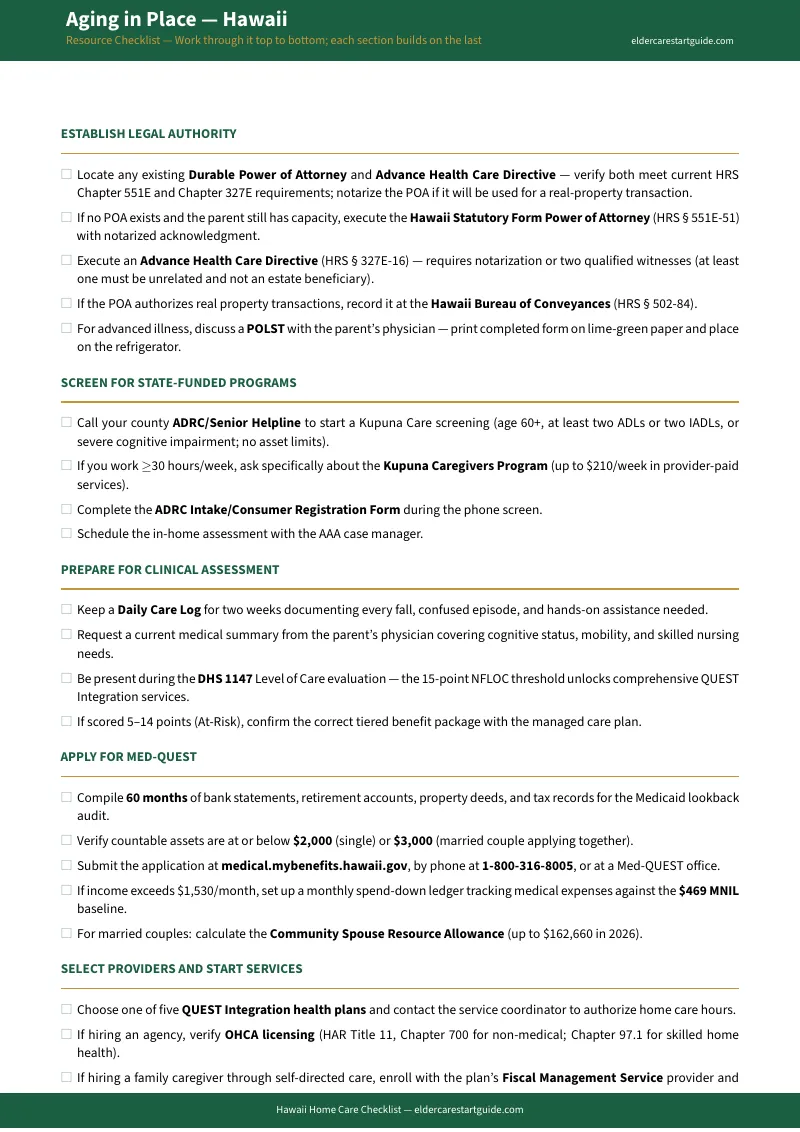
- Hawaii Aging in Place Resource Checklist — A 25-item action list organized by priority: legal authority steps, ADRC intake, Med-QUEST application, DHS 1147 assessment preparation, home safety audit, community resources, and emergency contacts.
- Daily Care Log — Record two weeks of falls, confused episodes, and hands-on assistance before the DHS 1147 assessment so the evaluator sees the full pattern, not just a single visit.
- Spend-Down Tracking Worksheet — Track monthly medical expenses against the $469 MNIL to maintain Med-QUEST eligibility each month. Submit with receipts to your eligibility worker.
- Asset Inventory Worksheet — Separate countable assets from exempt assets before the Med-QUEST application, with Hawaii's $2,000 limit, $1,130,000 home equity threshold, and spousal protections.
- Agency Communication Log — Document every call with ADRC intake specialists, MCO service coordinators, HSAG reviewers, and Med-QUEST eligibility workers. Your evidence trail for appeals.
- Family Care Coordination Worksheet — Distribute caregiving tasks, schedules, and financial contributions among family members. Replace emotional arguments with documented agreements.
- Legal Document Checklist — Audit your parent's Power of Attorney, advance directive, and POLST against Hawaii's current HRS Chapter 551E and Chapter 327E requirements.
- Provider Vetting Checklist — Evaluate home care agencies against OHCA licensing, insurance, background check, and service capability standards before signing a contract.
Who This Is For
- Adult children whose parent can no longer manage daily life safely at home in Hawaii and someone needs to figure out how to pay for care that costs over $60,000 a year
- Families trying to qualify a parent for Med-QUEST home services but who do not understand how the DHS 1147 clinical scoring determines whether services are approved — or how to document limitations accurately
- Caregivers who want to get paid through Consumer-Directed Personal Care or the Kupuna Caregivers Program but do not know the eligibility requirements or enrollment process
- Mainland children coordinating Hawaii care remotely — paralyzed by long-distance guilt and unable to attend ADRC intake appointments, but needing to establish legal authority and manage applications across state lines
- Families terrified that Med-QUEST will take the family home through estate recovery — and who need to understand what the program actually reaches versus what is protected
- Proactive planners who see cognitive decline starting and want to structure assets within the 60-month look-back window before a crisis forces institutional placement at over $13,000 per month
Why Not Free Government Resources?
The Med-QUEST Division publishes eligibility limits. The Executive Office on Aging maintains a website. County ADRCs answer phone calls during business hours.
Here is what none of them provide:
- A DHS 1147 assessment preparation strategy showing you how the clinical scoring actually works and how to document your parent's limitations precisely enough to clear the nursing facility level of care threshold — not just "call your ADRC and they will schedule an assessment"
- A Med-QUEST financial qualification walkthrough that explains the spend-down strategies, exempt asset categories, and 60-month look-back rules in plain language — not statutory references spread across provider memos and federal demonstration documents
- A side-by-side comparison of Kupuna Care versus Med-QUEST so you can determine which pathway fits your parent's situation without calling three different agencies to get conflicting answers
- A legal authority audit against Hawaii's Uniform Power of Attorney Act — because the generic POA template your parent signed ten years ago may be rejected by every bank and hospital on the islands
- A single document that integrates the clinical, financial, legal, and logistical steps in the order you actually need them — instead of scattering that information across four county websites, two state departments, and five managed care plan portals
Government sites publish regulations. This guide compiles fragmented county, state, and federal information into a single, sequential process you can follow from the first crisis call to stable, funded home care — without paying an elder law attorney to translate the system for you.
Your Parent's Safety Net
Every week you spend researching is a week your parent goes without the funded care they may already be entitled to. Med-QUEST applications can be filed online through the KOLEA portal tonight — but only if you know what documentation to prepare and which managed care plan to select.
Get the guide. Prepare the case. Start the clock.
Get the Hawaii Home Care Guide →
The free checklist gives you the 25-item action list to start immediately. The full guide gives you every chapter, every form reference, every spend-down strategy, the complete DHS 1147 assessment preparation framework, and 7 printable planning worksheets.