
Your Parent Qualifies for More Help Than You Think — Georgia Just Doesn't Make It Easy to Find
Every month, Social Security withholds $202.90 from your parent's check for Medicare Part B. On a fixed income of $1,300 or $1,400 a month, that deduction takes a devastating bite — before groceries, before prescriptions, before the electric bill.
Georgia will pay that premium. Under the Qualified Medicare Beneficiary program, it will also cover the Part A deductible ($1,736 per hospital stay), the Part B deductible ($283 per year), and the 20% coinsurance on every doctor visit. But the state has made the process nearly impossible to navigate alone: Georgia Gateway crashes mid-application, the DFCS phone system hangs up when you ask for a human, 159 county offices each handle things differently, and after approval there is a weeks-long limbo where premiums keep coming out of your parent's check anyway.
Most families never apply because they compare their parent's gross Social Security to the published limits and assume they earn too much. That comparison is wrong — Georgia applies a mandatory $20 income disregard that changes the math for thousands of households.
The Georgia Medicare Cost Relief System
This is not a general Medicare overview or a collection of government links. The Georgia Medicare Savings Programs & Extra Help Guide is a step-by-step filing and tracking system built around how Georgia actually administers these programs — through county DFCS offices, the Georgia Gateway portal, and the MMIS buy-in pipeline that connects Georgia Medicaid to Social Security.
It covers the complete process from screening eligibility through the income disregard calculation, completing Form 700, submitting through whichever channel actually works for your county, tracking the post-approval buy-in timeline, stopping illegal medical bills, and protecting benefits at renewal. Everything is organized by the order families encounter each step — not by bureaucratic category.
What's Inside the Guide
- Income disregard worksheets with worked examples — see exactly how the $20 general disregard applies to your parent's Social Security, pension, and other income. Three real scenarios (QMB, SLMB, QI) show the calculation step by step, so you know whether to apply before you fight the phone tree
- Georgia Gateway workaround routes — the portal at gateway.ga.gov crashes, locks out accounts, and loses case links. The guide covers login recovery, when to abandon the portal entirely, and how to switch to paper Form 700 or an in-person DFCS visit without restarting the process
- Form 700 field-by-field walkthrough — which sections matter for Medicare Savings Programs specifically, how to document income correctly so the disregard is applied, and how to designate yourself as your parent's authorized representative using Form 954/700
- Post-approval buy-in tracker — after DFCS approves your parent, it takes 30 to 60 days for the MMIS buy-in to process through CMS and reach Social Security. During that window, the $202.90 keeps coming out. The tracker logs each month's deduction and tells you when to call, who to call, and what to ask for if the refund is late
- QMB billing protection letters — under federal law, providers cannot bill QMB enrollees for Medicare deductibles or coinsurance. But automated billing systems send those invoices anyway. The guide includes a formal non-billing notice citing Section 1902(n) and 42 CFR 447.15 that you can send to any provider's billing department
- Renewal and appeal playbook — the annual redetermination process, the 90-day reinstatement window after a paperwork closure, the Form 508 fair hearing request, and the critical deadline to file that keeps benefits running while the appeal is decided
- Part A buy-in instructions — for parents who lack premium-free Part A, Georgia's buy-in status allows conditional enrollment at any time of year. The guide covers the SSA field office visit, the conditional filing statement, and how DFCS coordinates the enrollment
- Extra Help (Part D LIS) auto-enrollment — all three main programs trigger automatic Full Extra Help for Part D prescriptions, cutting drug costs to $5.10 per generic and $12.65 per brand-name. The guide explains what to expect from your parent's Part D plan after MSP approval
Who This Guide Is For
- Adult children managing a parent's Medicare costs — especially if you live out of state and need to handle Georgia DFCS paperwork remotely. The authorized representative section covers Form 954/700 and how to file on your parent's behalf without visiting a county office
- Seniors on a fixed income who are tired of watching $202.90 disappear from their Social Security check every month and want to know if Georgia will cover it
- Families who got a renewal notice or denial and need to respond before benefits get cut off — or who need to file a fair hearing to keep benefits running during the appeal
- Anyone who checked the limits and assumed their parent earns too much — the income disregard worksheets will show you the real number DFCS uses
What This Guide Is Not
This is not insurance advice. The guide does not recommend any Medicare Advantage plan, Part D plan, Medigap policy, or insurance broker. It does not sell leads to insurance agents. For plan-choice counseling, it directs you to GeorgiaCares (1-866-552-4464) — Georgia's free, unbiased state counseling program run by the Division of Aging Services.
This is not legal representation. If your parent faces a complex Medicaid spend-down, an asset trust situation, or needs someone to represent them at a state hearing, the guide directs you to Georgia Legal Services Program and Atlanta Legal Aid Society.
This is process navigation — the organized, step-by-step system that sits between "I think my parent might qualify" and "the premium stopped coming out of their check."
The Free Checklist vs. the Full Guide
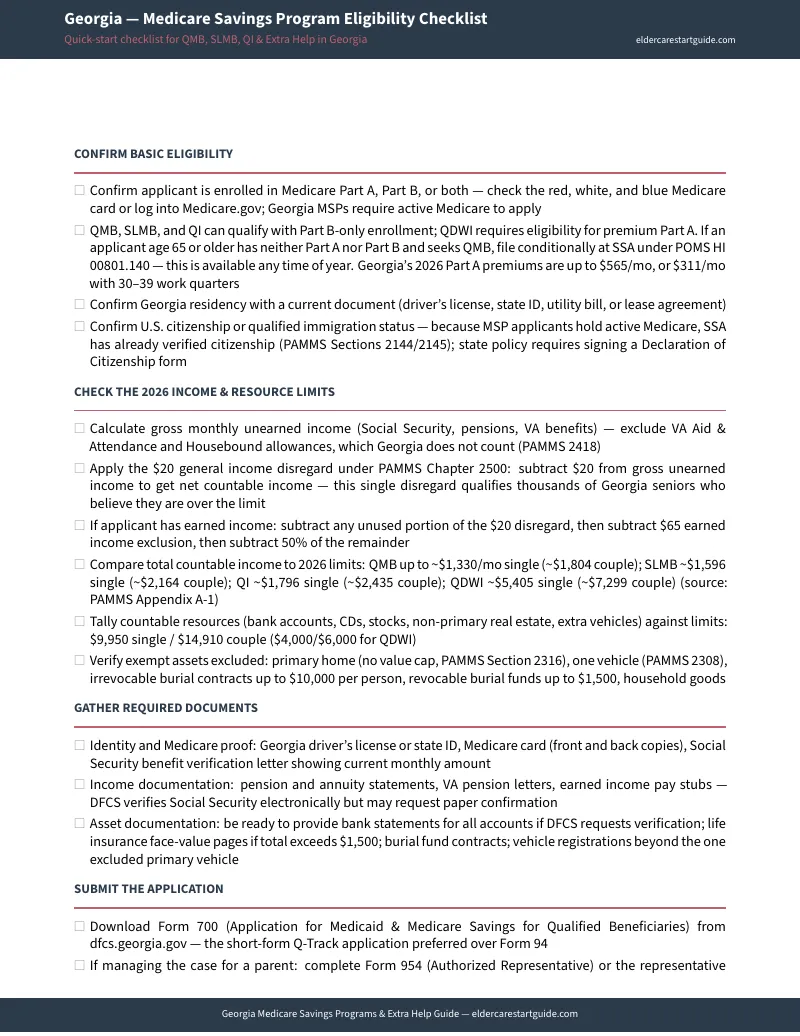
The free Georgia — Medicare Savings Program Eligibility Checklist tells you whether your parent likely qualifies — it has the 2026 income and asset limits, the basic document list, and the key phone numbers. It is a screening tool.
The full guide tells you how — how to calculate the real countable income, which form to submit and through which channel, how to navigate Georgia Gateway when it breaks, how to track the buy-in, how to dispute an illegal medical bill, and how to fight a denial or renewal termination. The checklist gets you to "probably yes." The guide gets you to "premium stopped, refund deposited, protections in place."
Get the Georgia Medicare Savings Programs & Extra Help Guide →
Your Parent's Coverage Is Protected
If the guide does not help your family, email [email protected] for a full refund, no time limit. Every purchase is a one-time download — no subscription, no recurring charges, no upsell calls.
Frequently Asked Questions
What if the rules change after I buy?
We update the guide when the rules change. Email us any time, even years later, and we'll send you the current edition free.