
Your parent can't stay alone anymore. Georgia's care system doesn't come with a map.
The hospital says your parent is "unsafe to return home." A social worker hands you a printout of local facilities. Your siblings are arguing about what's best. And every website you check is either a referral broker earning commission on your decision or a government portal written for caseworkers, not families.
Meanwhile, the clock is ticking. Discharge planners want an answer in 48 hours. The wrong choice means paying out of pocket for a setting your parent doesn't need — or placing them somewhere that can't legally provide the care they do need.
The Georgia Care Transition System
This isn't a pamphlet. It's a structured decision framework built on Georgia's actual licensing rules, 2026 cost data, and state waiver programs — the same information elder-law attorneys charge hundreds per hour to explain.
The Georgia Care Transition System walks you through three things most families get wrong:
- Choosing the right care level — Georgia draws legal lines between Personal Care Homes, Assisted Living Communities, and Skilled Nursing Facilities that determine what care your parent can legally receive. The license type, not the facility's marketing, is what matters.
- Paying for care without going broke — the CCSP and SOURCE waivers can fund home and community-based care, but most families don't know they exist until the money runs out. The guide maps the eligibility rules, the cost-share formula, and the application sequence.
- Protecting the family home — Georgia is a probate-only estate recovery state. That means Transfer-on-Death deeds and Lady Bird deeds (authorized July 2024) can shield the home from Medicaid recovery without triggering the 60-month look-back. The guide explains when these tools are enough and when you need an attorney.
What's inside the guide
- Care setting comparison with 2026 Georgia costs — statewide medians and metro Atlanta ranges for home care, adult day health, assisted living, memory care, and nursing home care, plus the tipping point where home care costs more than residential placement
- CCSP and SOURCE waiver walkthrough — income limits, asset caps, the monthly cost-share calculation, and how to start the application through your Area Agency on Aging
- Structured Family Caregiving enrollment — step-by-step instructions for qualifying for the tax-free daily stipend, including who's excluded and the residency and employment rules
- GaMap2Care facility audit system — how to pull state inspection surveys, check complaint histories, and evaluate staffing data before you visit a single facility
- Georgia legal document execution guide — the exact witnessing, notarization, and signing requirements for the Statutory Financial Power of Attorney and Advance Directive for Healthcare
- Asset protection roadmap — Transfer-on-Death deeds, Lady Bird deeds, the probate-only rule, the $25,000 estate recovery exemption, and the creditor priority hierarchy
- Medicare rehabilitation cliff calculator — a worked example showing exactly when Medicare coverage ends after a skilled nursing stay and why the Medicaid application needs to start during week one
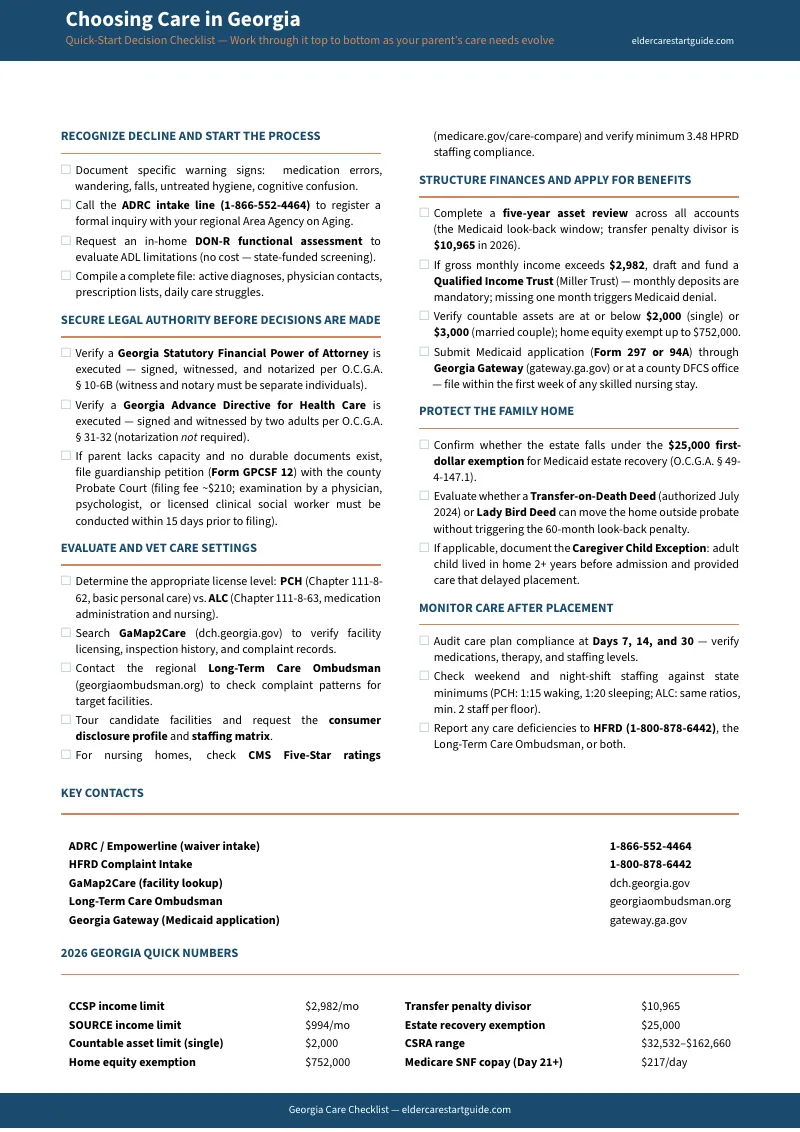
- Decision checklists and facility tour worksheets — structured tools for comparing facilities, documenting inspection findings, and organizing legal and financial documents
Who this is for
- Adult children choosing between home care, assisted living, and nursing home care for a parent in Georgia
- Families managing a hospital discharge and facing a placement decision under time pressure
- Caregivers applying for CCSP or SOURCE waiver benefits for the first time
- Families who need to protect a parent's home from Medicaid estate recovery but aren't sure whether they need a full estate plan or a simpler transfer mechanism
Why free resources aren't enough
"Free" referral services like A Place for Mom and Caring.com are placement brokers. They're paid by the facilities they recommend — commissions that typically run 50% to over 100% of your parent's first month's rent. They only show you their paying partners, which means smaller, non-profit, and independent care homes don't make the list. And they don't cross-reference state inspection records or active DCH complaints.
State agencies — DCH, the Division of Aging Services, Empowerline — provide accurate information, but it's scattered across a dozen portals and written in regulatory language. They explain their own rules but don't help you connect the financial, legal, and clinical decisions into a coherent plan. And they can't give you legal guidance on asset protection strategies.
This guide is neutral. It doesn't accept referral commissions. It doesn't steer you toward any facility network. It gives you the same framework an elder-law attorney would walk you through — the state-specific licensing rules, the waiver programs, the asset protection tools, the facility evaluation databases — organized as a step-by-step system you can follow on your own timeline.
What you get
Your download includes 8 PDFs: the complete 12-chapter guide, a portable decision checklist, and six standalone worksheets — a care level decision matrix, a five-year asset review for the Medicaid look-back, a facility tour comparison chart, a post-placement care audit form, an agency communication log, and a Medicaid application document checklist. Print the worksheets and bring them to facility tours, attorney meetings, and DFCS appointments.
Get the Georgia Care Decision Guide →
The free checklist gives you the decision framework. The full guide gives you the data, the procedures, and the tools to execute each step — from the initial care assessment through waiver applications, facility inspections, and legal document preparation.
Satisfaction guarantee
If the guide doesn't help you make a more informed care decision, email us and we'll refund your purchase. No forms, no hoops.