
D.C. Is a "Probate-Only" Recovery State — Most Families Don't Know What That Means Until It's Too Late
Your parent needs long-term care. Nursing homes in the District of Columbia cost $13,500 to $15,000 a month. Assisted living runs about $7,000. You've already discovered that Medicare stops paying after 100 days of skilled care — and private pay will drain a $200,000 nest egg in barely over a year. Medicaid is the answer, but the District scatters its system across three separate agencies, nobody explains the income rules clearly, and you can't tell whether your parent even qualifies.
Here's what makes D.C.'s system uniquely tricky — and uniquely protective: the individual asset limit is just $4,000 (one of the tightest in the country), but the District doesn't use Qualified Income Trusts. If your parent's income exceeds $2,982/month, there's no hard cutoff — they qualify through a Medically Needy Spend-Down instead. And because D.C. is a probate-only estate recovery jurisdiction, assets that pass outside of probate (joint accounts, transfer-on-death deeds, revocable trusts) are completely shielded from recovery after death. National guides don't mention these rules. Following their advice in D.C. means either setting up legal instruments the District doesn't use, or missing protections that could save the family home.
The D.C. Medicaid Navigation System
This guide maps the entire financial, clinical, and legal pathway through the District of Columbia's Medicaid long-term care system — from the first call to DACL's Aging and Disability Resource Center through Liberty Healthcare's clinical assessment, DHS financial eligibility, and DHCF coverage activation. It's built specifically around D.C.'s municipal framework, not a federal template with your jurisdiction's name swapped in.
What sets this apart from government brochures or law firm blog posts: it connects the steps that D.C.'s multi-agency system treats as separate processes. Your parent's financial eligibility (DHS), clinical assessment (DACL/Liberty Healthcare), asset restructuring, and spousal protections all interact — and timing one wrong can trigger a transfer penalty or leave the community spouse financially exposed. The guide shows you how these pieces fit together so you can sequence decisions correctly.
What's Inside
- Income & Asset Eligibility Calculator — walks you through the two-part test with 2026 numbers ($2,982 income cap, $4,000 asset limit) so you know exactly where your parent stands before contacting any agency
- Medically Needy Spend-Down Worksheet — D.C. doesn't use Miller Trusts or Qualified Income Trusts: if your parent's income exceeds $2,982/month, this worksheet calculates the monthly deductible against the $856.90 Medically Needy Income Level and shows how the 6-month budget period works
- Spend-Down Strategy Planner — District-approved methods for converting countable assets to exempt ones (home modifications, irrevocable funeral contracts up to $10,000, vehicle purchase, debt payoff) with documentation requirements for DHS caseworker review
- Spousal Protection Calculator — calculates the Community Spouse Resource Allowance ($32,532–$162,660) and the Community Maintenance Needs Allowance (up to $4,066.50/month) so the healthy spouse keeps enough to live on
- Five-Year Lookback Audit — maps every gift, transfer, or below-market sale from the past 60 months and calculates the penalty period using D.C.'s $12,883/month private-pay divisor
- EPD Waiver Application Guide — step-by-step instructions for the Elderly and Persons with Physical Disabilities waiver, including how to prepare for the Liberty Healthcare face-to-face assessment and document ADL limitations
- Probate-Only Estate Recovery Worksheet — maps which of your parent's assets currently pass through probate (exposed) versus outside probate (protected), and shows exactly how to restructure ownership using joint tenancy, TOD designations, and revocable trusts to shield the family home
- DACL Intake Preparation Script — what to say and what documents to have ready when you call (202) 724-5626 or email [email protected] for your parent's intake assessment
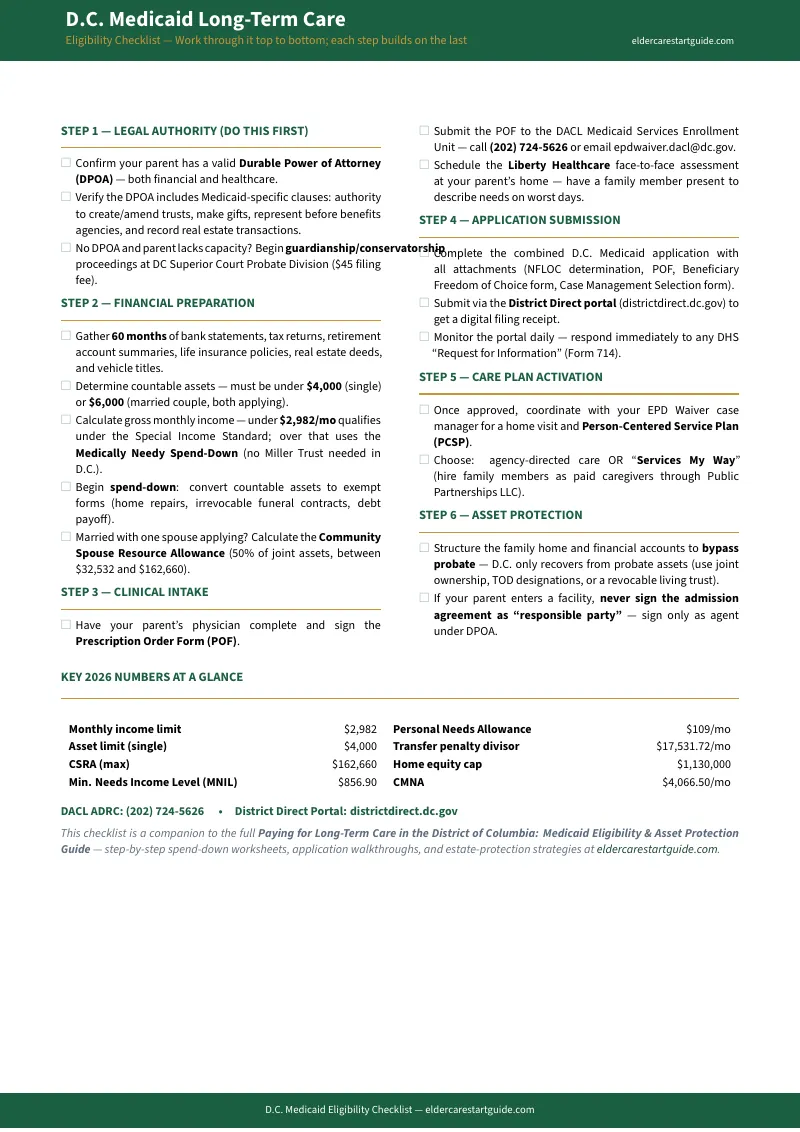
- Application Checklist — every document needed for the District Direct portal submission, organized in filing order: 5 years of bank statements, property deeds, POA copy, tax returns, and the NFLOC determination
- Legal Authority Quick-Reference — explains what your parent's Durable POA must include under the Uniform Power of Attorney Act of 2022 (D.C. Code § 21-2601.01), when guardianship becomes necessary, and how to file at D.C. Superior Court Probate Division ($45 filing fee)
Who This Is For
- Adult children facing a hospital discharge notice with 48–72 hours to find placement and no idea how to pay for it
- Families whose parent earns over $2,982/month and were told they "make too much for Medicaid" — without anyone mentioning the Medically Needy Spend-Down pathway
- Community spouses terrified of losing the family home or being left with too little income to survive
- Proactive planners whose parent has early-stage dementia and want to restructure assets before the 60-month lookback window opens
- Siblings who need a neutral reference to resolve disagreements about whether to spend down, apply for the EPD Waiver, or pursue nursing home placement
- Anyone paying $13,500+/month out of pocket who hasn't explored whether Medicaid could cover most or all of that cost
Why Free Resources Leave You Stuck
The District's three agencies — DACL, DHS, and DHCF — each publish brochures that explain what their piece of the process requires. But they don't hand you a worksheet for calculating your parent's spend-down deductible, mapping lookback penalties, or protecting the community spouse's resources. They describe eligibility. They don't sequence decisions.
National sites like A Place for Mom and Paying for Senior Care generate their D.C. pages from templates. They frequently recommend Qualified Income Trusts — a tool D.C. doesn't use. They miss the probate-only estate recovery rule that makes asset protection far simpler here than in most states. They also gloss over the EPD Waiver's enrollment cap (roughly 6,100 slots) and the fact that waiver services don't cover room and board in assisted living. Following generic advice in D.C.'s system can cost your family months of unnecessary private-pay care or miss protections that could save the house.
Elder law attorneys in the District will walk you through all of this — at $300 to $500 per hour. Using this guide to organize documents, understand the rules, and identify your parent's specific pathway before that first consultation can reduce billable hours from five to one. And for many families, the guide itself is enough to handle a straightforward application without legal fees at all.
Satisfaction Guarantee
If the guide doesn't help you identify at least one eligibility pathway, asset protection strategy, or application step you weren't already aware of, email us for a full refund. No forms, no waiting period.
Start Protecting Your Parent's Care and Assets Today
Download the free checklist to get the 20-item eligibility overview — or get the full guide for and have every worksheet, calculator, script, and template you need to navigate the District of Columbia's Medicaid system from first call to approved application.