Your parent needs more care than you can provide — and Delaware's managed care system doesn't come with a map.
The doctor said your parent can't live alone anymore. Or the hospital discharge planner is pushing a placement before the weekend. Or you've been managing home care aides for months and the arrangement is falling apart — missed medications, wandering episodes, a fall that sent everyone into crisis mode.
Now you're facing the hardest decision of your adult life: home care, assisted living, or a nursing home. And every option in Delaware costs more than the national average.
You've searched online and found two kinds of "help." The free referral services — A Place for Mom, CarePatrol, Oasis — call you within minutes, but they earn commissions from the facilities they recommend and will never mention the Medicaid programs that could fund care at home. The state agency websites — DSAAPD, DMMA, the ASSIST portal — dump regulatory language on you without telling you what to do first, second, or third.
Neither side explains the single most important thing about Delaware's system: it runs on managed care. Every Medicaid long-term care dollar flows through one of three private companies — AmeriHealth VIP Care, Delaware First Health, or Highmark Health Options Duals — and the MCO you choose determines which providers your parent can see, which facilities accept your parent's coverage, and how quickly services start. Pick the wrong one, and the agency you already hired isn't in network. Miss the enrollment window, and your parent sits without services while the paperwork resets.
The Delaware Care Decision System
The Choosing Care in Delaware Guide is a complete sequential system for navigating the state's managed care–driven elder care landscape. It translates DSHP-Plus enrollment rules, DHCQ licensing regulations, and 2026 Medicaid financial thresholds into step-by-step instructions you can follow without a lawyer, without a placement advisor, and without guessing what comes next.
This isn't a pamphlet that tells you to "explore your options." It's a working system — assessment frameworks, cost comparison worksheets, MCO evaluation criteria, facility vetting checklists, and the exact application sequence that gets your parent enrolled in the right level of care with the right managed care organization.
What's inside
The ADL Assessment Framework — because "Mom is declining" isn't a clinical determination. The guide provides the same functional assessment criteria Delaware's intake assessors use to establish nursing home level of care eligibility: bathing, dressing, toileting, transferring, eating, medication management, and cognitive orientation. Fill it in before the state assessor arrives so you can document your parent's worst days, not the good day they happen to show up on.
The Delaware Cost Comparison Engine — because knowing that assisted living "costs around $7,600 per month" doesn't tell you whether your parent should be in assisted living. The guide runs side-by-side cost scenarios across all five care settings — home care at $35/hour, adult day care at $2,193/month, assisted living at $7,600/month, memory care at $9,500/month, and nursing home at $14,494/month for a semi-private room — and shows you the exact breakpoints where one option becomes more expensive than another. It also exposes the room-and-board trap: DSHP-Plus will pay for care services in assisted living, but never for rent and meals, leaving families with thousands in out-of-pocket costs they didn't expect.
The DSHP-Plus Enrollment Playbook — because Delaware doesn't use traditional Medicaid waivers with waiting lists. The Diamond State Health Plan Plus is a managed care program, and the enrollment sequence is different from what your friend in Pennsylvania or Maryland went through. The guide walks you through DSAAPD intake, the nursing home level of care clinical assessment, MCO selection (with a comparison of AmeriHealth VIP Care, Delaware First Health, and Highmark Health Options Duals on network size, care coordination reputation, and provider coverage in your parent's county), and case manager assignment. No waiting list. No waiver application. A different pipeline entirely.
The 2026 Medicaid Financial Worksheet — because Delaware is an income-cap state, and that changes everything. If your parent's gross monthly income exceeds $2,485, they're categorically ineligible for Medicaid long-term care, no matter how high their bills are. The guide explains the $2,000 asset limit, the $752,000 home equity cap, the Community Spouse Resource Allowance (up to $162,660), the Miller Trust requirement for income over the cap, and the five-year lookback period. Fill in the worksheet to know exactly where your parent stands before the application process begins.
The DHCQ Facility Vetting Protocol — because a polished lobby doesn't mean safe care. The Division of Health Care Quality inspects every licensed nursing home and assisted living community in Delaware at least once a year, and those inspection reports are public. The guide shows you how to pull and read them, what deficiency codes actually mean, and how to identify facilities under active corrective action plans. It also explains Delaware's single-tier assisted living license and the legal care limits that determine when a facility must discharge your parent to a higher level of care.
The Memory Care Disclosure Audit — because Delaware has no separate memory care license, and any assisted living can market itself as "memory care." Title 6, Chapter 25K of the Delaware Code requires a formal Dementia Care Disclosure from any facility using the term. The guide gives you the exact questions to ask and the disclosure document to demand before you sign anything.
The Legal Authority Checklist — because without a valid Power of Attorney, banks, hospitals, and state agencies will refuse to talk to you. Delaware's POA requirements under Title 12, Chapter 49A are specific: written, dated, signed by the principal, witnessed by one adult who is not related and not an heir, and notarized. The agent must also execute a formal Agent's Certification before they have any authority. Miss any element and the document is invalid. If your parent has already lost capacity, the guide explains the Court of Chancery guardianship process — including the $125–$135 court fees, the mandatory Attorney Ad Litem, and the notice requirements to siblings.
The Medicaid Estate Recovery Map — because the family home is at risk after your parent passes. Delaware's recovery program can pursue the estate of any Medicaid recipient who received long-term care at age 55 or older. The guide explains the recovery rules, mandatory exemptions, how asset titling affects exposure, and the undue hardship waiver process.
Who it's for
- The adult child facing a hospital discharge deadline — you have days, not weeks, to find a safe placement while navigating a system you've never used. The guide gives you the decision sequence and the facility vetting protocol in one place.
- The family caregiver approaching burnout — the home care arrangement is breaking down and you need to understand DSHP-Plus services, MCO enrollment, and what a planned transition looks like before a crisis forces one.
- The sibling group that can't agree — the guide provides cost data and a structured comparison framework so the conversation moves from opinions to evidence.
- The family navigating Medicaid for the first time — your parent's savings are running out and you need to understand income caps, Miller Trusts, asset limits, and the managed care enrollment pipeline.
- The long-distance adult child — your parent lives in Delaware's Sussex County retirement corridor or the Wilmington suburbs and you're coordinating from Philadelphia, Baltimore, or DC. The guide maps every agency, intake number, and facility inspection portal so you can manage remotely.
Why free resources aren't enough
The Delaware ADRC and DSAAPD websites provide legitimate public information — but they're designed for program administration, not family crisis navigation. The ASSIST portal combines Medicaid, SNAP, LIHEAP, and child care applications into one dense interface. It doesn't tell you how to calculate a spousal asset spend-down, how to evaluate which MCO matches your parent's provider network, or what questions to ask before signing an assisted living admission agreement.
The elder law firms in Wilmington, Dover, and Rehoboth provide expert guidance — at $400–$475 per hour, with comprehensive Medicaid planning packages running $5,000–$12,000. For families who need legal asset protection strategies, those fees are justified. But for families who need to understand the system first — what care settings exist, what they cost, how DSHP-Plus works, what the clinical and financial eligibility criteria are — spending $400 an hour to get oriented is the wrong tool for the job.
The guide covers the ground between free government portals and $400-per-hour attorneys. It gives you the sequential knowledge to understand your parent's options, prepare the documentation, and walk into a lawyer's office — or an MCO enrollment meeting — already knowing what to ask, saving hours of billable time or bureaucratic confusion.
Satisfaction guarantee
If the guide doesn't help you navigate your parent's care transition in Delaware, email [email protected] for a full refund. No conditions, no time limit.
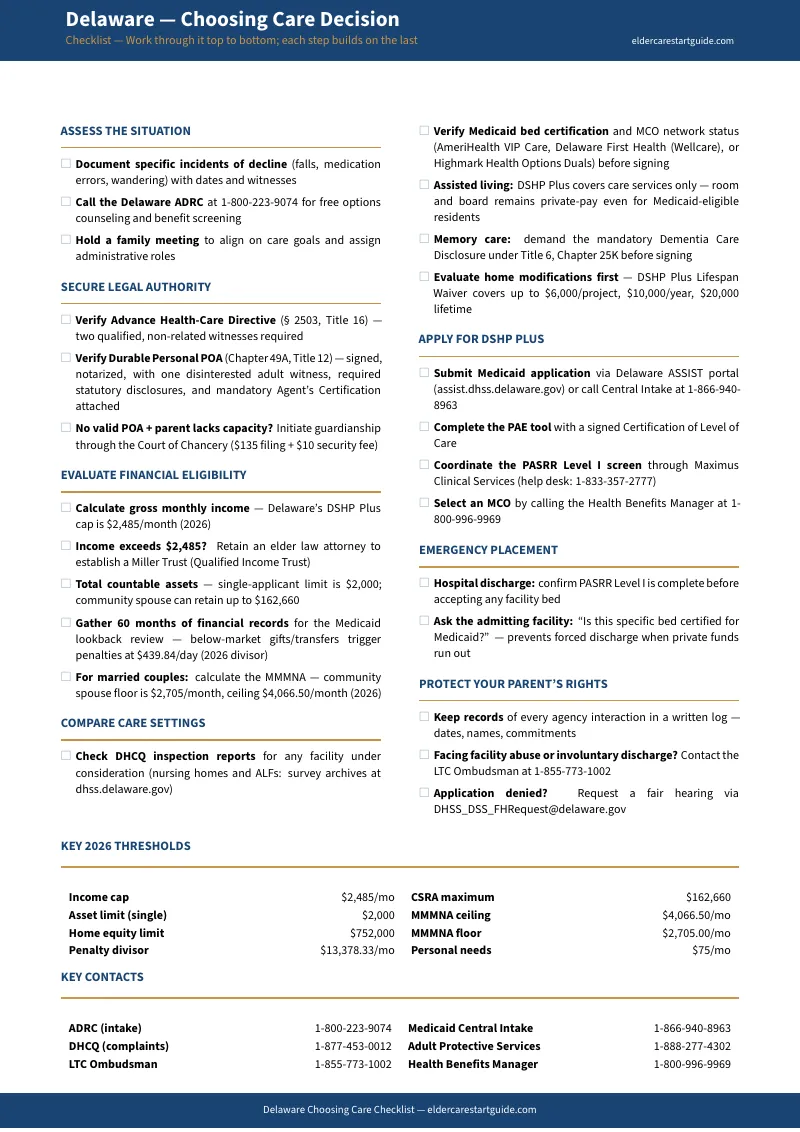
Get started now
Download the free checklist to see the decision framework. When you're ready for the complete system — the 46-page guide plus 10 printable worksheets including the Medicaid financial eligibility calculator, facility comparison worksheet, contract audit checklist, and the full DSHP-Plus enrollment playbook — get the full guide for .