The Bank Won't Let You Touch Your Parent's Account. The Hospital Won't Tell You What's Wrong. And No One Will Explain What to Do About It.
It starts with a phone call. Your parent fell, or the doctor used the word "dementia" for the first time, or the bills are piling up because nobody's paying them. You try to step in — and hit a wall. The bank says you're not authorized. The hospital cites HIPAA. The insurance company won't talk to you. You have no legal standing, and every day you spend figuring it out is a day your parent goes without the help they need.
Colorado's legal-authority system is not intuitive. There are two types of power of attorney — financial and medical — governed by different statutes with different rules. If your parent still has capacity, you need to execute both documents correctly before the window closes. If they've already lost capacity, you're looking at a guardianship or conservatorship petition through the district court — a process that requires a $229 filing fee, a CBI criminal background check, a CAPS check through Adult Protective Services, a credit report, a court-appointed visitor interview, and (if contested) $15,000 to $30,000 in attorney fees.
You shouldn't need to spend $400 an hour on an elder law attorney just to understand the process.
— The Colorado Legal Authority Action System
This is the Colorado Legal Authority Action System — a step-by-step guide that maps the entire path from "I have no authority" to "I can legally manage my parent's finances, healthcare, and long-term care benefits in Colorado." It covers both pathways: the POA route when your parent can still sign, and the court guardianship route when they can't.
It's not a blank PDF form with a "consult your attorney" disclaimer. It's the specific regulatory, procedural, and financial process for Colorado — the statutes, the thresholds, the court forms, the background checks, the CMA contacts — organized in the order you'll actually need them.
What's Inside
- Capacity Assessment Protocol (standalone printable) — a structured checklist that translates Colorado's contractual capacity standard into clear, functional questions. Determine whether your parent can still execute a valid POA or whether you must go through the courts — before you waste time on the wrong path.
- Durable Financial POA Execution Guide — step-by-step instructions for drafting, signing, notarizing, and registering a Durable Power of Attorney under C.R.S. § 15-14-701. Covers the specific provisions banks and title companies require, including real estate, retirement accounts, tax filings (Form DR 0145), and government benefits representation.
- Medical Directive Workbook (standalone printable) — how to appoint a healthcare agent, draft HIPAA disclosure language that hospitals will actually accept, integrate the MOST (Medical Orders for Scope of Treatment) form, and navigate the constraints of Colorado's End-of-Life Options Act.
- Guardianship Filing Roadmap (standalone printable) — complete walkthrough of JDF 841 (guardianship petition), JDF 876 (conservatorship petition), JDF 805 (Acceptance of Office), background verification requirements (CBI check, CAPS check, credit report), court visitor preparation, and the 60-day initial care plan filing deadline.
- Emergency Guardianship Quick-Start (standalone printable) — the exact legal standard for emergency filings (immediate risk of substantial physical harm), Form JDF 843 instructions, the 60-day authority limit, and how to transition to a full guardianship petition before emergency letters expire.
- Medicaid Authorized Representative Guide — how to submit a designation through the PEAK portal to manage Health First Colorado applications, navigate the EBD waiver and Community First Choice (CFC) program, and connect with your parent's regional Case Management Agency for functional needs assessments.
- Agency Contact Directory (standalone printable) — fridge-sheet reference for every Colorado agency: HCPF/PEAK portal, Judicial Branch self-help forms, CBI records check, CAPS check unit, Social Security Representative Payee, Long-Term Care Ombudsman, and CDPHE facility directory. Includes a fill-in section for your parent's CMA and case manager.
- Paid Family Caregiver Setup Guide — how to get paid as your parent's caregiver through CDASS (Consumer Directed Attendant Support Services) or IHSS (In-Home Support Services), including the 2026 workforce base wage of $17/hour, the Denver regional floor of $19.29/hour, and how to structure a Personal Services Care Agreement that Medicaid recognizes as a valid spend-down.
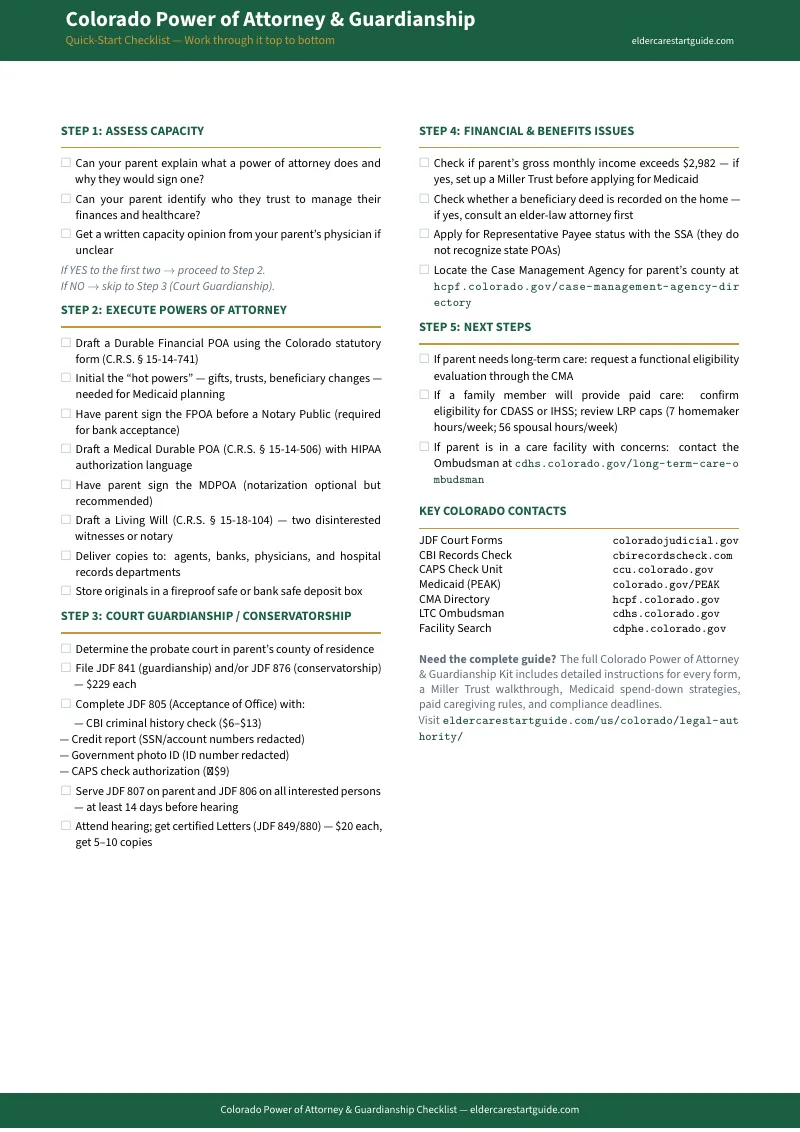
- Quick-Start Checklist (Free Download) — a one-page action checklist covering the 20 critical steps from identifying a legal-authority gap through establishing power of attorney or court-appointed guardianship.
Who This Is For
- Adult children in Colorado who need to establish legal authority for an aging parent — whether the parent can still sign documents or has already lost capacity
- Families facing a hospital discharge crisis who discover they have no legal standing to sign admission agreements, access medical records, or redirect financial accounts
- Siblings navigating family conflict over caregiving decisions who need a clear legal framework to establish fiduciary boundaries and protect themselves from accusations of exploitation
- Caregivers coordinating Medicaid long-term care applications through Colorado's new CMA system while managing a parent's finances and healthcare simultaneously
Why Not Just Use the Free Court Forms?
Colorado's Judicial Branch provides free guardianship and conservatorship forms. The JDF petition templates are downloadable. The statutory POA language is published. That part is genuinely free.
The problem is what the forms don't tell you. They don't explain which documents you need for your specific situation — POA vs. guardianship vs. both. They don't tell you that executing a POA after your parent has lost capacity is legally invalid and exposes you to litigation. They don't walk you through the CBI check, the CAPS check, and the credit report in the right order so the clerk doesn't reject your filing. They don't connect you to the correct Case Management Agency for your parent's county. And they definitely don't explain how to structure a paid caregiving agreement that Medicaid won't penalize as a gift under the 60-month look-back rule.
National legal aggregators like Nolo and eForms charge $35 to $120 for generic POA templates that ignore Colorado-specific procedures entirely — no CMA directory, no CAPS check instructions, no CFC program guidance. A Place for Mom will give you facility referrals for free, but they earn commissions from the facilities they recommend and don't cover legal authority, Medicaid navigation, or home-based care programs.
This guide covers every pathway, including the ones nobody gets paid to tell you about.
Satisfaction Guarantee
If this guide doesn't give you a clearer path to establishing legal authority for your parent in Colorado, email us within 30 days for a full refund. No forms, no questions.
Get Started Now
Download the free Quick-Start Checklist to see the 20 critical steps at a glance. When you're ready for the full process — the capacity assessment, the POA execution guide, the court filing roadmap, the CMA directory, and the paid caregiving setup — get the complete Colorado Power of Attorney and Guardianship Kit.