
Your parent has dementia. Colorado has programs that can help — but nobody explains them clearly.
You've probably already spent hours on the HCPF website trying to understand the EBD waiver. You've called a Case Management Agency and been told to call back. You've looked at memory care facilities and felt your stomach drop at the monthly cost. And somewhere in the background, your parent's condition is progressing, and you know the window for proactive planning is closing.
The information exists — scattered across three state agencies, buried in regulatory language, and fragmented into dozens of pages that don't reference each other. The Case Management Redesign reshuffled intake across all 64 counties, and the old Single Entry Point directories are broken. Even eldercare professionals struggle to keep up.
This guide is the Colorado Dementia Care Navigator — a single document that walks you through the entire system in the order you actually need it, from the safety assessment that tells you when home care is no longer enough, through the Medicaid application, to facility vetting and family caregiver compensation.
What's Inside
The safety assessment framework — because the hardest question is "when." An objective scoring tool based on Colorado's regulatory criteria for secured environments helps you evaluate wandering risk, medication errors, exit-seeking behavior, and caregiver capacity. If your parent triggers the threshold, the guide walks you through what a secured memory care unit requires under CDPHE licensing and what the preadmission assessment evaluates.
Care settings and costs, region by region — memory care in Boulder runs roughly $7,800/month; in Pueblo, roughly $4,800. The guide breaks down private-pay rates across in-home care, adult day programs, standard assisted living, secured memory care, and skilled nursing for every major Colorado region, so you're comparing real local numbers instead of national averages that don't apply.
The memory care licensing reality — Colorado has no separate "memory care" license. Every memory care unit operates under a standard ALR license from CDPHE. The guide explains what this means, what SB22-079 requires for dementia training, and gives you 15 specific questions to ask during facility tours — including how to verify ACF certification, Medicaid bed availability, and the staffing ratios that actually matter at 2 AM.
The complete EBD waiver walkthrough — the Elderly, Blind, and Disabled waiver is how Medicaid funds community-based memory care in Colorado, but it comes with rules that trip families up. The waiver covers care services but not room and board. The facility must be a certified Alternative Care Facility. The 2026 room and board cap is $810/month. The guide walks through the full eligibility process — income limits, asset thresholds, the functional needs assessment through your regional CMA, and what happens after approval.
The Miller Trust, step by step — Colorado is an income-cap state with no medical spend-down option. If your parent's monthly income exceeds the limit, they need a Qualified Income Trust to qualify for Medicaid. The guide explains exactly how a Miller Trust works, what gets deposited each month, and how to set one up — preparation that can save thousands in attorney fees.
Spousal asset protection — if your surviving parent is the community spouse, the guide covers the Community Spouse Resource Allowance, the Minimum Monthly Maintenance Needs Allowance, and the specific 2026 figures that determine how much the at-home spouse keeps. This is the section that prevents spousal impoverishment.
Family caregiver pay through Community First Choice — Colorado launched the CFC option on July 1, 2025, replacing fragmented caregiver programs with two clear pathways. CDASS lets your parent hire and pay you directly. IHSS works through an authorized agency. The guide covers both, including 2026 pay rate ranges, the application process, and the rules about hiring spouses versus other family members.
Legal planning before capacity is lost — the guide walks through Medical and Financial Power of Attorney under Colorado law, including the cognitive capacity threshold for signing. It contrasts the cost of proactive POA planning with the cost of court-ordered guardianship — which starts at $5,000 for uncontested cases — and covers the petition process, court filing fees, and the Court Visitor evaluation.
The Senior Alert and wandering safety system — how to prepare the documentation the Colorado Bureau of Investigation requires to activate a Senior Alert, how to pre-assemble a Wandering Emergency Profile, and how to access tracking technology through the CBI's Persons Who Wander program.
Who This Guide Is For
- Adult children managing a parent's dementia care in Colorado — whether you're still at the early-stage planning phase or already in crisis mode after a hospital admission or a wandering incident
- Community spouses — husbands and wives who've been caregiving at home and need to understand how to protect their own financial security while getting their partner into professional care
- Long-distance family members — siblings coordinating care from out of state who need the Colorado-specific rules and contacts in one place
- Anyone helping a Colorado resident apply for the EBD waiver — the waiver process is where most families get stuck, and this guide covers it from eligibility screening through CMA intake to post-approval patient liability calculations
Why Not Just Google It?
You can find pieces of this information online. The HCPF website has the EBD waiver page. CDPHE has the licensing regulations. The CMA directory exists somewhere in the state's system. But here's what happens in practice:
You start on the Medicaid page and discover your parent might be over the income limit. You search for "Miller Trust Colorado" and get three law firm landing pages quoting $3,000–$10,000 for Medicaid planning. You look for memory care facilities and land on A Place for Mom, which captures your phone number and starts calling you about partner communities they earn commissions on. You try to find your local CMA and discover the old Single Entry Point number is disconnected because of the Case Management Redesign.
Three hours later, you have 47 browser tabs open, conflicting information about Medicaid asset limits, and no clear next step.
This guide consolidates everything into one sequence you can work through in order. No referral commissions. No upsell to legal services. Just the Colorado-specific rules, current 2026 figures, and step-by-step processes your family needs.
What You Get
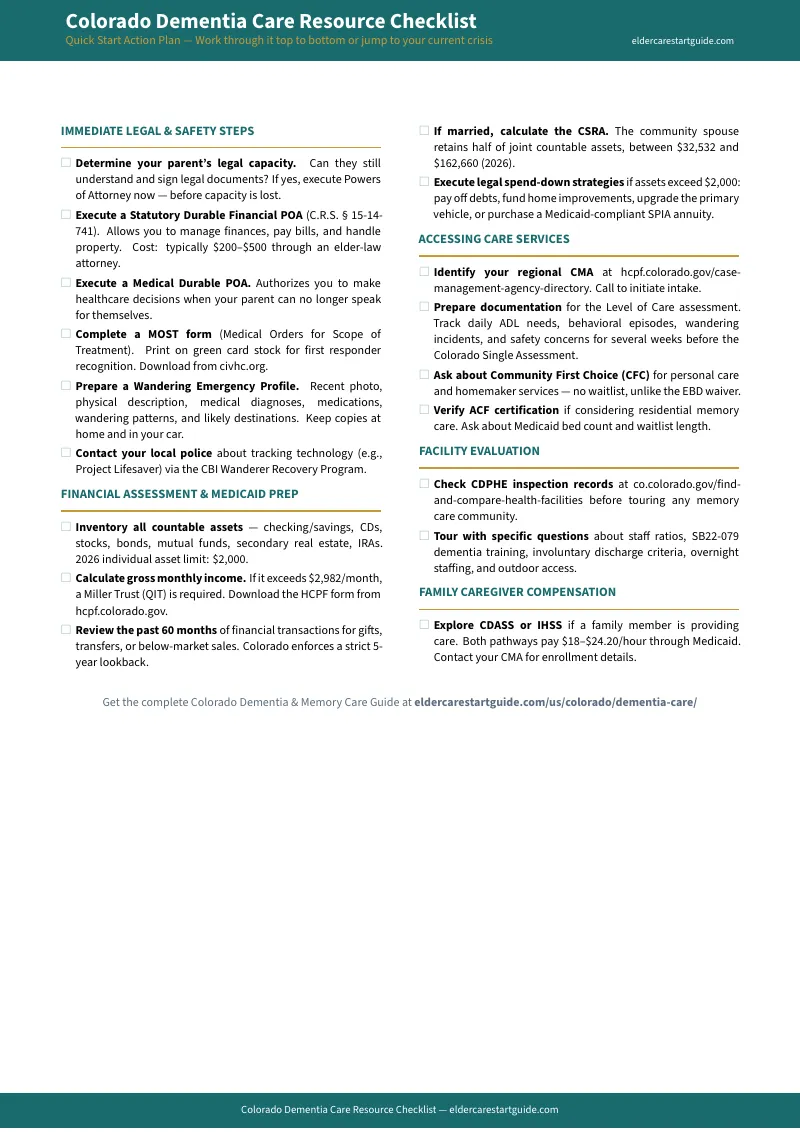
Your download includes 12 PDFs: the full Colorado Dementia & Memory Care Guide (13 chapters), the Colorado Dementia Care Resource Checklist, and 10 standalone printables you can bring to tours, CMA appointments, and the first 911 call:
- guide.pdf — the 13-chapter navigator
- checklist.pdf — one-page contacts, thresholds, and first actions
- safety-assessment.pdf — score wandering, meds, ADLs, and caregiver capacity at home
- facility-tour-audit.pdf — the 15 tour questions with write-in answers
- cost-comparison-worksheet.pdf — quote log vs. 2025–2026 Colorado rates
- medicaid-eligibility-tracker.pdf — 2026 income, assets, and CSRA
- miller-trust-setup.pdf — Qualified Income Trust setup and monthly ledger
- spend-down-lookback.pdf — legal spend-down plan and 60-month transfer log
- wandering-emergency-profile.pdf — hand this to officers; Senior Alert checklist
- legal-authority-checklist.pdf — POA, MOST, and guardianship filing steps
- cma-intake-tracker.pdf — first-call pack, CSA date, PCSP, call log
- caregiver-pay-worksheet.pdf — CDASS / IHSS enrollment and hour log
All files download instantly after purchase. No shipping, no waiting, no subscription.
Satisfaction Guarantee
If this guide doesn't give you a clearer path through Colorado's dementia care system — a concrete understanding of what your parent qualifies for, what it costs, and what steps to take first — email [email protected] for a full refund. No time limit, no questions.
Your parent's diagnosis changed everything. This guide helps you figure out what to do about it — specifically in Colorado, with the current rules and the current numbers.