
Your parent needs long-term care in Arkansas — and one wrong financial move could cost the family everything
Nursing homes in Arkansas cost $6,200 to $7,500 a month. Medicare covers skilled rehabilitation for a maximum of 100 days — with escalating co-pays after day 20 — then the private-pay bills start. You've been told to "look into Medicaid," but the information you're finding is scattered across DHS county office reference charts, OLTC clinical criteria, AFMC prior-authorization portals, and state legislature archives. And none of it explains the one fact that changes everything: Arkansas is an income-cap state.
That means if your parent's gross monthly income exceeds $2,982, they are ineligible for long-term care Medicaid — no matter how high their medical bills are. They cannot spend down excess income to qualify the way families do in most other states. The only way through is a Qualified Income Trust (Miller Trust), and most families don't learn about it until the nursing home's admissions director is asking for a private-pay deposit.
Meanwhile, the asset limit is $2,000. Both spouses' retirement accounts — IRAs, 401(k)s — count against it. DHS audits five years of financial transactions through the electronic Asset Verification System. A single gift to a grandchild, a car sold to a family member below market value, or a house transferred without proper planning can trigger a penalty period during which the state refuses to pay for care.
And after your parent dies, the Medicaid Estate Recovery Program can file a claim against their estate — unless you know that Arkansas uses a narrow, probate-only definition of recovery, which means assets transferred outside probate are protected.
The Medicaid Crisis Triage System — every Arkansas-specific rule, form, and deadline in one manual
The Arkansas Medicaid Long-Term Care & Asset Protection Guide is a 15-chapter manual built specifically for Arkansas's DHS rules, income-cap structure, and probate-only estate recovery system. It replaces the scattered government documents, the conflicting advice from forums, and the $300-to-$500-per-hour elder law consultations you'd need just to understand the basics.
This is not a generic "Medicaid planning" overview. Every threshold, every form, every strategy in this guide is tied to Arkansas-specific statutes, DHS procedures, and 2026 dollar figures. It's written for the adult child standing in the middle of a crisis — not the attorney billing by the hour to explain what the crisis is.
What's inside the full guide
- The Miller Trust setup guide — because Arkansas's hard income cap of $2,982 blocks anyone earning more from qualifying, and the Miller Trust is the only legally permitted workaround. Step-by-step bank account setup, trustee selection, monthly routing instructions, and the critical requirement that the State of Arkansas is named as remainder beneficiary.
- The complete asset map — every exempt and countable asset under Arkansas rules, including the primary residence ($752,000 equity cap), one vehicle, burial contracts, and the distinction that catches most families off guard: both spouses' retirement accounts are countable, regardless of disbursement status.
- The 60-month lookback defense — how DHS uses the electronic Asset Verification System to audit five years of transactions, the penalty divisor formula, which transfers are exempt (spousal transfers, transfers to disabled children), and what to do if a penalty is already triggered.
- Emergency spend-down strategies — converting countable assets to exempt ones without triggering transfer penalties. Mortgage payoff, home modifications for accessibility, vehicle purchase, irrevocable prepaid funeral contracts, medical equipment — each with documentation requirements that satisfy DHS caseworkers.
- Spousal impoverishment protections — the Community Spouse Resource Allowance (up to $162,660), the Minimum Monthly Maintenance Needs Allowance ($2,705/month effective July 1, 2026), the asset-split calculation on the first day of continuous institutionalization, and how to request an increased allowance through a fair hearing.
- ARChoices in Homecare preparation — how to document your parent's actual daily limitations before the DHS Registered Nurse arrives for the Task and Hour Standards assessment. An incomplete picture means denied or insufficient care hours. The guide covers every physical and cognitive criterion the THS form evaluates.
- Home protection through Act 570 Beneficiary Deeds — Arkansas's probate-only estate recovery means assets that bypass probate are protected from MERP claims. The guide explains how to execute a Beneficiary Deed, set up payable-on-death accounts, and structure ownership so the family home is untouchable after death — without violating the lookback period.
- The application process from start to finish — where to file at DHS Division of County Operations, required documents (SSA award letters, property deeds, 60 months of financial statements, cash surrender values of life insurance), submission through Access Arkansas, and the 45-day processing timeline.
- The appeals process — the 35-calendar-day window to request a fair hearing, the difference between financial denials (County Operations) and medical necessity denials (OLTC/AFMC), and what evidence to present.
- When to hire an attorney — and how to cut the bill — Arkansas elder law firms charge $6,000 to $15,000 for comprehensive Medicaid planning. The guide helps you identify exactly which situations require professional help (Miller Trust drafting, irrevocable trust creation, contested guardianship) and which you can handle with organized records and clear instructions.
Who this is for
- The adult child in a hospital-discharge crisis — your parent can't go home, the facility wants a private-pay deposit, and you have days to figure out how Medicaid works in Arkansas.
- The family told their parent "earns too much" for Medicaid — you don't realize a Miller Trust can resolve income above the $2,982 cap when the other eligibility rules are met.
- The community spouse terrified of losing everything — you need to know exactly how much you can keep and how to protect the house, the car, and your monthly income.
- The out-of-state child coordinating from Texas, Missouri, or Tennessee — managing DHS county offices remotely and compiling five years of financial records without local support.
- The proactive planner whose parent has an early-stage diagnosis — you want to position assets, execute a Beneficiary Deed, and structure finances before the 60-month lookback window catches past transfers.
- The burned-out family caregiver — you've been providing unpaid care for years and need to know how ARChoices IndependentChoices can pay you as an employed caregiver while keeping your parent at home.
Why free resources won't get you there
The Arkansas DHS website has the application packet. Medicaid planning portals have the income and asset limits. Area Agencies on Aging answer general questions. But here's what none of them will do:
- They won't tell you how to structure a spend-down — state employees are legally prohibited from providing asset-protection or spend-down advice. They can tell you the $2,000 limit exists; they cannot tell you how to get there without triggering a penalty.
- They won't explain Arkansas's probate-only estate recovery advantage — most generic guides treat MERP as a universal threat. In Arkansas, the narrow probate-only definition means Beneficiary Deeds and payable-on-death accounts bypass recovery entirely. No free government resource will walk you through how to use this.
- They won't prepare you for the THS assessment — the ARChoices clinical evaluation determines whether your parent qualifies for home care and how many hours they receive. Families who document limitations accurately get adequate care; families who don't get denied or underfunded. No DHS form tells you how to prepare for this visit.
- They won't connect the dots — the income cap, the Miller Trust, the lookback period, the asset exemptions, the spousal protections, and the estate recovery rules all interact. A mistake in one area cascades into the others. The guide puts them in sequence so you can see the whole picture before you act.
Your files
Your purchase includes 12 printable PDF files:
- guide.pdf — the complete 15-chapter manual covering every eligibility rule, application step, asset protection strategy, and appeal process specific to Arkansas DHS.
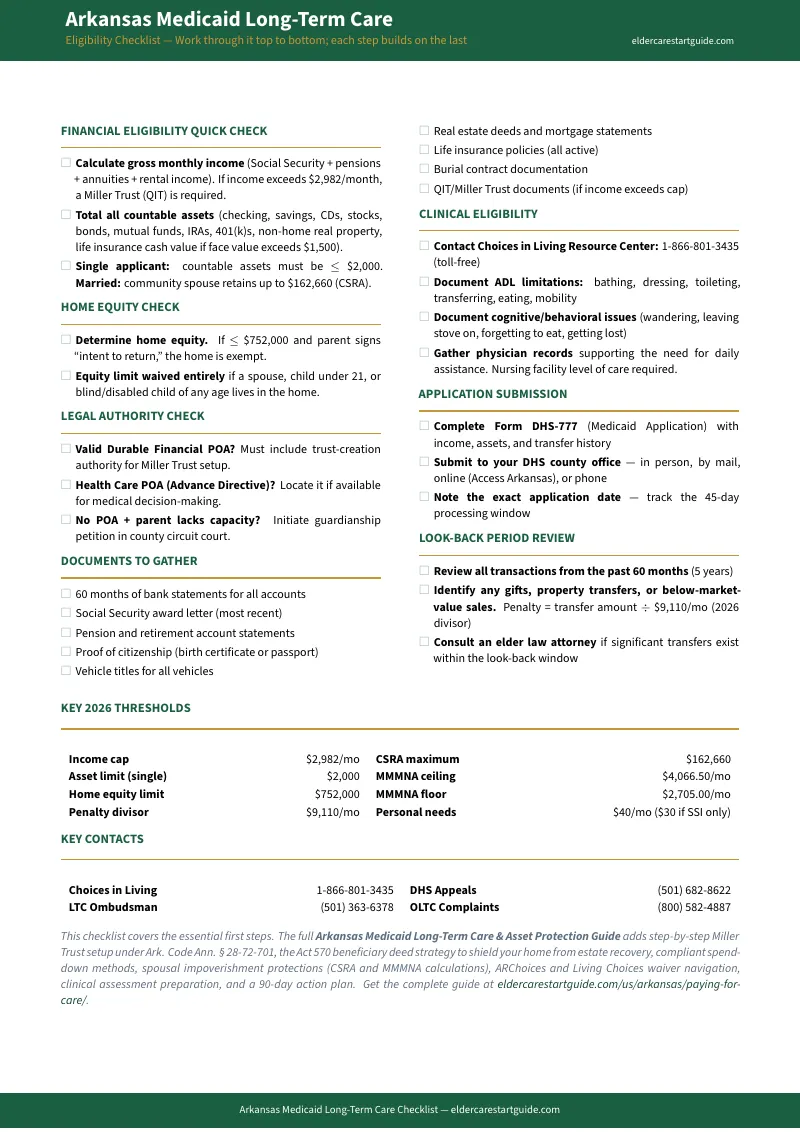
- checklist.pdf — a one-page action-item reference with the 20 most critical steps in priority order.
- eligibility-calculator.pdf — income and countable-asset worksheet against the 2026 $2,982 / $2,000 limits.
- miller-trust-setup.pdf — QIT parties, required clauses, monthly distribution order, and a six-month deposit ledger.
- asset-inventory-worksheet.pdf — every account, retirement plan, property, vehicle, and insurance policy with countable vs. exempt status.
- spend-down-planner.pdf — penalty-free spend-down tracker with amounts, dates, and a running total down to $2,000.
- spousal-protection-calculator.pdf — CSRA 50/50 split (floor $32,532 / ceiling $162,660) and MMMNA worksheet (floor $2,705).
- lookback-audit.pdf — 60-month transfer log and penalty math using the $9,110 monthly divisor.
- estate-recovery-worksheet.pdf — Act 570 Beneficiary Deed, POD/TOD designations, TEFRA lien check, and home-equity math.
- application-document-checklist.pdf — every document for Form DHS-777, plus DHS-703, DMS-787, and DMS-780.
- archoices-assessment-prep.pdf — two-week ADL log for the ARIA / THS nurse visit.
- appeals-hearing-prep.pdf — 35-day fair-hearing deadline math, evidence pack, and hearing notes.
Satisfaction guarantee
If the guide doesn't help you understand your family's options, email [email protected] and we'll make it right.
Get started now
An elder law attorney in Arkansas charges $6,000 to $15,000 for comprehensive Medicaid planning. Even a one-hour consultation runs $300 to $500. The guide gives you the same knowledge framework — every rule, every form, every strategy — so you walk into that first meeting (if you need one at all) with organized records and clear questions instead of confusion and panic.
Get the Arkansas Long-Term Care Guide
Or start with the free checklist — the 20 most urgent action items, including the Medicaid eligibility thresholds, the Miller Trust requirement, and the home protection steps — delivered instantly to your inbox.