Your parent's dementia diagnosis just changed everything. Alabama's care system doesn't come with a map.
You've spent hours searching Alabama Medicaid's website. You've read fragments about memory care licensing, income caps, Miller Trusts, and waivers — and none of it connects into a plan you can act on. The state's care system is split across a dozen agencies, each with its own forms, its own eligibility rules, and its own waiting lists. Meanwhile, the clock is ticking on your parent's legal capacity, their safety at home, and your family's savings.
The national directories want your phone number so they can sell you a facility placement. An elder-law attorney can navigate the system for you — at $250 to $500 an hour. The state agency portals give you regulations, not guidance.
You need something between a five-dollar pamphlet and a five-thousand-dollar retainer.
The Alabama Dementia Care Navigator
This is a step-by-step system that walks you through every decision in sequence — legal authority, financial eligibility, community programs, facility placement, and asset protection — with the specific Alabama rules, thresholds, and forms at each step. It bridges the gap between the state's fragmented portals and the expensive professional advice you may or may not need.
It's built for the caregiver who needs to act now, not the one who has months to research.
What's Inside
- The Two-License System Explained — Alabama separates standard Assisted Living Facilities from Specialty Care Assisted Living Facilities (SCALFs) with entirely different licensing rules. The guide explains the staffing mandates, safety requirements, and admission criteria for each so you know which type of facility your parent actually qualifies for.
- Power of Attorney Timing Guide — Under Alabama's Uniform Power of Attorney Act, your parent must have the cognitive capacity to sign at the moment of execution. The guide explains the legal standard, the warning signs that capacity is closing, and the difference between a $50 POA and a $2,000–$10,000 guardianship proceeding when the window shuts.
- Medicaid Income Cap and Miller Trust Walkthrough — Alabama is one of the strictest income-cap states: $2,982 per month in 2026, no medically needy spend-down. The guide walks you through the Qualified Income Trust (Form 262) step by step — opening the trust bank account, directing income, managing monthly distributions, and naming Alabama as primary beneficiary.
- E&D Waiver and Community Program Navigator — The Elderly and Disabled Waiver covers personal care, homemaker services, adult day health, respite care, and home modifications up to a $5,000 lifetime cap. The guide maps out each service, explains the Personal Choices self-directed option that lets you hire family members as paid caregivers, and tells you how to start the application through your regional Area Agency on Aging.
- SCALF Vetting Checklist — 25 specific questions to ask during facility tours, covering licensing status, staff-to-resident ratios, dementia training records, delayed-egress lock systems, and private-pay contract terms. Know what to verify before you sign anything.
- PSMS Self-Scorecard — SCALFs use the Physical Self Maintenance Scale to determine admission eligibility (score of 23 or lower required). The guide includes a simplified version so you can pre-calculate your parent's score before the formal assessment — avoiding a surprise denial at the worst possible time.
- 60-Month Financial Document Organizer — Alabama's Medicaid lookback period covers five full years of financial records. This organizer helps you gather, categorize, and document every bank statement, property deed, and asset transfer before you sit down with a caseworker or attorney.
- Asset Protection Through the Alabama Family Trust — For parents aged 65 and older, the Alabama Family Trust is a legislatively created pooled special needs trust that shelters assets above the $2,000 Medicaid limit. The guide covers the enrollment process, the $1,500 minimum deposit, and how disbursements work for supplemental needs Medicaid does not cover.
- Silver Alert Preparation Kit — How to compile the information Alabama law enforcement needs to activate a Missing and Endangered Persons Alert under Code Section 26-19A-4 — before a wandering emergency happens. Includes the documentation checklist and agency contact paths.
- Spousal Impoverishment Protections — When only one spouse needs care, the at-home spouse can protect $32,532 to $162,660 in assets and receive income protections through the Minimum Monthly Maintenance Needs Allowance. The guide shows how these calculations work so the community spouse doesn't lose everything.
Who This Guide Is For
- Adult children managing a parent's care in Alabama — whether you live nearby or coordinate from out of state
- Spouses facing the financial reality of a $4,425-to-$7,800 monthly memory care bill with no Medicaid coverage for room and board
- Families preparing for the attorney meeting — walking in with organized financials, a completed asset inventory, and the right questions saves three to five hours of billable time
- Caregivers who have just been told "your parent needs more care than you can provide at home" and need to understand the options before the hospital discharge planner hands them a list
Why Not Just Use Free Resources?
Alabama's Medicaid portal, the Department of Senior Services website, the ADPH licensing database, the Alabama Family Trust enrollment forms, your regional AAA's waiver application — they all exist. None of them talk to each other. The Medicaid portal tells you the income limit but not how to set up the trust that solves the income problem. The AAA can screen you for the waiver but cannot advise on whether the waiver or nursing home Medicaid makes more financial sense for your family. The attorney's blog explains the lookback period but not the specific Alabama forms the caseworker will ask for.
This guide connects every step into a single decision sequence. You open it at the chapter that matches your current crisis — legal capacity closing, first facility tour, Medicaid application prep — and follow the instructions forward.
Satisfaction Guarantee
If the guide doesn't give you a clearer path forward within the first reading, email us and we'll refund you — no questions, no hoops.
Start With the Free Checklist or Get the Full Guide
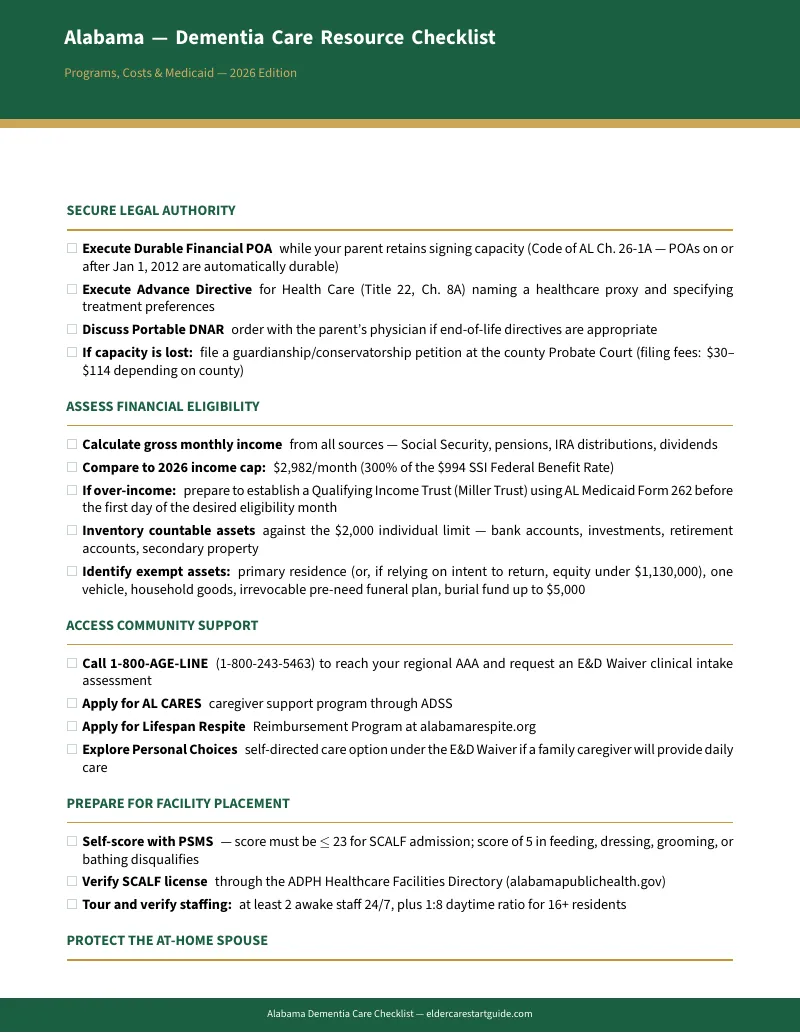
The free checklist covers the key action items across six phases: legal authority, financial eligibility, community support, facility placement, spousal protections, and home safety. It tells you what to do.
The full Alabama Dementia & Memory Care Guide tells you how — with the specific Alabama statutes, dollar thresholds, form numbers, and step-by-step procedures at every stage. Includes nine standalone printable worksheets and the complete resource directory with AAA contact information for every region of the state.