Your Parent Has Dementia — And Northern Ireland Plays by Its Own Rules
The GP says "memory clinic referral" and hands you a leaflet. The Trust social worker mentions something called NISAT. A website talks about Lasting Power of Attorney and you start filling one out — only to discover that Northern Ireland doesn't use LPAs at all. Meanwhile your parent is leaving the cooker on, asking the same question every ten minutes, and you're lying awake trying to figure out who pays for what if this gets worse.
You are not lost because you haven't tried hard enough. You're lost because Northern Ireland runs dementia care on its own system — five HSC Trusts instead of councils, Enduring Power of Attorney instead of LPA, CRAG means-testing instead of the English care cap, and no formal Continuing Healthcare framework for dementia. Almost every guide you find online quietly assumes the English rules. Follow them and you could miss a free service you were entitled to, sign a top-up contract you didn't need to, or lose the window to set up an EPA before your parent's capacity slips away entirely.
The Northern Ireland Dementia Care Navigator
This is the guide we wished existed the day the diagnosis landed. Dementia Care in Northern Ireland: Funding, Support & Rights takes the entire maze — diagnosis pathway, legal authority, Trust assessments, care home funding, home safety, benefits — and turns it into a clear, sequential plan built specifically for Northern Irish law and the HSC Trust system.
No hunting through nidirect PDFs that bury the answer you need in paragraph 47. No £300-an-hour solicitor to explain the difference between an EPA and a Controllership Order. Just the worksheets, checklists, and step-by-step decisions that let you act fast and get it right — before a crisis forces someone else to decide for you.
What's Inside — And the Problem Each Part Solves
- The Diagnosis Pathway Map — Follow the exact route from GP referral to Trust Memory Service to Dementia Navigator assignment. Includes a behavioural checklist to document symptoms before the appointment and a script for the GP conversation. Solves: "Nobody told us what happens after the referral."
- The EPA vs. Controllership Decision Guide — A side-by-side comparison showing why an Enduring Power of Attorney at £189 registration plus modest solicitor fees saves your family from a High Court Controllership that starts at £1,368 in legal costs plus annual OCP administration fees. Action steps, forms guidance, and deadline warnings for each path. Solves: "I'm managing everything but I have no legal authority to touch their money."
- The Care Funding Worksheet — Fill in your parent's savings, property, and income to see exactly where they sit under CRAG: the £23,250 self-funder threshold, the £14,250 full-funding threshold, and the tariff income band between them. Covers the 12-week property disregard, mandatory exemptions, and the £100/week Nursing Care Contribution that many families never claim. Solves: "Will the Trust take the house?"
- The Trust Needs Assessment Prep Kit — A walkthrough of the NISAT assessment process with a pre-meeting checklist so nothing gets missed. Covers what to document, who should attend, and how to request services if the initial allocation falls short. Solves: "The social worker asked questions I wasn't prepared for and now Mum's getting less help than she needs."
- The Respite Care Planner — Maps every respite option available through Northern Ireland Trusts: domiciliary sitting services, day centres, short-break residential stays, and Carers Support grants. Includes a carer's assessment request template. Solves: "I haven't had a full night's sleep in months and I don't know what help exists."
- The Care Home Evaluation Checklist — A printable scorecard mapped to RQIA inspection standards with the exact questions to ask a care home manager: staffing ratios, dementia-specific training, activity programmes, medication management, and how the home handles wandering and behavioural symptoms. Solves: "How do I tell a good care home from a bad one?"
- The Home Safety and Herbert Protocol Guide — Room-by-room hazard checklist plus the complete Herbert Protocol setup: the PSNI missing-person form, photograph requirements, and the list of significant locations to include. Covers NFC safeguarding wristbands and GPS tracking options available in Northern Ireland. Solves: "Dad walked out at 3am last week and we didn't find him for two hours."
- The Benefits Quick Reference — Every 2026 Northern Ireland dementia-related benefit on one printable page: Attendance Allowance rates, Carer's Allowance, Disability Living Allowance, Personal Independence Payment, and the Personal Expenses Allowance for care home residents. Solves: "There's money we should be claiming and I don't know where to start."
Who This Is For
- Adult children in Northern Ireland whose parent has just been diagnosed with dementia — or whose diagnosis is overdue and you need to push for a Memory Service referral
- Families who need to set up an EPA urgently before their parent's capacity declines further
- Caregivers managing a parent at home who need to understand what Trust services exist and how to access respite
- Families facing a care home placement and needing to understand exactly how CRAG means-testing works — especially the property rules
- Long-distance children coordinating Northern Irish care from Great Britain or further afield, drowning in cross-border confusion between English and NI systems
Why Not Just Use the Free Resources?
Because "free" has a hidden cost. The information on nidirect and from Age NI is authoritative — and deliberately fragmented. It's spread across dozens of dense PDFs, each written to explain the system's rules rather than tell you what to do. The Alzheimer's Society is excellent, but its UK-wide guides routinely mix English terminology (LPA, ICB, local authority) with Northern Irish — and if you follow the wrong system's process, you lose time you cannot get back.
The alternative is a solicitor at £200 to £500 for an EPA consultation, or a care-fees adviser who may steer you toward financial products you don't need yet. This guide sits in the gap: it translates the same official Northern Irish policy into a plan you can act on tonight, so that if you later pay a professional, you arrive knowing exactly what to ask — and what you no longer need them for.
A Simple Promise
If this guide doesn't give you a clearer, calmer path through the Northern Irish dementia care system than anything you've found for free, email us and we'll refund you — no forms, no arguments. We built this for families in one of the hardest seasons of their lives, and we won't keep your money if it didn't help.
Start Now — Two Ways
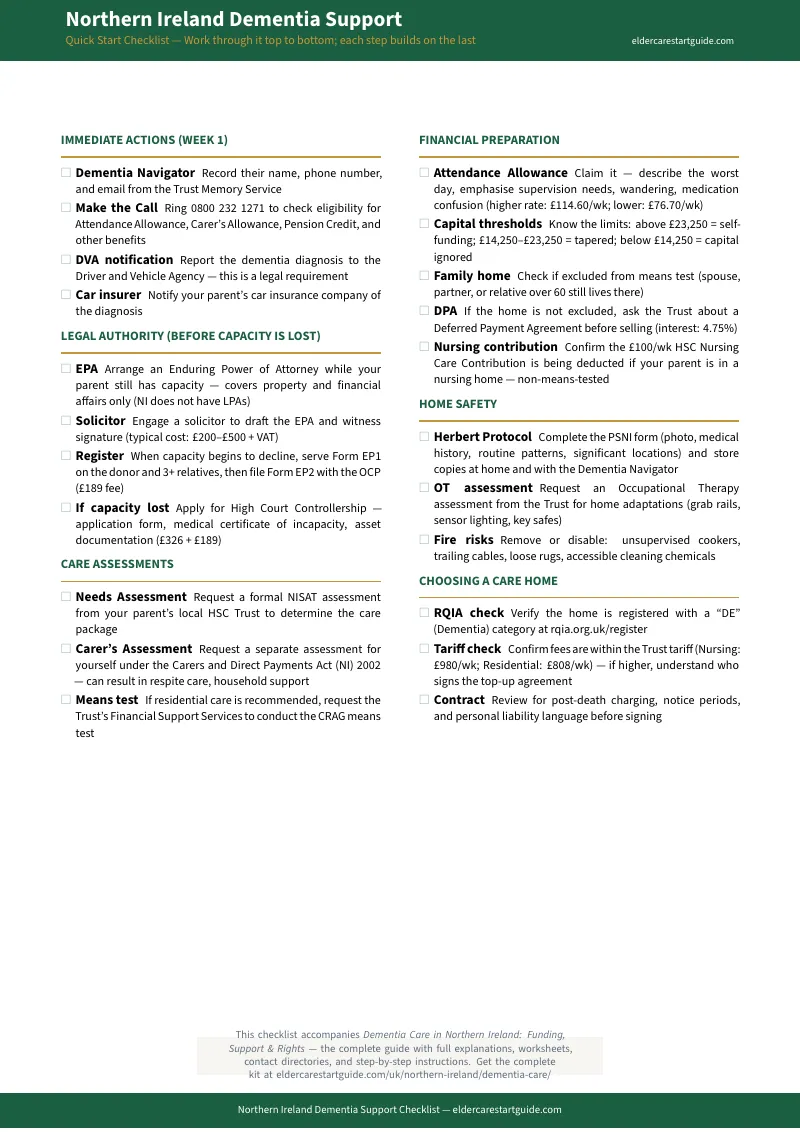
Not ready to buy? Start with the free Northern Ireland Dementia Support Checklist — a one-page guide covering the essential steps after a dementia diagnosis, so you know what to do first and what can wait.
Ready to navigate the whole thing? Get the complete Dementia Care in Northern Ireland guide plus 8 standalone printable worksheets — the care funding calculator, EPA decision guide, assessment prep kit, care home scorecard, and more — for , a fraction of a single solicitor's consultation.