
The Bank Says No. The Hospital Needs a Decision. And Being Their Child Means Nothing.
Your parent had a fall — or a stroke, or a slow slide you tried to ignore. You've been managing informally: paying bills, calling doctors, driving them everywhere. Then the bank freezes you out of a CD rollover. The hospital discharge planner says your parent can't go home safely and you need to sign a skilled nursing admission contract by Friday. Social Security tells you no power of attorney works for benefit payments. You discover that "adult child" is not a legal standing in Wyoming.
Now you're racing. You need authority over medical decisions, financial accounts, and government benefit applications — and you're not sure your parent can still sign the documents that would give it to you. If they can't, your only path is a guardianship petition in Wyoming District Court, which takes months, costs thousands, and puts your family's private life on a public record.
The Wyoming Legal Authority Navigator — Every Path to Decision-Making Power in One Sequence
The Wyoming Power of Attorney & Guardianship Kit maps every legal route — from a straightforward POA signing to a full guardianship petition — into one step-by-step sequence built on Wyoming's 2026 statutes. It starts with assessing whether your parent can still sign, walks you through the execution requirements for each document, covers the federal processes Wyoming law can't reach, and maps the Medicaid programs that pay for the care you're trying to arrange.
This is not a generic national overview. Every statute citation, filing fee, witness requirement, asset threshold, and agency contact is specific to Wyoming.
What's Inside
Capacity Assessment Framework — a structured approach for evaluating whether your parent can still legally execute documents. A dementia diagnosis does not automatically disqualify someone under Wyoming law — what matters is whether they understand the document, who they're appointing, and what assets are involved at the moment of signing. The guide helps you assess readiness, prepare for the signing conversation, and document the process in case capacity is later challenged.
Durable Financial Power of Attorney (W.S. § 3-9-105) — Complete Execution Walkthrough — under the Wyoming Uniform Power of Attorney Act, all financial POAs are durable by default, meaning they survive your parent's future incapacity. The guide covers the mandatory notarization requirement, the conscious-presence signing option, the specific Medicaid planning powers you should include under W.S. § 3-9-201 (gifting authority, trust creation, Miller Trust establishment, beneficiary changes), and why a standard blank form without these provisions leaves you powerless to protect assets.
Bank Enforcement Rights Under W.S. § 3-9-120 — local branch employees routinely reject validly executed powers of attorney. The guide explains your statutory rights: Wyoming law gives financial institutions seven business days to accept an acknowledged POA or request a certification. Institutions that refuse in violation face court orders and attorney fee liability. You'll know the exact statute to cite, the certification process, and the escalation path when compliance isn't voluntary.
Advance Healthcare Directive (W.S. § 35-22-403) — Witness Rules That Can Void the Document — Wyoming's directive combines a healthcare power of attorney with a living will. Execution requires either notarization or two qualified witnesses, with specific disqualification rules for who cannot serve. The guide flags every disqualification, covers the WyoPOLST form for immediate medical treatment preferences, and explains how to integrate a HIPAA authorization so your parent's medical agent has unrestricted records access.
Guardianship Filing Sequence (W.S. § 3-2-101) — when your parent has already lost capacity and no POA exists, guardianship is the only remaining path. The guide walks through the full process: drafting the petition, required court forms, proving incapacity, the guardian ad litem appointment, service of process to all interested parties, and the court hearing. It covers the biennial status reports, the consequences of missing filing deadlines, and how the priority order of appointment works when multiple family members want the role.
Conservatorship — Financial Authority Through the Court — a separate petition for financial management authority. The guide covers the distinction between guardianship (person) and conservatorship (property), the fiduciary bond requirement, the annual financial accounting obligations under W.S. § 3-3-901, and the court's ongoing oversight of every significant financial transaction.
Emergency Guardianship (W.S. § 3-2-106) — when substantial harm is imminent and there's no time for a standard petition. The guide covers the emergency filing requirements, the 72-hour mandatory hearing, the 90-day maximum duration, and the restriction to medical decisions only until a full hearing is scheduled.
Social Security Representative Payee — the one pathway no power of attorney can replace. The SSA does not accept any private legal document for managing retirement or disability benefits. The guide covers the separate application process through the local field office, the in-person interview, what documentation to bring, and the annual accounting obligations.
Community Choices Waiver & Medicaid Planning — Wyoming's primary home-care Medicaid program for seniors who need nursing-home-level care but want to stay home or in assisted living. The guide covers the LT101 clinical assessment, the $2,982 monthly income cap, the $2,000 asset limit, spousal impoverishment protections (Community Spouse Resource Allowance up to $162,660), and the Participant Direction option that allows adult children to become paid caregivers.
Miller Trust Setup — Wyoming is an income-cap state, not a spend-down state. If your parent's income exceeds $2,982 per month by even one dollar, they're disqualified unless you establish a Qualified Income Trust to channel the excess. The guide explains when a Miller Trust is needed, how to structure it, and how to fund it correctly so Medicaid eligibility isn't jeopardized.
Asset Protection & Estate Recovery — Wyoming enforces a 60-month look-back on all asset transfers before a Medicaid application. The guide covers penalty calculations, exempt transfers (including the sibling exemption and caregiver child exemption), how the family home is treated during the parent's lifetime versus after death, and how Wyoming's Medicaid Estate Recovery Program works — including when mandatory deferrals protect the home and when an undue hardship waiver is available.
Standalone Printable Tools
Every tool below is a separate PDF you can print individually and bring to the exact situation where you need it:
- Capacity Assessment Protocol — structured evaluation checklist to determine whether your parent can still legally sign documents under Wyoming law
- POA Execution Checklist — step-by-step preparation, execution, and distribution guide to bring to the notary appointment
- Bank Acceptance Playbook — W.S. § 3-9-120 escalation protocol to bring to the branch when a financial institution refuses your POA
- Guardianship Filing Checklist — complete District Court petition process with required forms, service requirements, and post-appointment reporting deadlines
- Medicaid Eligibility Worksheet — fillable income, asset, and spousal protection calculator with 2026 Wyoming thresholds
- Miller Trust Setup Checklist — Qualified Income Trust creation steps and mandatory monthly distribution sequence
- Estate Recovery Worksheet — evaluate your family's exposure under Wyoming's expanded Medicaid estate recovery with deferral and exemption checklist
- Decision Flowchart — one-page voluntary vs. involuntary pathway comparison with timeline and cost breakdown
- Wyoming Contacts Reference — key agencies, court forms, Medicaid programs, advocacy resources, and legal help in one fridge-ready sheet
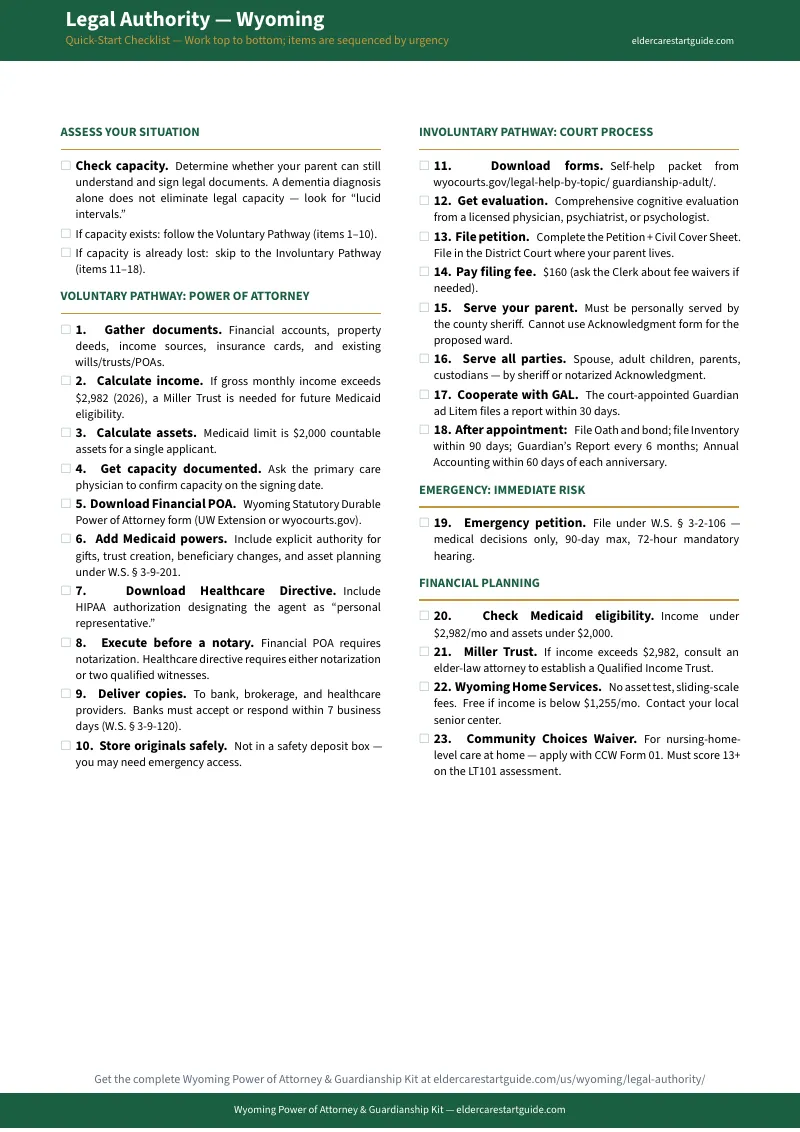
Plus: The Wyoming Legal Authority Quick-Start Checklist — a one-page printable reference with every critical action item, key contact, statute reference, and deadline in priority order.
Who This Is For
- The adult child who needs to act before capacity is gone — your parent can still sign documents today, but you see the window closing and need financial and healthcare POAs executed correctly under Wyoming law while there's still time
- The family facing a hospital discharge deadline — a discharge planner says your parent can't go home safely, and you need legal authority to sign facility admission contracts, access medical records, and submit benefit applications within days
- The family that missed the POA window — your parent can no longer sign, and you need the full guardianship and conservatorship process mapped out: what it costs, how long it takes, what the court requires, and how to prepare for the hearing
- The caregiver navigating Medicaid for the first time — your parent's savings are running out, and you need to understand Community Choices Waiver eligibility, Miller Trust requirements, asset protection rules, and estate recovery exposure before making irreversible decisions
- The family caregiver who wants to get paid — you're providing daily care and need to understand the Participant Direction option, the caregiver exclusion rules, and the LT101 assessment process
Why Not Use Free Resources?
Wyoming provides blank statutory forms on the Judicial Branch website. The Department of Health publishes program guidelines. The Wyoming Guardianship Corporation offers services to those who qualify. Legal Aid of Wyoming provides free representation for low-income applicants. The information exists — but it's scattered across disconnected state portals, written in statute-level language, and structured for compliance rather than action.
A blank W.S. § 3-9-401 form does not explain which powers to include for Medicaid planning in the Special Instructions section. The Judicial Branch's guardianship packet does not prepare you for what the judge will ask at the hearing. The Department of Health website does not tell you how to document your parent's worst-day behaviors before an LT101 assessment. Legal Aid has strict income ceilings and massive backlogs — many families are turned away.
An elder-law attorney in Wyoming charges $300–$500 per hour, with a standard estate planning package running $2,500–$5,000. For families dealing with a straightforward POA execution or a standard guardianship petition without contested assets, this kit covers the same statutory ground. And for those who do need legal counsel, it ensures you arrive at that first meeting with organized documentation and clear questions rather than paying premium hourly rates for basic orientation.
This kit is 100% independent — no referral commissions, no facility partnerships, no sponsored recommendations. It organizes Wyoming's legal authority system into one clear action plan for .
100% Satisfaction Guarantee
If the kit does not help you navigate Wyoming's legal authority process more confidently, email us for a full refund. No conditions, no time limit.
Start with the free checklist or get the complete kit
Download the Wyoming Legal Authority Quick-Start Checklist at no cost — a one-page reference with every critical action item in priority order. If you need the full process mapped out, the complete kit covers every statute, filing requirement, and decision point for .