
Your Parent Needs Help at Home. Wyoming's Programs Can Pay for It — If You Can Get Through the Application.
Your parent fell. Or they forgot their medications again. Or the neighbor called because Mom was outside in January without a coat. Whatever the trigger was, you are now the person figuring out how to keep a parent safely at home in the most expensive state in the country for in-home care.
You searched for Wyoming home care and discovered that private caregivers charge $46 an hour — $95,688 a year for 40 hours a week. That is more than assisted living ($63,900/year) and nearly as much as a nursing home ($118,990/year). You learned that there is something called the Community Choices Waiver, but it requires nursing facility level of care, a clinical assessment you have never heard of, and financial eligibility through a Medicaid system with a $2,000 asset limit and a $2,982/month income cap with absolutely no spend-down flexibility.
You called the Aging Division. They gave you a phone number for a county office and a link to the WES portal. You still do not know whether your parent qualifies, what the LT101 assessment actually measures, or whether applying for Medicaid will put the family home at risk.
The CCW Navigation System
This is not a list of eligibility thresholds you can find on the Wyoming Department of Health website. It is the process around the thresholds — the part that $295-to-$435/hour elder law attorneys explain in billable consultations and that no state portal ever covers.
The guide walks you through every step from the first signs of decline through securing state-funded home care, establishing legal authority, preparing for the LT101 clinical assessment, hiring family members as paid caregivers, funding home modifications, and shielding the family home from Wyoming's unusually broad estate recovery program — organized in the order you will actually need them.
Wyoming has a structural challenge most families discover too late: the Community Choices Waiver is slot-limited, not an entitlement. When all slots are filled, eligible applicants go on a waitlist. But the financial and clinical eligibility process takes weeks — and a single mistake on the application, an incomplete document package, or a poorly documented LT101 assessment can mean a denial that pushes your family to the back of the line.
What's Inside
- Wyoming's Home Care Landscape — The Real Numbers — A side-by-side comparison of the Medicaid Community Choices Waiver and Wyoming Home Services, the state's two in-home care programs. Who qualifies for each, what they cover, how they differ, and why some families should apply for both simultaneously.
- Legal Authority Chapter — The Wyoming Durable Power of Attorney under W.S. 3-5-101 and the Healthcare Power of Attorney under the Wyoming Health Care Decisions Act. Explains the signing requirements, the specific powers you need for Medicaid applications and asset management, and why getting this done before capacity declines avoids a guardianship process that costs $3,000 to $10,000 and takes months.
- Financial Eligibility Audit — Step by Step — How to map your parent's income and assets against Wyoming's strict limits: $2,000 individual asset cap, $2,982/month gross income cap (2026), spousal impoverishment protections ($162,660 asset allowance, $4,066.50/month income allowance). Includes the complete 60-month look-back worksheet and a section on which assets are exempt — the primary residence, one vehicle, prepaid burial contracts up to $6,500.
- The Miller Trust Setup Guide — Wyoming is an income-cap state. If your parent's monthly income exceeds $2,982 by even one dollar, they are denied — no spend-down, no deductions. The guide walks through the Qualified Income Trust requirements: the irrevocable trust language, the dedicated bank account, the monthly disbursement sequence (Personal Needs Allowance first, then patient liability), and naming the State of Wyoming as remainder beneficiary. Designed to take to your bank and attorney — not a generic template.
- The LT101 Clinical Assessment — What It Actually Measures — The LT101 is the single assessment that determines whether your parent meets nursing facility level of care. Administered by a County Public Health Nurse, it scores Activities of Daily Living — mobility, bathing, dressing, eating, toileting, and cognitive function. This chapter explains how the scoring works, how to document your parent's typical daily challenges (not their best-day performance), and how to prepare so the assessment reflects reality.
- CCW Application Walkthrough — The complete application process from first contact through approval: reaching your regional Benefits and Eligibility Specialist, preparing the document package for the WES portal, selecting a state-certified case management agency, requesting the LT101 assessment through the County Public Health Nursing office, choosing between agency-directed and participant-directed care models, and the $2,500 transition allowance for families bringing a parent home from a facility.
- Hiring Family Caregivers Under the CCW — The Participant Directed care option allows adult children to be hired as paid caregivers through Medicaid funds. Covers who is eligible (spouses and financial POA holders are excluded), the role of ACES$ Financial Management Services as the state fiscal agent, background check requirements, CPR certification, Electronic Visit Verification (EVV) compliance, and how to structure compensation correctly.
- Wyoming Home Services — The Non-Medicaid Safety Net — For families whose parent does not yet meet nursing facility level of care or whose income and assets exceed Medicaid limits. WyHS has no asset test and uses a sliding fee scale instead of a hard income cap. Covers personal care, chore services, homemaker assistance, respite, and medication setup — a critical bridge program that keeps families afloat while a CCW application is pending.
- Home Modifications and Assistive Technology — Funding sources for accessibility improvements: CCW covers modifications up to $20,000 lifetime, WyHS provides up to $300/year, the USDA Section 504 program offers grants up to $10,000, and WYTAP provides low-interest loans up to $40,000. Covers grab bars, wheelchair ramps, walk-in tubs, stairlifts, emergency response systems, and the approval process for each funding stream.
- Asset Protection and Estate Recovery Shield — Wyoming has one of the broadest estate recovery programs in the country, reaching both probate and non-probate assets — including joint tenancies, payable-on-death accounts, and interests in living trusts. This chapter details the statutory exemptions under W.S. 42-4-206: the Caregiver Child exemption, the Sibling exemption, spousal co-residency protections, and the Undue Hardship Waiver process for families that don't fit the standard exceptions.
- When Aging in Place Is No Longer Safe — The safety indicators that signal a transition is needed, how a current LT101 assessment transfers to a facility placement, and the role of the State Long-Term Care Ombudsman. Includes the decision framework for weighing cost, safety, and quality of life when the home setting cannot provide adequate care.
Plus: Standalone Printable PDFs
- Financial Eligibility Pre-Screen — Map your parent's income and assets against Wyoming's 2026 thresholds to determine if a Miller Trust is needed and how much the spousal allowances protect
- 60-Month Lookback Audit — Track every gift, transfer, and large purchase over the past five years to flag potential penalty triggers before the state finds them
- Level-of-Care Self-Assessment — Evaluate your parent's ADL and cognitive deficits against the LT101 criteria Wyoming uses to determine clinical eligibility
- Document Preparation Checklist — Every document you need before filing the CCW application through the WES portal, organized by category with status tracking
- CCW vs. WyHS Program Comparison — Side-by-side comparison of the two programs on eligibility, services, and costs to determine your family's best strategy
- Participant-Directed Care Setup — Step-by-step instructions for hiring a family caregiver through the CCW, from ACES$ enrollment to EVV compliance
- Home Modification Funding Map — All four funding sources (CCW, WyHS, USDA 504, WYTAP) with dollar caps, eligibility requirements, and application contacts
- Estate Recovery Shield — Which assets Wyoming can reach and which ownership structures are protected, with the statutory exemptions that preserve the family home
- Key Contacts & Resources — Every county public health nursing office, DFS regional office, certified case management agency, and 2026 financial threshold on one page
Plus: Printable Quick-Start Checklist
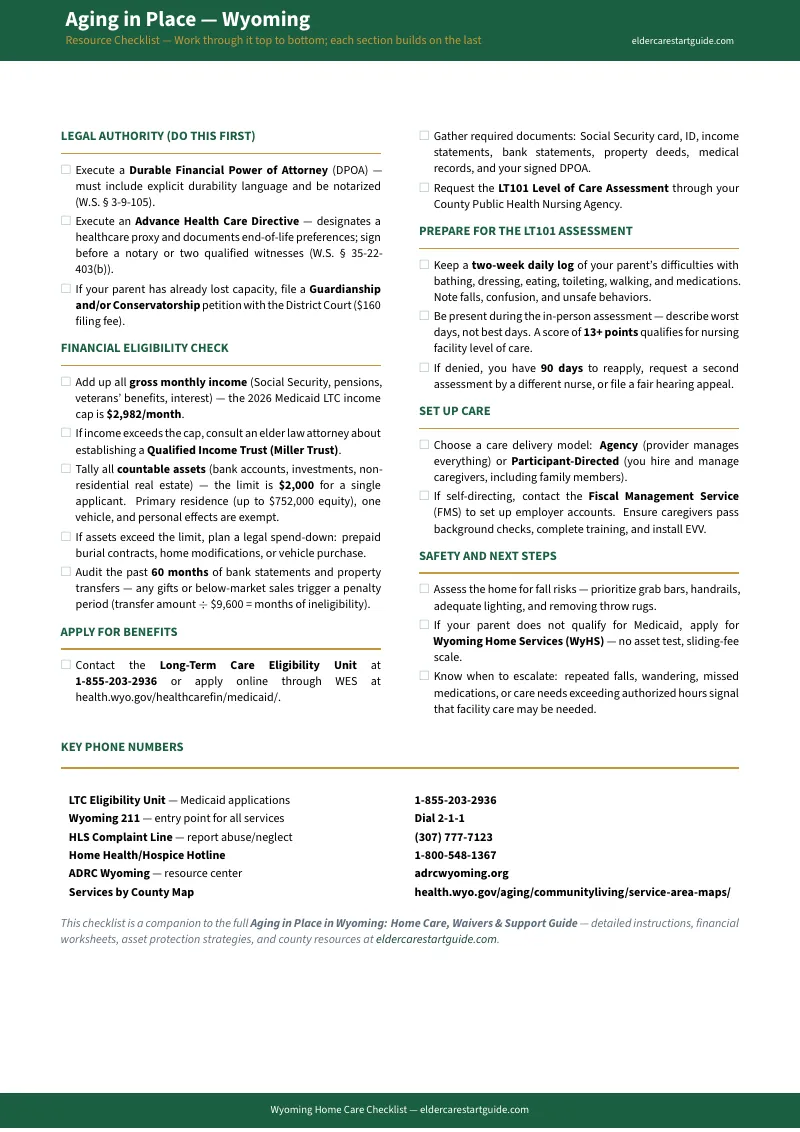
- Wyoming Aging in Place Checklist — A one-page action list covering the 20 most critical items: establish legal authority, contact the ADRC, gather 60 months of financial records, calculate countable assets, schedule the LT101 assessment, file the CCW application. Every threshold, phone number, and deadline at a glance.
Who This Is For
- Adult children whose parent is paying $46/hour for private home care and needs to get on the Community Choices Waiver before savings run out
- Families whose parent's income exceeds $2,982/month and needs a Miller Trust set up correctly — not a generic template that gets rejected
- Caregivers who want to get paid through Wyoming's Participant Directed program but don't know how to set up the ACES$ enrollment or EVV compliance
- Families whose parent doesn't qualify for Medicaid and need to understand Wyoming Home Services — the sliding-scale program with no asset test
- Anyone terrified that Wyoming's estate recovery program will seize the family home, the ranch, or assets in a living trust after death
- Rural families coordinating care from Cheyenne or Casper for a parent living hours away, with no local agencies nearby
Why Not Free Government Resources?
The Wyoming Department of Health publishes eligibility limits. The ADRC offers referrals. Brevy and PayingForSeniorCare list state-specific thresholds.
Here is what none of them provide:
- A step-by-step Miller Trust setup with the trust language, bank account instructions, and disbursement order Wyoming requires — not a "consult an attorney" note
- A practical LT101 preparation guide so you know how to document your parent's typical day — not just a list of what ADLs are scored
- A side-by-side strategy for deciding between the CCW and Wyoming Home Services — or applying for both simultaneously
- An estate recovery shield that maps which of Wyoming's unusually broad recovery powers apply to your parent's specific asset structure
- A county-by-county contact directory connecting you directly to the Public Health Nursing office, DFS regional office, and certified case management agencies in your parent's county — not a generic statewide phone number
Government portals tell you what the rules are. This guide tells you how to navigate them — in the order you need them, with the worksheets you need to get it done.
Satisfaction Guarantee
If the guide doesn't help you navigate Wyoming's home care system more clearly than the state websites and ADRC calls you've already tried, email [email protected] for a full refund. No forms, no questions.
Get Started Now
Download the free Wyoming Aging in Place Checklist to see exactly what steps are ahead of you. When you're ready for the full system — the complete guide, the Miller Trust walkthrough, the LT101 prep chapter, and every standalone worksheet — the full toolkit is waiting.