Your Parent's Nursing Home Costs $10,000 a Month. The Asset Limit Is $2,000. The ADRC Options Counselor Cannot Tell You How to Protect a Single Dollar.
The hospital discharge planner just told you your parent can't go home safely. The nursing facility wants $10,000 or more per month — private pay. Someone mentioned "contact your local ADRC," so you called. They scheduled a Long-Term Care Functional Screen. They explained that Family Care and IRIS exist. They offered "options counseling."
What the ADRC cannot do — by law — is tell you how to protect your parent's home from estate recovery, structure a legal spend-down to reach the $2,000 asset limit without triggering the five-year lookback, calculate exactly how much of the couple's assets the at-home spouse can keep, or explain how to fund a caregiver agreement that Income Maintenance won't challenge. The ADRC is a neutral government administrator. They open doors but don't arm you for what's on the other side.
And the elder law attorneys in Dane, Milwaukee, and Waukesha counties? They're $275 to $435 per hour. Crisis planning packages start at $5,000 and reach $12,000 or more. Their blog posts tell you just enough to realize you're drowning, then end with "schedule your consultation." That's a structural gap — and it's exactly where this guide fits.
The Wisconsin Medicaid Asset Protection Navigation System
This isn't a summary of Medicaid rules you could piece together from dhs.wisconsin.gov, county ADRC websites, and law firm blogs. The Wisconsin Medicaid Asset Protection Navigation System maps the exact sequence of decisions, screenings, filings, and deadlines your family needs — starting from wherever you are right now — so you don't burn through savings because you did things in the wrong order or missed a protection you were entitled to.
The critical mistakes Wisconsin families make: they contact the ADRC without understanding what the functional screen actually evaluates — and when their parent downplays deficits to the screener, they get denied a nursing-home level of care and lose access to Family Care entirely. They pick Family Care over IRIS (or vice versa) without understanding that IRIS lets you hire family members as paid caregivers while Family Care's MCO controls your provider network. They give money to a caregiving child without a formal written agreement, then watch Income Maintenance classify it as a lookback violation and impose a penalty period calculated at $295.47 per day of ineligibility. They assume the home is safe because a surviving spouse lives there — without realizing that estate recovery resumes the moment the surviving spouse dies or sells.
The guide puts you in the right order: prepare for the ADRC functional screen, understand the financial eligibility thresholds, calculate spousal protections, execute the spend-down with documented methods, choose between Family Care and IRIS based on your family's actual situation, file with everything organized, and protect the home against estate recovery after your parent passes.
What You Get
- 15-Chapter Guide — The complete Wisconsin Medicaid Asset Protection Navigation System: ADRC functional screening preparation, financial eligibility rules (income and assets), spousal impoverishment protections, the five-year lookback with exceptions and penalty calculations, legal spend-down strategies, choosing between Family Care and IRIS, the application process through your local Income Maintenance consortium, hospital discharge and Medicare skilled nursing transition, appeals and fair hearings at DHS, estate recovery rules and home protection strategies, essential legal documents (POA language requirements), and professional referral thresholds. Every dollar figure reflects 2026 Wisconsin regulations.
- 10 Standalone Printable Worksheets — Asset Inventory Worksheet (countable vs. exempt classification with running totals), Spousal Protection Calculator (CSRA split and MMMNA income-shifting formula), Spend-Down Planner (track every approved strategy with receipt documentation), Five-Year Lookback Audit (transfer log with penalty calculation), Patient Liability Calculator (monthly cost share for nursing home or waiver), Application Document Checklist (every document Income Maintenance needs for Form F-10101), Family Care vs. IRIS Comparison (side-by-side decision sheet), Estate Recovery Worksheet (exposure assessment under Wisconsin's expanded estate rules), 2026 Financial Reference Card (every dollar figure on one page), Critical Deadlines Timeline (action sequence from crisis through approval), and ADRC Functional Screen Prep (what the screener evaluates and what documentation to bring).
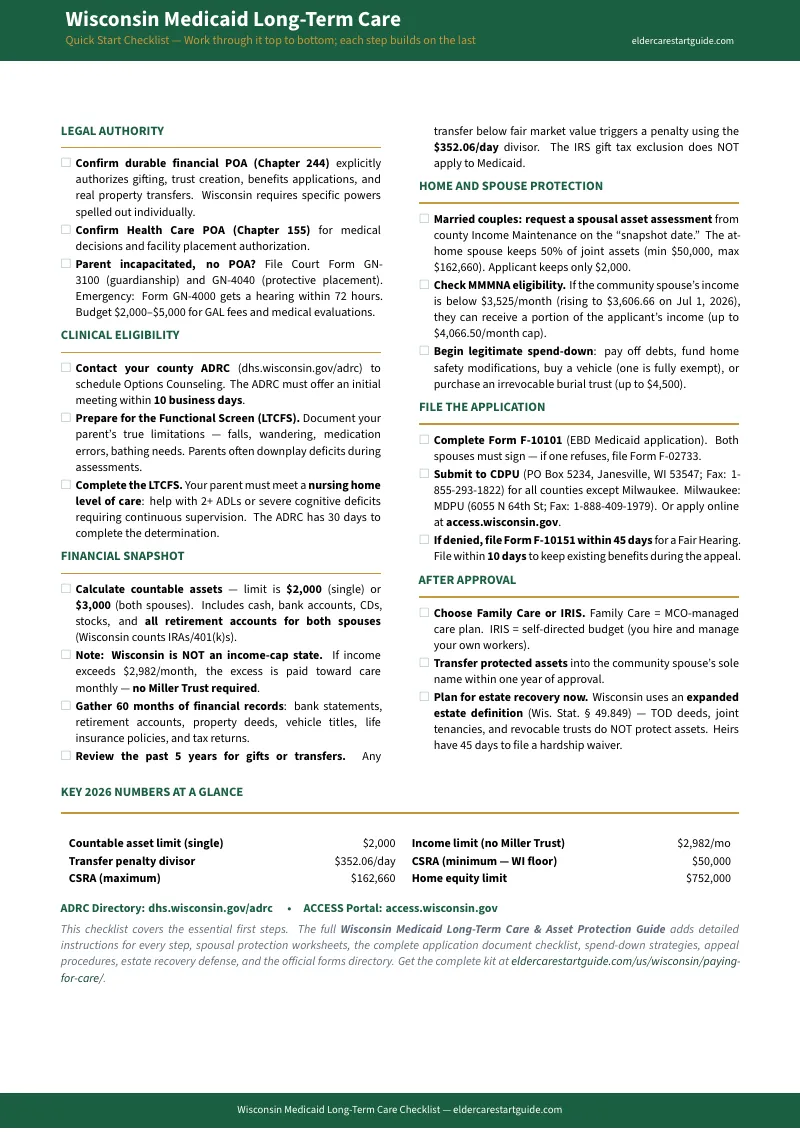
- Quick-Start Checklist — The 20 most urgent action items in priority order from POA verification through application filing and home protection.
Who This Guide Is For
- Adult children in Wisconsin who need to figure out how to pay for a parent's long-term care — nursing home, CBRF, or home care through Family Care or IRIS — without draining the family's savings
- Families facing a hospital discharge with Medicare's 100-day skilled nursing window closing and a facility demanding $10,000+ per month private-pay immediately
- Community spouses terrified that qualifying an institutionalized spouse for Medicaid will leave them destitute — and needing to understand the exact CSRA and MMMNA protections Wisconsin guarantees
- Families deciding between Family Care (managed care) and IRIS (self-directed) and needing to compare coverage, flexibility, the ability to hire family as paid caregivers, and budget control before enrolling
- Adult children preparing for the ADRC's Long-Term Care Functional Screen and wanting to understand what the screener evaluates so their parent's needs are captured accurately — not minimized
- Families who made gifts, transfers, or informal payments to caregiving children in the last five years and need to understand the lookback penalty, exceptions, and cure requirements before applying
Why Free Information Isn't Getting You Anywhere
The Wisconsin Department of Health Services publishes official ForwardHealth policies and program manuals. The numbers are accurate. But the information is scattered across dozens of disjointed PDFs, written for county administrators rather than families, and structured by program code rather than by what you actually need to do next. DHS tells you what the rules are — not which order to follow them in or how to use them to protect your family.
Your local ADRC offers free options counseling. They explain which programs exist and administer the functional screen. But they are legally prohibited from advising on asset protection, spend-down strategy, or legal structures. They will not tell you how to convert countable assets to exempt ones, how to structure a caregiver agreement that survives Income Maintenance review, or how to protect the house from estate recovery. That's not what they do.
A Place for Mom and Caring.com rank well for Wisconsin senior care searches, but their revenue comes from facility referral fees. They are structurally incentivized to move your parent into an assisted living facility that pays them a commission — not to help you qualify for publicly funded home care through IRIS, where no referral fee exists.
This guide fills the gap between the government portal that gives you rules without sequence, the ADRC that opens doors but can't arm you for what's behind them, the law firm that gives you strategy but only through a $5,000+ engagement, and the referral site that steers you toward placements you may not need.
Satisfaction Guarantee
If this guide doesn't give you a clear, actionable path to paying for your parent's long-term care in Wisconsin while protecting what the at-home spouse needs to survive, email [email protected]. We read every message.
— Less Than One Hour of a Wisconsin Elder Law Attorney's Billable Time
Wisconsin elder law attorneys charge $275 to $435 per hour. A comprehensive crisis planning package — the kind you need when a parent is already in a facility and assets are exposed — runs $5,000 to $12,000 or more. A single procedural error can cost your family months: a lookback penalty triggered by an undocumented gift, a functional screen that fails because the parent downplayed deficits, a missed one-year deadline to transfer protected spousal assets, or an estate recovery claim against a home that could have been shielded with a Transfer on Death deed.
This guide won't replace an attorney when you need one (and it tells you exactly when that is). But it will save you dozens of hours of research, prevent the most expensive timing mistakes, and ensure you walk into any conversation — with the ADRC screener, the Income Maintenance caseworker, the nursing facility billing office, or an elder law firm — knowing exactly what Wisconsin law requires and what you're entitled to protect.
Download the free Quick-Start Checklist to see the 20 most urgent action items. When you're ready for the complete system, the full guide is waiting.