
The Bank Said No. The Hospital Needs a Signature. The ADRC Can't Draft Your Documents.
Your parent needs help. Maybe the dementia is progressing, or the bills are piling up, or a fall just landed them in the hospital. You try to step in — and three different institutions tell you that without the right legal documents, you have no authority to act.
The bank won't let you pay their mortgage. The hospital discharge planner needs a legally authorized representative to sign the rehab facility admission papers. You call your county's Aging and Disability Resource Center for help and they offer options counseling — but they're legally prohibited from drafting documents or representing you in court. And the Medicaid office won't discuss your parent's eligibility until you produce paperwork they haven't explained.
You're not a lawyer. You're an adult child trying to keep your parent safe. But in Wisconsin, there are four separate legal pathways to get decision-making authority — plus a federal system for Social Security benefits that ignores all of them — and each one has rules that can invalidate your authority with a single missed step.
The Wisconsin Legal Authority Process Kit
This is not a set of generic POA forms downloaded from a legal template site. It's a process kit — the step-by-step procedural roadmap that connects each legal document to the institutions that need to accept it, the agencies that need to process it, and the public benefit programs that depend on it.
Wisconsin's legal framework for elder care authority is split across four statutory systems and one federal process. A durable financial power of attorney under Chapter 244 handles money. A healthcare power of attorney under Chapter 155 handles medical decisions. Supported decision-making under Chapter 52 is the less-restrictive alternative when your parent has mild cognitive impairment. Guardianship and conservatorship under Chapter 54 are the court routes when capacity is gone. And Social Security has its own Representative Payee application that no state document can replace. This kit walks you through all five in the order you'll actually need them.
What's Inside
- Durable Financial POA Roadmap (Wis. Stat. Ch. 244) — The full execution process for a financial power of attorney that Wisconsin banks will actually accept: the notary acknowledgment requirement, the remote witnessing option under s. 244.05(3) using two-way audiovisual technology, and the critical distinction between "immediately effective" and "springing" powers — because a springing POA requires proof of incapacity before every transaction, and that proof bottleneck can lock you out at the worst possible moment.
- Bank Acceptance Enforcement Kit — When a financial institution refuses your statutory POA, Wisconsin law is on your side. The kit covers the mandatory 10-business-day acceptance window under s. 244.20, the Agent's Certification form under s. 244.62 that forces compliance, and the attorney-fee-shifting provisions under s. 244.20(5)(b) that make unreasonable refusals costly for the bank. Includes the step-by-step escalation process from initial presentation through formal demand.
- Healthcare POA Guide (Wis. Stat. Ch. 155) — How to set up medical decision-making authority using DHS Form F-00085. Covers the strict witness disqualification rules under s. 155.10(2) — the entire document is void if a relative, heir, or healthcare facility employee signs as witness. Includes the feeding-tube checkbox that silently strips your agent's authority over nutrition and hydration decisions if left unmarked, and the statutory checkboxes for authorizing CBRF and nursing home admission.
- Supported Decision-Making Agreement Guide (Wis. Stat. Ch. 52) — The less-restrictive alternative that preserves your parent's civil rights. When your parent has early-stage cognitive decline but can still express their wishes, a formal SDM agreement gives you legal standing at banks and healthcare providers without any court process. The kit covers how to execute the agreement using DHS Form F-02377, how to educate institutions on their obligation to honor it, and when this path is no longer sufficient.
- Guardianship & Conservatorship Court Guide (Wis. Stat. Ch. 54) — The full circuit court process for when your parent can no longer sign voluntary documents: filing the Petition (Form GN-3100), preparing the Statement of Acts (GN-3140), coordinating the physician evaluation (GN-3130), Guardian Ad Litem appointment, the clear-and-convincing evidence standard, the difference between Guardian of the Person and Guardian of the Estate, mandatory UW-Green Bay guardian training under Act 97, the 60-day inventory filing requirement (Form GN-3440), and annual reporting due every April 15 (Forms GN-3480 and GN-3500).
- Emergency Temporary Guardianship Procedure (s. 54.50) — When your parent faces immediate danger to their health, safety, or property and you can't wait for the standard court timeline. Covers the 60-day maximum duration with one possible 60-day extension, the $2,000 spending cap without specific court approval, the bond requirement, and the physician evaluation that must be secured within 48 hours.
- Voluntary Conservatorship Guide (s. 54.76) — The court-supervised financial management option your parent can petition for themselves. They are not declared incompetent, they don't lose their civil rights, and they can dismiss the conservator at any time — unless the court later finds incapacity at a subsequent hearing. Covers the initial asset inventory, annual financial accountings, and surety bond requirements.
- Medicaid & Long-Term Care Navigation — How EBD Medicaid eligibility works in Wisconsin: the $2,000 asset limit for single applicants, the $2,982/month income threshold, and the critical advantage that Wisconsin is a medically-needy spend-down state — meaning no Qualified Income Trust (Miller Trust) is needed. Covers the 5-year look-back rule, the divestment penalty calculation (based on the $352.06/day divisor), how to cure a penalty by returning transferred assets, and the spousal impoverishment protections that let a community spouse retain up to $162,660 in assets and receive up to $4,066.50/month in income allocation.
- ADRC & Waiver Programs — How to work with your county Aging and Disability Resource Center, schedule the Long-Term Care Functional Screen to verify Nursing Facility Level of Care, and enroll in Family Care managed care or the IRIS self-directed program. Includes the advocacy resources: the Board on Aging Ombudsman (age 60+) and the Disability Rights Wisconsin IRIS Ombudsman Program (ages 18–59).
Plus: 9 Printable Worksheets and Checklists
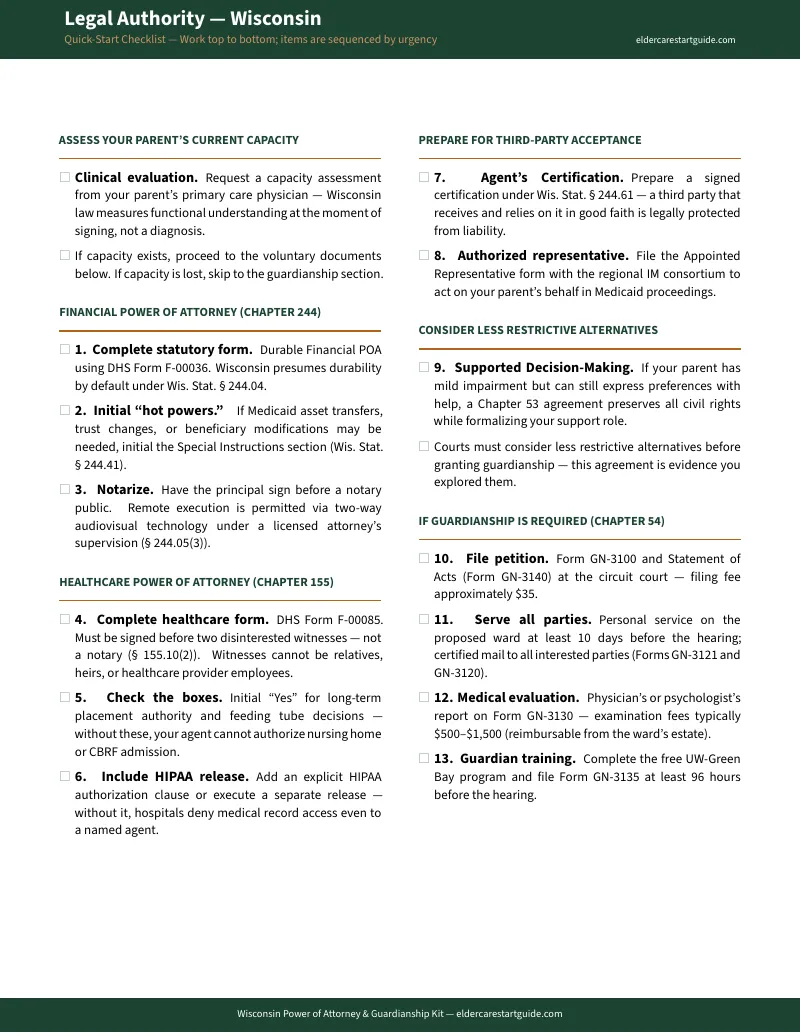
- 25-Item Legal Authority Checklist — Every step from initial capacity evaluation through document execution, institutional acceptance, ADRC intake, and Medicaid application — in the order you'll actually do them
- Parent Capacity Assessment Sheet — Evaluate your parent's cognitive indicators, inventory existing legal documents, and determine which authority pathway is still available
- Bank POA Acceptance Tracker — Log for tracking which institutions have accepted your POA, the statutory 10-business-day deadline for each, and the escalation process if refused
- 2026 Medicaid Financial Pre-Screen — Worksheet to check your parent's countable assets against the $2,000 limit and monthly income against the $2,982 threshold, including the spend-down calculation
- Spousal Impoverishment Worksheet — Calculate the community spouse's protected asset share and monthly income allocation under Wisconsin's generous floor ($50,000 asset minimum, well above the federal $32,532 floor)
- Guardianship Filing Checklist — Sequential checklist of every form, filing fee, service requirement, and deadline in the Chapter 54 circuit court process
- Court Filing Cost Estimator — Filing fees, physician evaluation costs, GAL fees, and bonding requirements broken down by estate size
- ADRC Meeting Preparation Checklist — Documents, records, and questions to bring to your county ADRC Discovery interview
- Agency Communication Log — Track every call, email, and meeting with banks, the ADRC, Income Maintenance, medical providers, and the court
- Annual Guardian Reporting Reminder — Calendar-style checklist for the annual reporting cycle: bank statements, asset updates, the April 15 deadline, and Watts Review preparation
Who This Is For
- Adult children who just discovered they can't pay their parent's bills, access their bank account, or sign facility admission papers because they don't have legal authority
- Families whose parent is being discharged from the hospital and needs someone to sign rehab or skilled nursing facility admission agreements — this week
- Caregivers whose parent has early-stage cognitive decline — the window to execute voluntary documents is closing and the supported decision-making path may still be available
- Anyone whose parent's bank is refusing to honor an existing power of attorney and needs the statutory enforcement process under Ch. 244
- Families who need to file for guardianship in Wisconsin circuit court without an attorney and want a step-by-step filing guide with every required form referenced
- Caregivers navigating the ADRC system, Family Care or IRIS enrollment, or Medicaid spend-down who need formal legal standing before the state will process their parent's application
Why Free Templates Don't Work for Wisconsin
National legal template sites give you a fillable form and a "sign here" arrow. They don't tell you that Wisconsin's healthcare POA has witness disqualification rules that void the entire document if a relative signs. They don't mention that leaving the feeding-tube checkbox blank silently strips your agent's authority over nutrition decisions. They don't explain that Wisconsin banks have a mandatory 10-day acceptance window with attorney-fee penalties for unreasonable refusal. And they have no guidance on the ADRC system, the medically-needy spend-down path that eliminates the need for a Miller Trust, or the UW-Green Bay guardian training requirement.
Wisconsin elder-law attorneys charge $250–$500 per hour, with estate planning packages running $2,500–$4,500. A contested guardianship can cost $3,000–$7,000+. This kit covers the same Wisconsin-specific legal framework those attorneys explain in billable consultations — organized in the order you'll actually need it, written in plain language, and available the same day you realize you need it.
100% Satisfaction Guarantee
If the kit doesn't give you the legal authority process you need, email [email protected] for a full refund, no time limit. No forms to fill out, no questions asked.
— A Fraction of One Attorney Consultation Hour
Download the complete kit now and get the legal authority you need to protect your parent — before the next institutional barrier stops you cold.
Included free: The Wisconsin — Power of Attorney Quick-Start Checklist comes with every purchase. Want to start with just the checklist? Download it free below.