
Your Parent's Discharge Is Happening in Hours — And Nobody Mentioned Act 115, the ADRC, or Why "Observation" Just Cost You the Rehab Bed
The discharge planner just handed you a notice and told you your parent's bed is needed. Maybe your mother had a stroke and can barely transfer from bed to wheelchair. Maybe your father fell and broke a hip but still "doesn't meet criteria" for continued stay. You have until noon tomorrow to figure out whether this is legal, whether you can stop it, and what happens next — while your siblings disagree over whether Dad can really manage alone and the social worker moves on to the next case.
Here's the part that makes Wisconsin's system harder to navigate than the national advice you've been reading: everything routes through a local ADRC before your parent can access any publicly funded long-term care. The state just passed Act 115, which lets a next-of-kin authorize nursing home admission without guardianship — but only from an inpatient unit, only through a sworn declaration filed with probate court, and only until the law sunsets in 2029. The choice between Family Care managed care and the self-directed IRIS program comes with enrollment deadlines nobody explains at the bedside. And Wisconsin has no filial responsibility laws, but the nursing home contract sitting in front of you has a "Responsible Party" clause that can create the same liability through a signature.
The Wisconsin Discharge Navigation System
This guide maps the entire hospital-to-home pathway through Wisconsin's specific administrative and legal framework — from the moment you receive "An Important Message from Medicare" through rehab appeals, ADRC screenings, Medicaid qualification, and long-term care enrollment. It's built around the state agencies, screening tools, and statutes that actually govern your parent's care in Wisconsin, not the generic templates that rank well in search results.
What separates this from government brochures and law-firm marketing: it connects the decisions that Wisconsin's system treats as separate. The discharge appeal through Acentra Health, the observation status challenge, the ADRC's Long-Term Care Functional Screen, the Family Care vs. IRIS decision, and the Medicaid spend-down calculation all interact — and getting the sequence wrong can cost your family months of unnecessary private-pay bills or a missed appeal deadline that can't be recovered.
What's Inside
- Acentra Health Appeal Blueprint — the exact timeline for filing an expedited Medicare appeal before the noon deadline, a script for demanding the Detailed Notice of Discharge from the discharge planner, and a written statement template explaining why the discharge is unsafe so you don't freeze at the critical moment
- Act 115 Surrogate Authority Walkthrough — how to use Wisconsin's "Patient's Representative" declaration to authorize nursing home or CBRF admission without filing for guardianship, the strict priority hierarchy (spouse, adult child, parent, sibling), the sworn declaration process with no notary required, filing with the county Register in Probate, and the specific situations where the authority terminates
- Observation Status Decoder — how to identify whether your parent was classified as outpatient under observation (and why it voids the three-day inpatient requirement for SNF rehab), the prospective appeal rights using the Medicare Change of Status Notice, and what to do if the classification stands
- Rehab Denial Response Protocol — what to do when the facility says your parent has "plateaued," how to challenge a Notice of Medicare Non-Coverage through Acentra Health, and the timeline for keeping therapy going while the appeal is reviewed
- ADRC Screening Preparation Guide — how the Long-Term Care Functional Screen evaluates your parent's ADLs and IADLs, why most denials happen because families over-report independence, and how to document needs based on worst days rather than best days
- Family Care vs. IRIS Decision Matrix — a side-by-side comparison of managed care coordination through MCOs (Inclusa, Community Care, Lakeland Care, My Choice Wisconsin) versus the self-directed IRIS program, including the strict IRIS timeline: select a consultant within 3 business days, in-person visit within 14 business days, plan implemented within 60 calendar days
- Medicaid Spend-Down Calculator — the Medically Needy qualification pathway (no Miller Trust required in Wisconsin), a step-by-step worksheet for the patient liability calculation, the 2026 asset limits ($2,000 single / $4,000 married couple), the home equity exemption up to $752,000, and the Community Spouse Resource Allowance (half of joint assets, floor of $50,000 up to $162,660)
- Spousal Income Protection Worksheet — how to calculate and maximize the Minimum Monthly Maintenance Needs Allowance ($3,525/month floor, up to $4,066.50/month ceiling based on excess shelter costs), and how income is diverted from the institutionalized spouse to protect the at-home spouse
- Nursing Home Contract Audit Checklist — how to identify and cross out "Responsible Party" clauses that create personal liability, confirmation that Wisconsin has no filial responsibility laws, and how to sign strictly as a fiduciary or representative so you're never personally on the hook
- Guardianship Preparation Guide — when Act 115 doesn't apply, what county probate court requires, the 30-day asset inventory deadline, the $250 spending cap without court approval, and the mandatory free training course through UW-Green Bay (must be completed at least 96 hours before the final hearing)
- Standalone Printable PDFs — discharge appeal scripts, observation status decoder, Medicaid eligibility workbook, SNF comparison matrix, home safety assessment, nursing home contract audit checklist, ADRC screening preparation sheet, and Wisconsin resource directory with every key phone number and 2026 limit on a single fridge sheet
Who This Is For
- An adult child whose parent is being discharged from a Wisconsin hospital in the next 24 to 48 hours and needs to know whether they can stop it
- A family whose parent's Medicare-covered rehab is ending and the facility is demanding private pay starting next week
- Anyone facing the ADRC's Long-Term Care Functional Screen and trying to understand the difference between Family Care managed care and the IRIS self-directed program
- A long-distance adult child managing Wisconsin-specific care decisions from another state, trying to separate what actually applies from the generic advice they keep finding
- Siblings who need a neutral, Wisconsin-specific reference to settle disagreements about discharge timing, facility choice, and who pays for what
Why Free Resources Leave You Stuck
The Wisconsin Department of Health Services, county ADRCs, and Acentra Health each publish pieces of the process. None of them hand you a chronological action plan that connects the discharge appeal to the rehab denial to the ADRC screening to the Medicaid application to the long-term care enrollment. Government manuals are written for providers and caseworkers — hundreds of pages organized by administrative section, not by what a family needs to do first.
National portals like A Place for Mom and Caring.com rank well in search but operate as referral engines for private-pay facility chains. They skip the public Medicaid waiver pathways, the ADRC front door, and the Family Care vs. IRIS decision entirely. And their discharge guides have never heard of Act 115's Patient's Representative authority because it took effect in 2026.
Elder law attorneys in Milwaukee, Madison, and Green Bay handle this work expertly — at $400 to $435 an hour. Arriving at their office with your parent's ADRC screening documented, the Medicaid asset inventory completed, the appeal timeline mapped, and the nursing home contract already audited can turn a multi-hour billable engagement into a focused one-hour execution. For many families with a straightforward discharge-to-home situation, the guide covers enough to handle the process without legal fees at all.
Satisfaction Guarantee
If the guide doesn't show you at least one appeal strategy, Medicaid pathway, or contract trap you didn't already know, email us for a full refund. No forms, no waiting period.
Get Ahead of the Discharge Clock
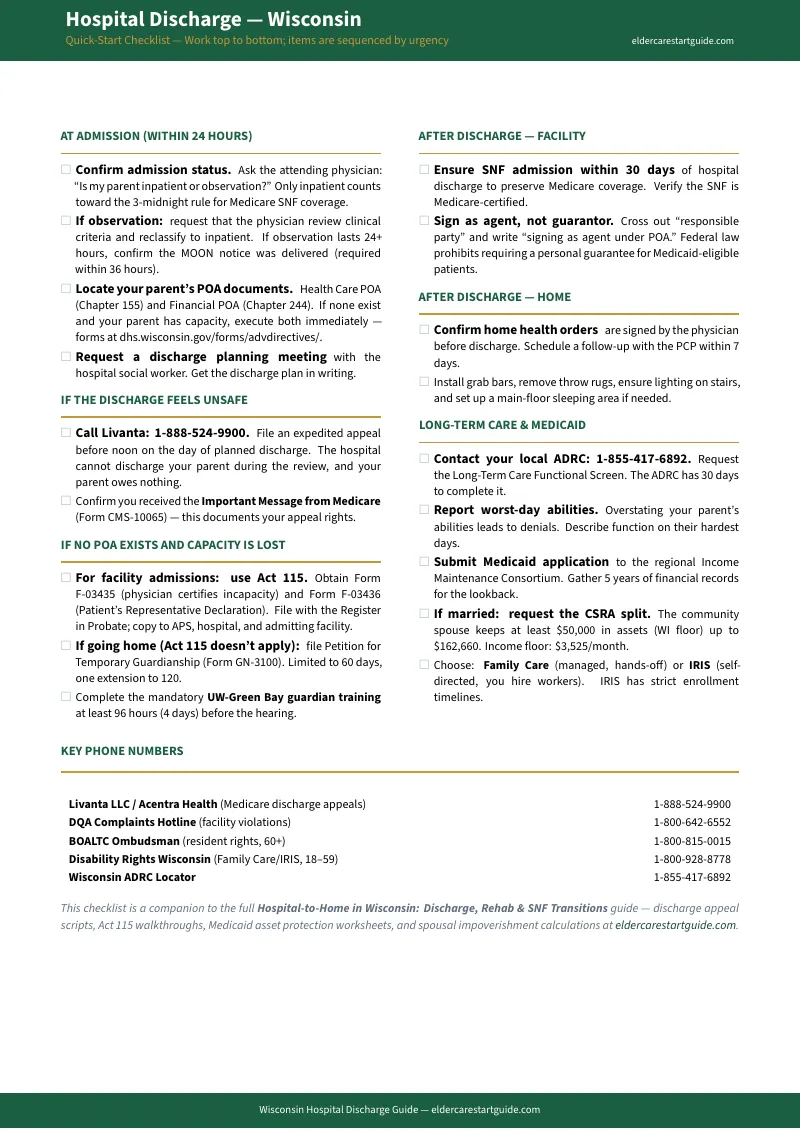
Download the free checklist for a one-page discharge timeline and key phone numbers — or get the full guide for and have every appeal template, Medicaid calculator, ADRC screening guide, and contract audit checklist you need to navigate your parent's hospital-to-home transition in Wisconsin.