Your Parent Has Dementia. Wisconsin's Care System Has 72 Front Doors, Three Competing Waiver Programs, and One Checkbox That Can Force You into Court.
You called the county ADRC. They scheduled a functional screen — in four weeks. The hospital wants your parent discharged in 48 hours. You pulled up the DHS website and found 200 pages of administrative code written for caseworkers, not families. The elder-law attorney quoted $4,000 for a retainer. And your parent's savings are draining at $7,000 a month for memory care while you try to figure out which Medicaid waiver will actually cover a secured CBRF unit.
Meanwhile, your parent's existing Power of Attorney for Health Care may be silently defective — Wisconsin law defaults the assisted-living admission checkboxes to "No" if they were left blank, meaning you legally cannot place your parent without a court-ordered guardianship that costs thousands of dollars and takes months to complete.
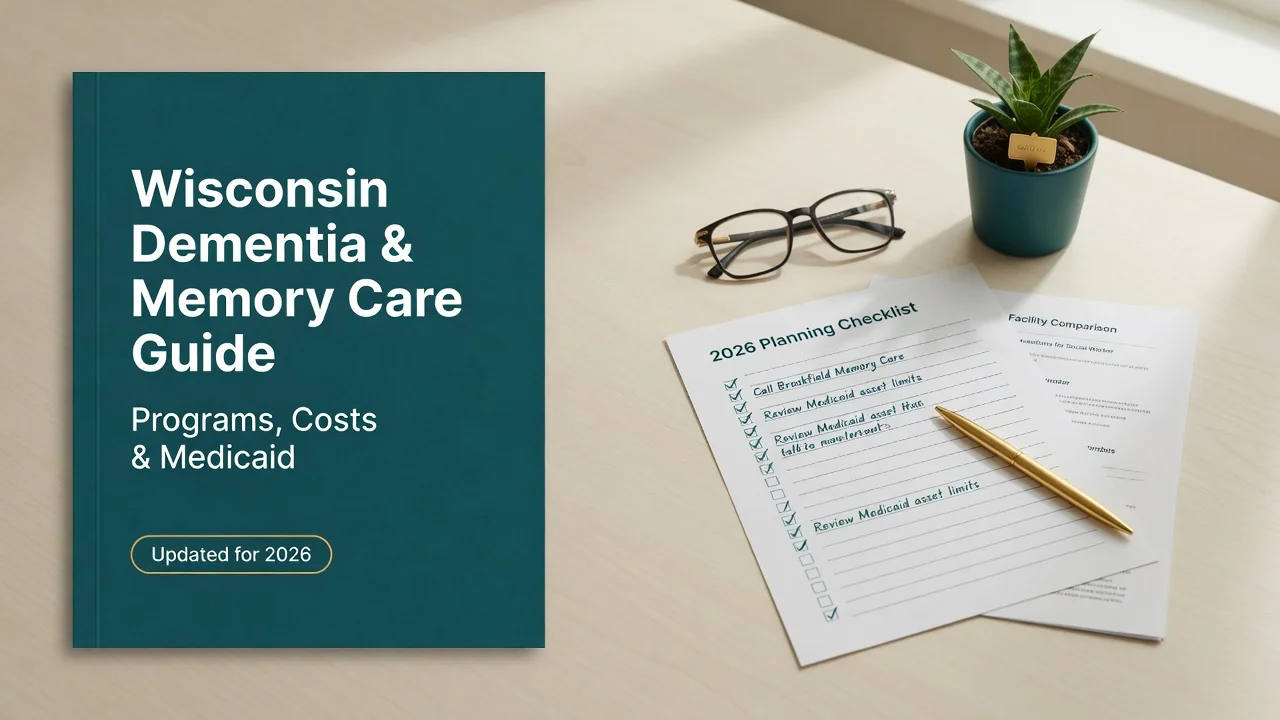
The Wisconsin Dementia Care Navigator is a single, sequentially organized system that replaces the scattered agency handouts and expensive attorney consultations with a clear action plan — built specifically around Wisconsin's ADRC structure, Family Care and IRIS waiver rules, CBRF/RCAC/AFH licensing framework, and 2026 Medicaid eligibility numbers.
What's Inside the Full Guide
- ADRC Screening Prep Worksheet — a two-week ADL journal and pre-screen checklist so your parent's actual daily difficulties are documented before the assessment, not glossed over on a "good day" that can derail eligibility
- Family Care vs. IRIS Decision Map — a fillable comparison of the two Medicaid waiver programs, highlighting the critical restriction most families discover too late: IRIS legally cannot fund care inside a CBRF memory care unit, limiting your parent to home care, RCACs, or Adult Family Homes
- POA-HC Audit Checklist — a line-by-line checklist of the standard Wisconsin POA-HC form showing exactly which assisted-living and nursing-home admission checkboxes must be marked "Yes" to avoid the guardianship trap, plus what to do if your parent has already lost capacity to sign a correction
- Spousal Asset and Income Calculator — worksheets for Wisconsin's Community Spouse Resource Allowance ($50,000 state floor to $162,660 ceiling), the Monthly Maintenance Needs Allowance ($3,525 floor), and income allocation math — the exact calculations elder-law attorneys charge $400 an hour to run through
- 60-Month Divestment Penalty Calculator — shows how Wisconsin calculates the Medicaid penalty period using the 2026 daily nursing-home divisor of $352.06, with examples of penalty length for common gift amounts and the process for "curing" a divestment by returning assets
- Facility Evaluation Checklist — a side-by-side comparison of Wisconsin's three assisted-living license types covering resident capacity, nursing care limits, Medicaid coverage, secured-unit availability, and which settings work for each stage of cognitive decline
- Emergency Hospital Discharge Playbook — a 48-hour action sequence for when a hospital says your parent cannot return home, covering emergency Medicaid applications, ADRC screening, and the Chapter 55 Protective Placement petition required when a guardian admits someone to a locked unit or a facility with 16+ beds
- Wandering Safety Response Kit — Silver Alert activation criteria, a fill-in missing-person description, local law enforcement registration, Project Lifesaver radio-frequency tracking, and a home-based prevention checklist
- Care-Transition Timeline — a dated tracker for legal authority, ADRC screening, Medicaid, facility tours, and hospital-crisis steps
- Five-Year Financial Audit Worksheet, Agency Communication Log, and Emergency Contacts Card — the look-back records, call log, and wallet card the rest of the kit points you to at each milestone
- Caregiver Grant Directory — Wisconsin's AFCSP (up to $4,000/year, income under $48,000 with care-cost deductions) and NFCSP (no income limit, no hour cap since the state eliminated the 112-hour limit) plus county Dementia Care Specialist contacts
- Driving Safety Reporting Protocol — how to file Form MV3141 with the DMV Medical Review Unit to trigger an official assessment, plus the Form MV3454 confidentiality pledge for family members who need to remain anonymous
- Guardianship & Protective Placement Guide — chronological breakdown of Chapter 54 guardianship and Chapter 55 protective placement including the $500 GAL deposit, examining physician's report, GN-3480/GN-3500 annual probate reports, and the ongoing Watts Review requirements
Who This Is For
- Local care coordinators — adult children in Wisconsin balancing full-time work with a parent's escalating care needs, who need to cut through the ADRC wait and the DHS regulatory maze without spending thousands on professional guidance
- Remote caregivers — sons and daughters managing a parent's cognitive decline from out of state, who cannot physically visit the county ADRC and need a complete procedural manual for Wisconsin's highly localized county-based system
- Spouses facing impoverishment — healthy partners at home terrified of losing the family residence and retirement savings to private-pay memory care costs, who need the exact Wisconsin spousal protection calculations to know what they can keep
Why Not Just Use the Free Government Resources?
The Wisconsin DHS publishes exhaustive policy manuals — hundreds of pages of administrative code written for state caseworkers, scattered across dozens of departmental portals. County ADRCs provide options counseling, but they are legally prohibited from advising you on how to structure assets, time a Medicaid application, or navigate the spend-down strategically. National websites like Paying for Senior Care still instruct Wisconsin families to set up Miller Trusts — a tool Wisconsin doesn't use because it's a medically-needy spend-down state, not an income-cap state. Following that advice can delay your application by months.
The guide translates Wisconsin's fragmented administrative framework into a single chronological action plan. Every form reference, financial threshold, and eligibility rule is specific to Wisconsin and updated for 2026 — not a national template with state names swapped in.
Start for Free
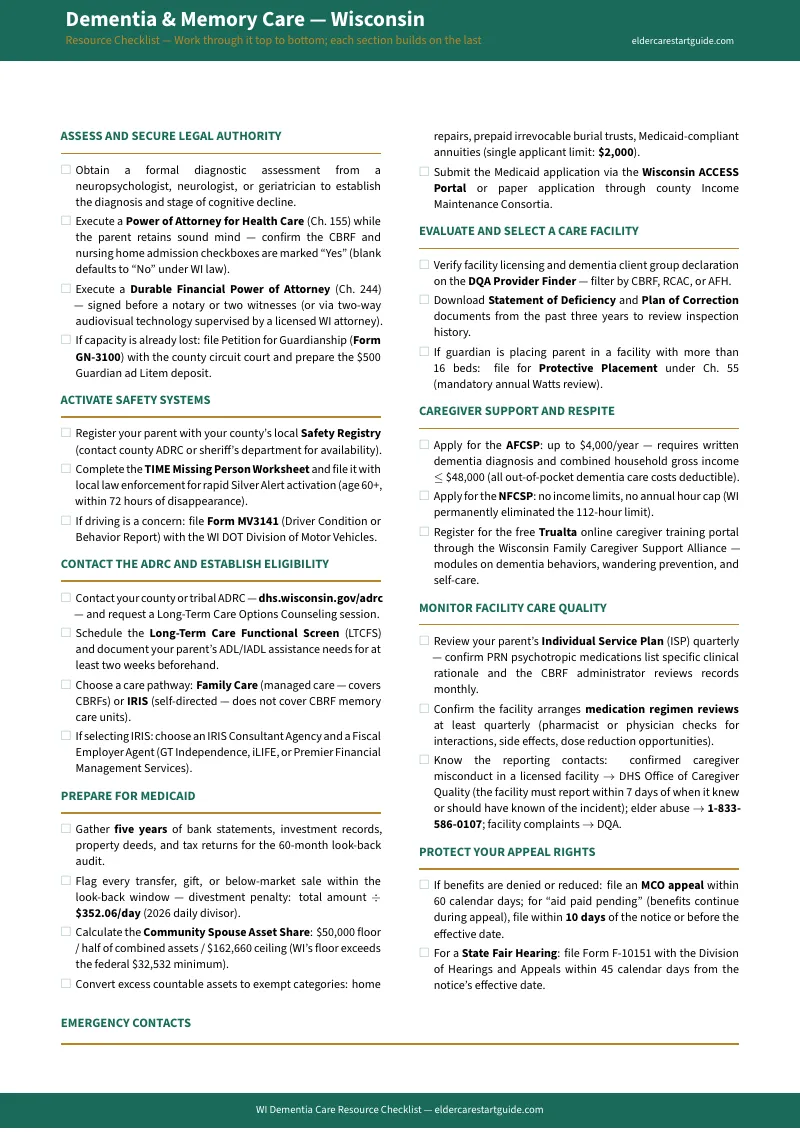
Download the Wisconsin Dementia Care Resource Checklist — a two-page quick-reference with the key agencies, programs, phone numbers, and first steps. If you need the full system with calculation worksheets, decision maps, and step-by-step procedures, the complete guide is .
Full refund, no time limit. If the guide doesn't give you a clearer path through Wisconsin's dementia care system, email [email protected] for a complete refund.