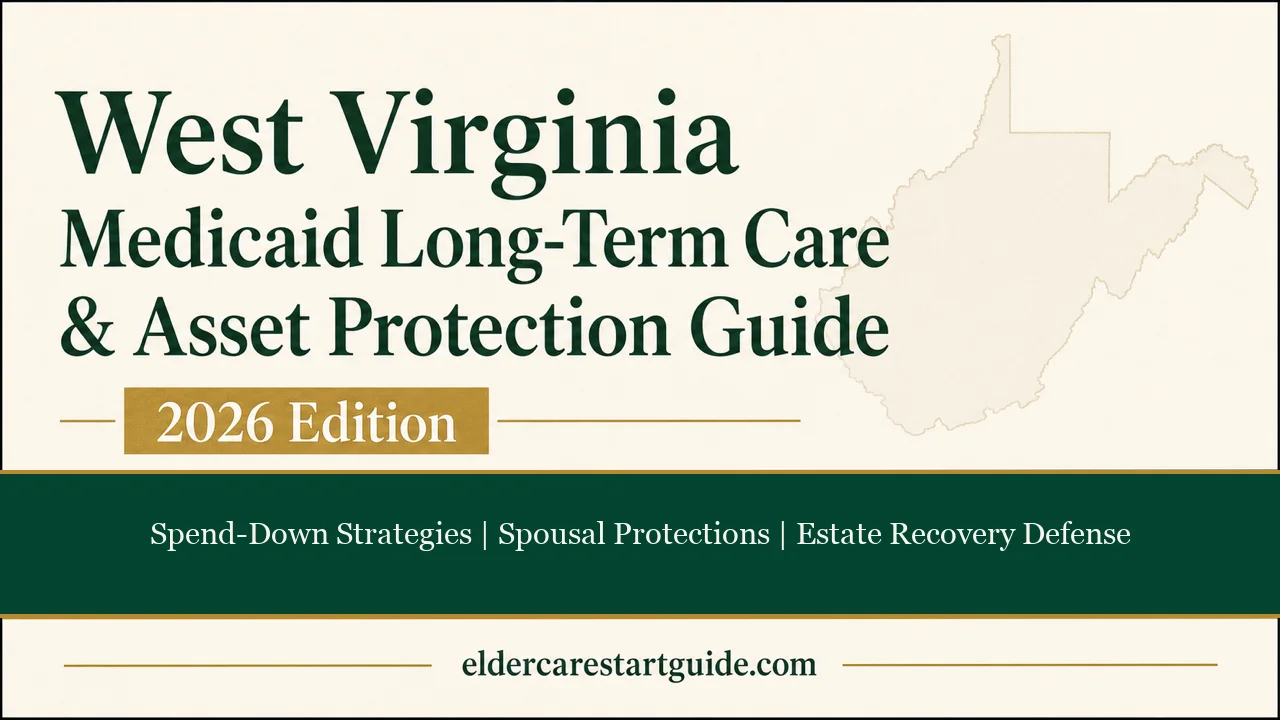
Your Parent's Nursing Home Costs $12,836 a Month. The Asset Limit Is $2,000. And West Virginia's Estate Recovery Can Reach Assets That Never Went Through Probate.
The rehab facility just called. Medicare's skilled nursing benefit is about to end. Your parent can't go home safely, and the nursing home wants $12,836 per month — private pay. The social worker mentioned "Medicaid" like it was a simple form. Then you started reading the rules.
You found the income limit: $2,982. Your parent's Social Security and pension combine to $3,400 a month. In an income-cap state, that excess $418 would require a Qualified Income Trust. But West Virginia isn't an income-cap state. West Virginia uses the medically needy pathway — the oldest and most misunderstood Medicaid eligibility route in the country. The Medically Needy Income Limit is $200 a month. Not $2,982. Two hundred dollars. The gap between $3,400 and $200 is your parent's spend-down amount, satisfied when their care costs eat through it. Get the math wrong, and the caseworker sends back the application.
Meanwhile, your parent's home — the asset you assumed was safe — faces a threat most families don't discover until after probate opens. West Virginia is one of the states that pursues estate recovery against non-probate assets: joint tenancies, payable-on-death accounts, transfer-on-death designations, life estates, and Lady Bird deeds. The strategies that protect homes in neighboring states may not work here.
The West Virginia Medicaid Care & Asset Protection System
This isn't a summary of Medicaid rules you could piece together from bms.wv.gov, three elder law blogs, and a forum thread. The West Virginia Medicaid Care & Asset Protection System maps the exact sequence of financial calculations, application steps, spend-down mechanics, and asset protection strategies your family needs — starting from wherever you are right now — so you don't drain savings because you did things in the wrong order.
The critical mistake most West Virginia families make: they treat the $2,982 income limit as the only number that matters and miss the medically needy pathway entirely. They assume the family home is automatically safe and discover the broad estate recovery rules after a lien is already filed. They give a grandchild $19,000 thinking the IRS gift tax exclusion protects them from Medicaid scrutiny — it doesn't. They don't know the Aged and Disabled Waiver can keep a parent at home with personal attendant care, or that the state-funded Lighthouse Program fills the gap for seniors who don't qualify for Medicaid.
The guide puts you in the right order: assess financial eligibility first, calculate the medically needy spend-down, map countable versus exempt assets, protect the family home before the application triggers estate recovery exposure, evaluate in-home alternatives to nursing home placement, then file with the county DoHS office with every document organized.
What You Get
- 16-Chapter Guide with Quick Reference Tables — The complete West Virginia Medicaid Care & Asset Protection System: what Medicare does and doesn't cover, the medically needy spend-down with the $200 MNIL, income and asset eligibility for 2026, the full application process through WV PATH, spousal protections (CSRA up to $162,660, MMMNA up to $4,066.50/month), the five-year lookback with penalty divisor calculations, approved spend-down strategies, getting paid as a family caregiver through the ADW Personal Options program, care settings and what Medicaid covers, legal authority and powers of attorney, estate recovery including non-probate asset exposure and undue hardship waivers, the appeals process, bridge programs (Lighthouse, FAIR, ADW waitlist), a complete funding timeline, and when to consult an elder law attorney. Every dollar figure reflects 2026 West Virginia regulations.
- 6 Standalone Printable Worksheets — Ready to print and fill in with your family's actual numbers:
- Medically Needy Worksheet — Calculate the six-month deductible using West Virginia's $200 MNIL, track qualifying medical expenses, and determine patient liability
- Spousal Protection Calculator — Work through the CSRA ($32,532–$162,660) and MMMNA calculations, including the excess shelter allowance and the critical ADW exception
- 60-Month Lookback Audit — Flag every transfer type, log details for each one, and calculate penalty periods using the $11,903 monthly divisor
- Spend-Down Planner — Track approved penalty-free strategies to reduce countable assets below $2,000 with a running total
- Estate Recovery Worksheet — Audit non-probate asset exposure (joint tenancies, POD accounts, Lady Bird deeds), check for permanent blocks, and note the 45-day hardship waiver deadline
- Care Setting Comparison Chart — Side-by-side comparison of nursing home, ADW home care, Lighthouse Program, and private pay across cost, eligibility, spousal protections, and services
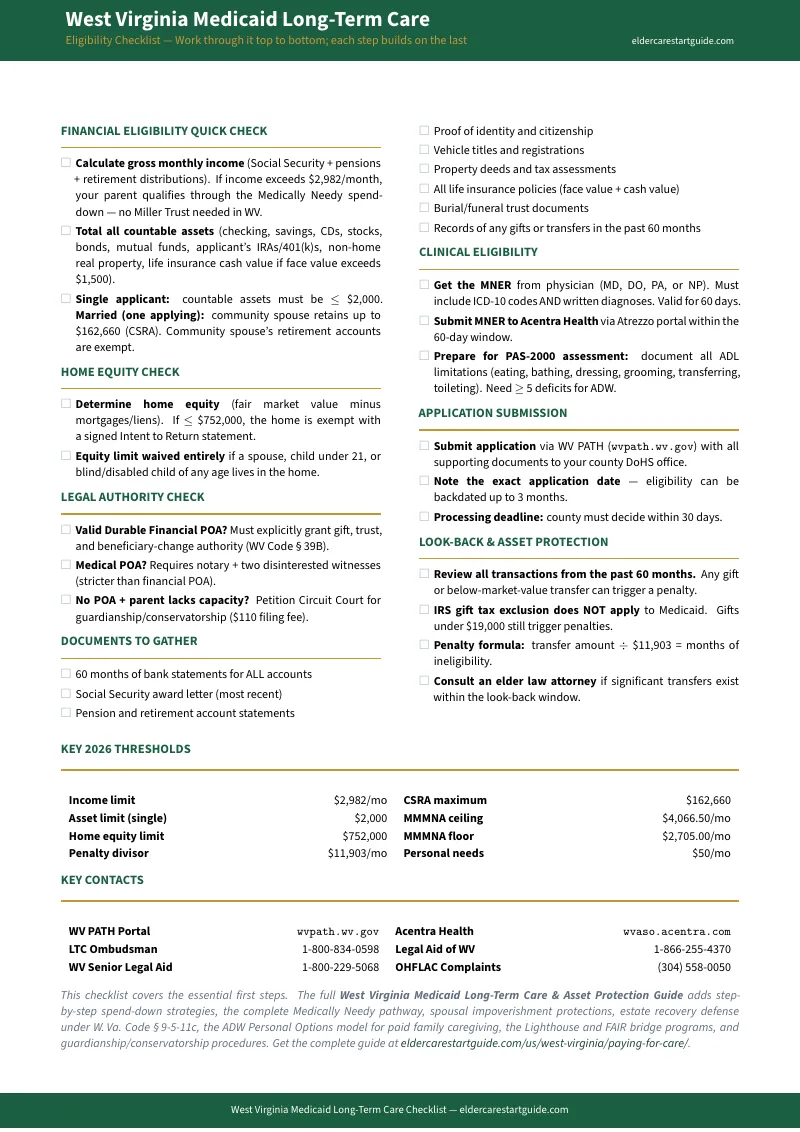
- Quick-Start Checklist (Free Download) — 20 actionable items across 7 sections: check financial eligibility, gather 60-month lookback documents, start the clinical pathway through Acentra Health, submit the financial application, protect family assets, bridge care while waiting, and know your appeal rights.
Who This Guide Is For
- Adult children in West Virginia who need to figure out how to pay for a parent's long-term care — nursing home or home-based — without losing the family home and retirement savings
- Families facing a hospital discharge with no Medicaid application started and a facility demanding private-pay rates of $12,836 or more per month
- Anyone whose parent earns more than $2,982 per month and needs to understand how the medically needy spend-down works in West Virginia — why Miller Trusts don't apply, how the $200 MNIL creates the spend-down obligation, and what counts as qualifying medical expenses
- Married couples where one spouse needs nursing home care and the other needs to know exactly how much of their joint savings and monthly income West Virginia law protects — including why the MMMNA spousal income transfer doesn't apply to ADW home-care applicants
- Families who made financial transfers in the last five years and need to determine whether those gifts will trigger a Medicaid penalty — and what the $11,903 monthly penalty divisor means for their exposure
- Caregivers who want to keep a parent at home through the Aged and Disabled Waiver or the Lighthouse Program but don't understand the Managed Enrollment List, the Acentra Health clinical evaluation, or the Personal Options model that pays family members as caregivers
Why Free Information Isn't Getting You Anywhere
The West Virginia Bureau for Medical Services publishes the official financial guidelines. The numbers are accurate. But they don't tell you the order. They don't explain that West Virginia's medically needy pathway uses a $200 MNIL — one of the lowest in the country — or that estate recovery reaches beyond probate assets, or that ADW slots are capped at roughly 8,750 and families wait on the Managed Enrollment List for months.
West Virginia elder law firms publish helpful blog posts about Medicaid planning. Every one ends with a call to schedule a consultation at $300 to $500 per hour. Their content is designed to pull you into a multi-thousand-dollar planning engagement, not to give you a complete, executable sequence of steps.
A Place for Mom and Caring.com rank well on Google, but their guides are national templates with West Virginia numbers dropped in. They don't explain the medically needy spend-down, the Lighthouse Program's sliding fee scale, or the fact that West Virginia estate recovery can pursue Lady Bird deeds and POD accounts. They are lead-generation platforms for facility referral fees, not planning tools.
This guide fills the gap between the government portal that gives you facts without sequence, the law firm that gives you sequence only through a multi-thousand-dollar engagement, and the referral site that steers you toward facility placements that may not be necessary.
Satisfaction Guarantee
If this guide doesn't give you a clear, actionable path to paying for your parent's long-term care in West Virginia, email [email protected]. We read every message.
— Less Than One Hour of an Elder Law Attorney's Time
West Virginia elder law attorneys charge $300 to $500 per hour. A comprehensive Medicaid planning package runs $3,000 to $5,000. A single procedural mistake — misunderstanding the medically needy spend-down, a gift inside the five-year lookback that creates a penalty calculated at the $11,903 divisor, a missed 45-day hardship waiver deadline — can cost your family months of private-pay nursing home bills at $12,836 per month.
This guide won't replace an attorney when you need one (and it tells you exactly when that is). But it will save you hours of research, prevent the most expensive mistakes, and ensure you walk into any conversation — with the county DoHS office, the nursing facility, the Bureau of Senior Services, or an elder law firm — knowing exactly what West Virginia law requires.
Download the free Quick-Start Checklist to see the 20 most urgent action items. When you're ready for the complete system, the full guide is waiting.