West Virginia Has Four Agencies Processing One Waiver Application, a Respite Program Most Families Never Find, and a Medicaid System That Runs on a Clinical Threshold Nobody Explains
Your parent has dementia. Maybe the diagnosis just came, and you're scrambling to get a Medical Power of Attorney signed before the capacity window closes. Maybe you've been managing care at home for months — but a wandering incident, a stove left on, or total physical exhaustion has made it clear that the current arrangement can't continue. Either way, you're now navigating a system that was built for caseworkers and eligibility specialists, not for families in crisis.
You call the local Department of Human Services and learn that Medicaid might help — but your parent's application goes to a county DoHS office, then to Acentra Health for a clinical evaluation, then to the Bureau of Senior Services for a Managed Enrollment List slot, then back to a local case manager who actually implements the care plan. You search for memory care facilities and discover that West Virginia doesn't issue a separate memory care license — any assisted living facility can market a wing as "memory care" under a single licensing category, and the only enforceable standards are buried in the Alzheimer's Special Care Standards Act (WV Code § 16-5R), a law most families don't know exists.
The West Virginia Dementia Care Action System
This guide maps every West Virginia-specific program, clinical requirement, financial threshold, and application pathway into a single chronological sequence. It starts with the legal authority decisions you must make while your parent still has cognitive capacity, moves through safety planning and wandering preparation, and walks you through the complete Medicaid application process — including how to prepare for the PAS-2000 nurse assessment that determines whether your parent qualifies for state-funded care.
What separates this from government websites and national caregiving portals: it connects the systems that West Virginia treats as separate bureaucracies. Your parent's PAS-2000 score determines their clinical eligibility. Their clinical eligibility determines whether they can access the Aged and Disabled Waiver. Their financial eligibility requires understanding West Virginia's unique medically needy spend-down model (the state doesn't use Miller Trusts), the 60-month lookback period, the daily penalty divisor of $396.76, and the patient liability calculation that determines how much of their income goes directly to the facility each month. And their estate recovery exposure after death depends on how the family home and assets are titled right now — because West Virginia's MERP operates on a probate-only model that creates specific protection opportunities most families miss. These are not independent decisions. The guide shows how each one flows into the next so you can sequence the applications correctly and avoid the gaps that cost families months of coverage or tens of thousands of dollars in penalties.
What's Inside
- The Complete Guide (12 chapters) — covers West Virginia's dementia care landscape from initial diagnosis requirements through legal authority (durable POA, MPOA, advance directives, guardianship/conservatorship), safety planning (wandering prevention, Take Me Home WV registry, DMV medical review, APS reporting), four in-home care programs (Lighthouse, FAIR respite, ADW, Personal Options), memory care facility evaluation using the Alzheimer's Special Care Standards Act, Medicare coverage limits, Medicaid financial and clinical eligibility, the medically needy spend-down, the 60-month lookback, estate recovery protections (MERP), the Take Me Home WV transition program, the RYPAS program, and when to call a professional
- Medicaid Financial Eligibility Worksheet — the 2026 individual asset limit ($2,000), married couple protections, Community Spouse Resource Allowance, the medically needy income limit ($200/month individual, $275/couple), and a fillable asset categorization tool that separates countable from exempt resources
- PAS-2000 Assessment Prep Worksheet — how West Virginia's Pre-Admission Screening evaluates your parent across activities of daily living, the five-deficit threshold for Nursing Facility Level of Care, a 14-day ADL care log to document real daily deficits, and how to prevent the "good day" effect that causes clinical denials
- 60-Month Lookback Audit Worksheet — a fillable transfer log covering five years of financial history, the $396.76 daily penalty divisor, exempt transfer categories, and a Medicaid-compliant personal care agreement template to compensate family caregivers without triggering penalty periods
- Estate Recovery Protection Worksheet — which assets are subject to West Virginia's probate-only MERP recovery, which are protected, the $5,000 minimum recovery threshold, transfer-on-death deeds, joint ownership strategies, and hardship waiver criteria
- Facility Tour Scorecard — a printable comparison worksheet for evaluating three memory care facilities side-by-side against the Alzheimer's Special Care Standards Act disclosure requirements, staffing ratios, Medicaid acceptance, contract terms, and red flags
- Silver Alert and Take Me Home WV Preparation Sheet — pre-formatted with the fields law enforcement needs to activate a search within minutes of a wandering incident, plus the Take Me Home WV registry enrollment form and home safety assessment checklist
- Crisis Contacts Sheet — all four Area Agencies on Aging, Bureau of Senior Services, Adult Protective Services, Long-Term Care Ombudsman, Alzheimer's Association 24/7 helpline, WV Senior Legal Aid, and Medicaid application contacts on one printable page
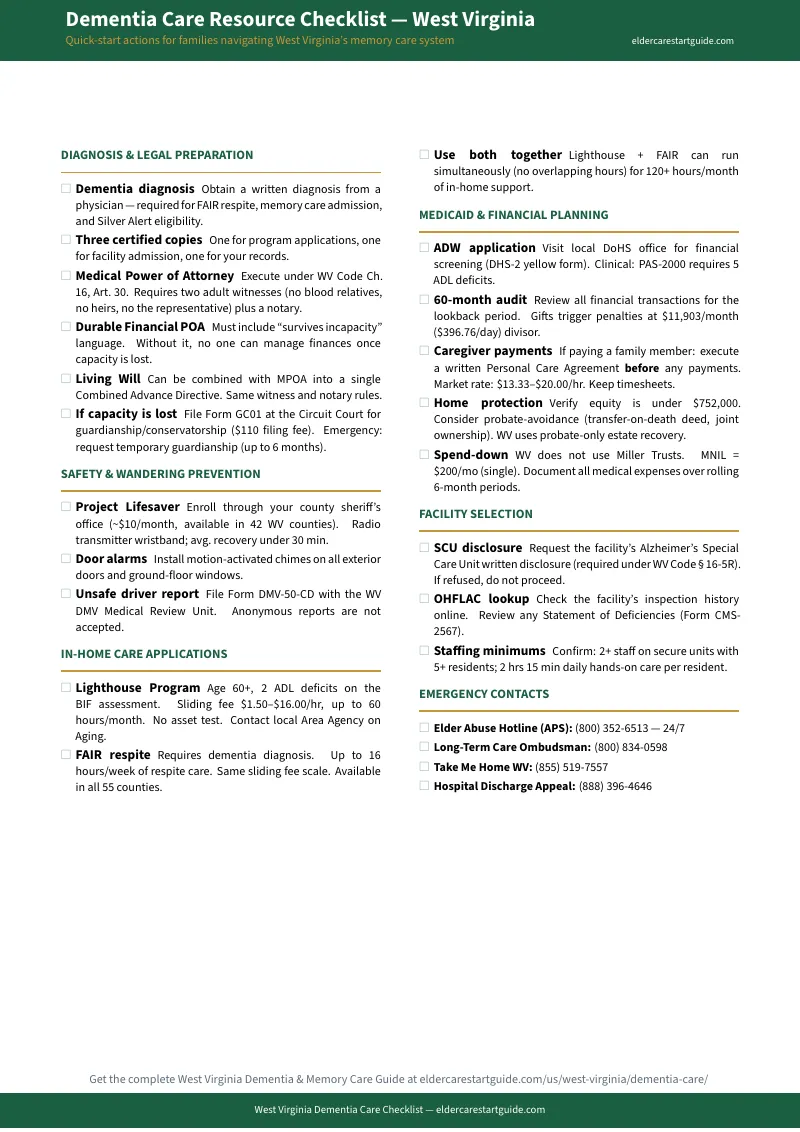
- 22-Item Dementia Care Checklist (free) — the essential actions from legal authority through program enrollment, facility evaluation, and safety planning in a single printable page
Who This Is For
- Adult children managing a parent's dementia in West Virginia who need to understand which state programs exist and how to apply for them in the right order
- Families facing a hospital discharge where the parent can't return home safely and a care placement decision must happen within 48–72 hours
- Caregivers whose parent is burning through savings on private-pay memory care at $7,000+ per month and needs to transition to Medicaid-funded options before the money runs out
- Anyone preparing for a PAS-2000 assessment who needs to document their parent's real daily deficits and prevent the "good day" effect that causes clinical denials
- Families trying to protect the family home and other assets from Medicaid Estate Recovery after a parent passes
- Out-of-state adult children coordinating care from Ohio, Virginia, or Pennsylvania who need West Virginia-specific agency contacts, program names, and application pathways — not generic national caregiving advice
Why Free Resources Leave You Stuck
West Virginia's Bureau of Senior Services publishes program descriptions and application forms. But those documents are written by compliance officers to define eligibility criteria, not to help families secure benefits. You can find the Aged and Disabled Waiver description on the BoSS website, but you won't find an explanation of how the PAS-2000 scoring thresholds determine whether your parent qualifies for home care versus institutional placement, how to document cognitive impairment alongside physical ADL deficits, or how to prevent a misleadingly lucid day during the assessment from erasing months of documented decline.
Free placement services like A Place for Mom will connect you with memory care facilities — the ones that pay them referral commissions. They don't mention that West Virginia has no stand-alone memory care license, that the Alzheimer's Special Care Standards Act requires specific disclosures most families never request, or that the Lighthouse Program and FAIR respite services provide alternatives to facility placement that no commission-based referral service has any reason to tell you about. And they won't help you navigate the Medicaid application that would eliminate their referral fee.
Elder law attorneys and certified Medicaid planners provide expert, personalized guidance — at $300 to $500 per hour. For complex asset protection strategies, professional counsel is essential. But you shouldn't be paying attorney rates to learn the basic difference between the ADW and the Lighthouse Program, understand what a PAS-2000 assessment evaluates, or figure out how West Virginia's medically needy spend-down model works differently from every neighboring state. Using this guide to organize your documentation and understand the system before your first consultation can save hundreds in billable hours.
Satisfaction Guarantee
If the guide doesn't help you identify at least one program, eligibility pathway, or protection strategy you weren't already aware of, email us for a full refund. No forms, no waiting period.
Navigate West Virginia Dementia Care with Confidence
Download the free checklist to get the essential action items — or get the full toolkit for and receive 9 PDFs: the 12-chapter guide, Medicaid financial eligibility worksheet, PAS-2000 assessment prep worksheet, 60-month lookback audit worksheet, estate recovery protection worksheet, facility tour scorecard, Silver Alert and Take Me Home WV preparation sheet, crisis contacts sheet, and the printable checklist.