Your Parent Needs Long-Term Care in Washington. The System Won't Tell You How to Pay Without Losing Everything.
Nursing home costs in Washington average $14,000 a month. Your parent's savings could vanish in under a year. And somewhere between the DSHS intake forms, the caseworker's voicemails, and your sibling's opinion about what to do, you need to figure out whether Medicaid will help — and whether applying will cost you the family home.
Washington's Apple Health system can cover nursing homes, assisted living, adult family homes, and in-home care through programs like COPES and Community First Choice. But the state's own website won't tell you how to structure your parent's finances to qualify. Caseworkers are legally prohibited from advising you on asset protection. And elder-law attorneys charge $300 to $500 an hour for what often starts as basic document gathering you could have done yourself.
The DSHS Application & Asset Protection Blueprint
This guide is a chronological, step-by-step system for navigating Washington Medicaid long-term care — from your first eligibility screening through the CARE assessment, DSHS application, spousal protections, and estate recovery shielding. It's the bridge between the raw WAC regulations on the state's website and the $5,000 to $15,000 attorney retainer you're trying to avoid.
Instead of piecing together fragments from state agency PDFs, you get a single action sequence: assess eligibility, organize 60 months of financial records, calculate your exact spend-down, protect the community spouse's income, prepare for the CARE assessment, submit a clean application, and shield the family home from post-death recovery under RCW 43.20B.080.
What's Inside — 11 PDFs
- Complete 14-Chapter Guide (guide.pdf) — Washington's care programs (CFC, COPES, PACE), income and asset tests with 2026 thresholds, legal spend-down strategies, spousal protections, the five-year lookback, CARE assessment preparation, the DSHS application process, estate recovery, Medicare limits, legal documents, appeals, professional team building, and a month-by-month action timeline
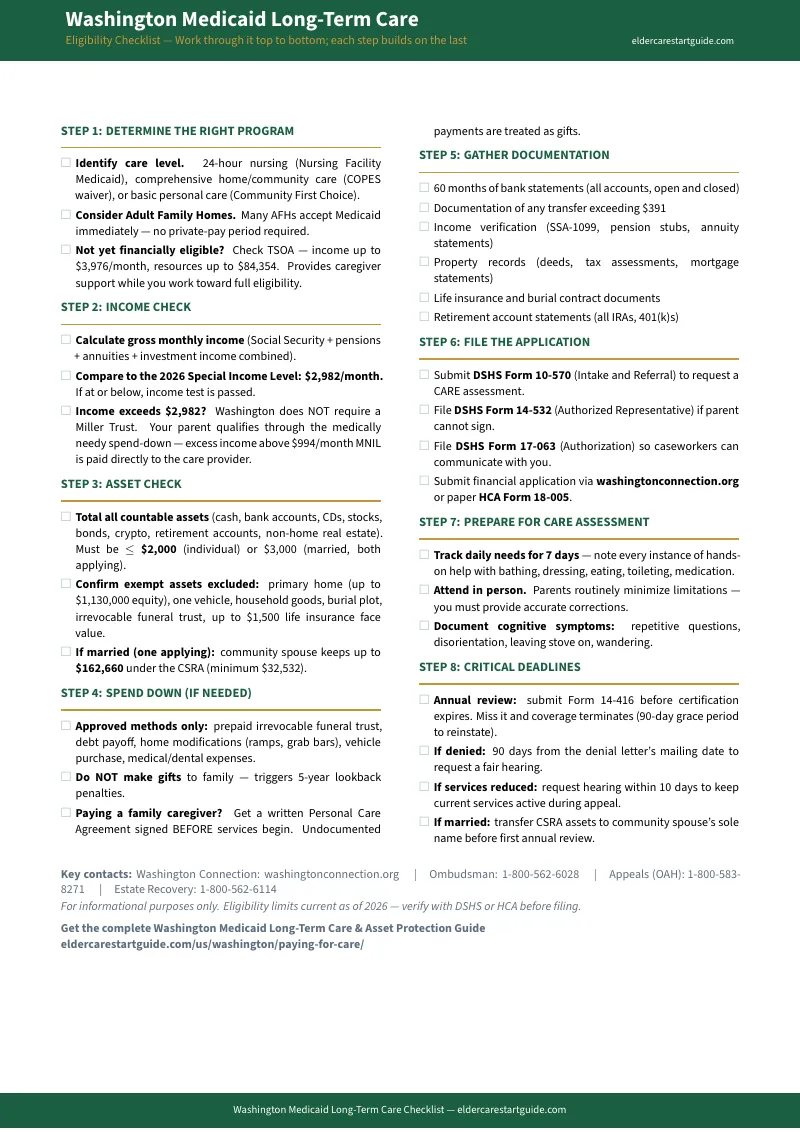
- Quick-Start Eligibility Checklist (checklist.pdf) — 20-item action checklist across 8 steps, from program selection and eligibility screening through document gathering and application submission
- CARE Assessment Worksheet (care-assessment-worksheet.pdf) — ADL deficit documentation, safety incident log, and cognitive symptom checklist to complete before the caseworker visit
- Spousal Protection Calculator (spousal-protection-calculator.pdf) — Fillable CSRA and MMMNA worksheets with excess shelter allowance and patient liability calculations
- 60-Month Look-Back Audit (look-back-audit.pdf) — Transfer-type checklist, detail log for every flagged transaction, and penalty calculation using Washington's $462/day divisor
- Application Document Checklist (application-document-checklist.pdf) — Every legal, income, financial, property, and medical document DSHS requires, organized by category with status tracking
- Spend-Down Planner (spend-down-planner.pdf) — Approved penalty-free strategies with amount tracking and a running total to reach the $2,000 asset limit
- Estate Recovery Worksheet (estate-recovery-worksheet.pdf) — RCW 43.20B.080 expanded-estate exposure audit with asset risk assessment, deferral conditions, and action steps
- Month-by-Month Action Timeline (action-timeline.pdf) — Printable chronological checklist from crisis through approval and first annual review
- Care Program Comparison (program-comparison.pdf) — CFC vs. COPES vs. nursing facility Medicaid vs. PACE side-by-side, plus bridge programs (TSOA, MAC, RCL)
- Forms & Contacts Reference (forms-and-contacts.pdf) — Every DSHS/HCA form number and URL, key phone numbers, and critical deadlines on a single printable sheet
Who This Is For
- Adult children managing a parent's transition to nursing home, assisted living, adult family home, or home-based long-term care in Washington
- Spouses trying to protect household income and savings when a partner enters a facility — the guide walks through the exact CSRA calculation (up to $162,660) and MMMNA income diversion
- Families who discovered the 60-month lookback after making gifts or property transfers they didn't realize would trigger penalties
- Anyone who just hit the Medicare Day 100 cliff and is facing $14,000+/month private-pay nursing home costs with no plan
- Families considering the Community First Choice program to hire and pay a family member as a caregiver through CDWA
Why the DSHS Website Isn't Enough
DSHS and HCA publish the raw forms and eligibility rules. What they don't provide:
- A chronological action plan that tells you what to do first, second, third — not just what the rules are
- Strategic guidance on how to legally structure a spend-down (caseworkers cannot advise on this — it's outside their role)
- CARE assessment preparation — how the 0-to-4 ADL scoring works and why your parent's natural tendency to minimize deficits leads to denials
- Annotated walkthroughs of the DSHS application forms — the HCA 18-005 and Community Resource Declaration (Form 14-501) are dense bureaucratic documents with no context
- Spousal protection calculations specific to your income and asset situation, including the income diversion process
National directories like A Place for Mom and Caring.com earn referral fees from private-pay facilities — they have no financial incentive to explain state-funded home care programs like CFC or COPES that would let your parent stay home. And generic Medicaid guides from national publishers miss Washington-specific details: the $1,130,000 home equity limit (highest tier in the country), the medically needy spend-down pathway that eliminates the need for a Miller Trust, and the expanded-estate recovery rules that reach non-probate assets.
60-Day Satisfaction Guarantee
If the guide doesn't give you a clear path forward within the first week, email us and we'll refund every cent. No forms, no justification required.
Start With the Free Eligibility Checklist
Download the Washington Medicaid Long-Term Care Eligibility Checklist — a 20-item action checklist you can complete in 20 minutes. It covers program selection, income and asset thresholds, spend-down basics, documentation requirements, and application channels. No email sequence, no sales pressure — just clarity on whether your parent might qualify.
When you're ready for the full application and asset protection blueprint — the 14-chapter guide plus 9 standalone worksheets including the CARE assessment worksheet, spousal protection calculator, look-back audit, spend-down planner, and estate recovery worksheet — the complete 11-PDF toolkit is .