You manage everything for your parent. Washington says you're a stranger.
You pay the bills, schedule the doctors, sort the medications. You drove your parent to every appointment this year. And then a bank compliance officer tells you they can't discuss the account. A hospital discharge planner needs a signature you're not authorized to give. DSHS won't process the Medicaid application because no one with legal standing filed it.
The gap between what you do every day and what Washington law lets you do is invisible — until the moment it blocks everything.
The Legal-Authority Roadmap
The Washington Power of Attorney & Guardianship Kit is a step-by-step system for closing that gap. It covers voluntary authority while your parent can still sign, court-supervised authority when capacity is already lost, and the DSHS Medicaid interface that connects legal documents to actual care — all specific to Washington statutes, DSHS procedures, and current 2026 dollar thresholds.
This is not a stack of blank forms. It is the operational sequence that tells you which form to use, how to execute it so Washington institutions actually accept it, and what to do when they push back.
What's Inside
Durable Power of Attorney Under RCW 11.125
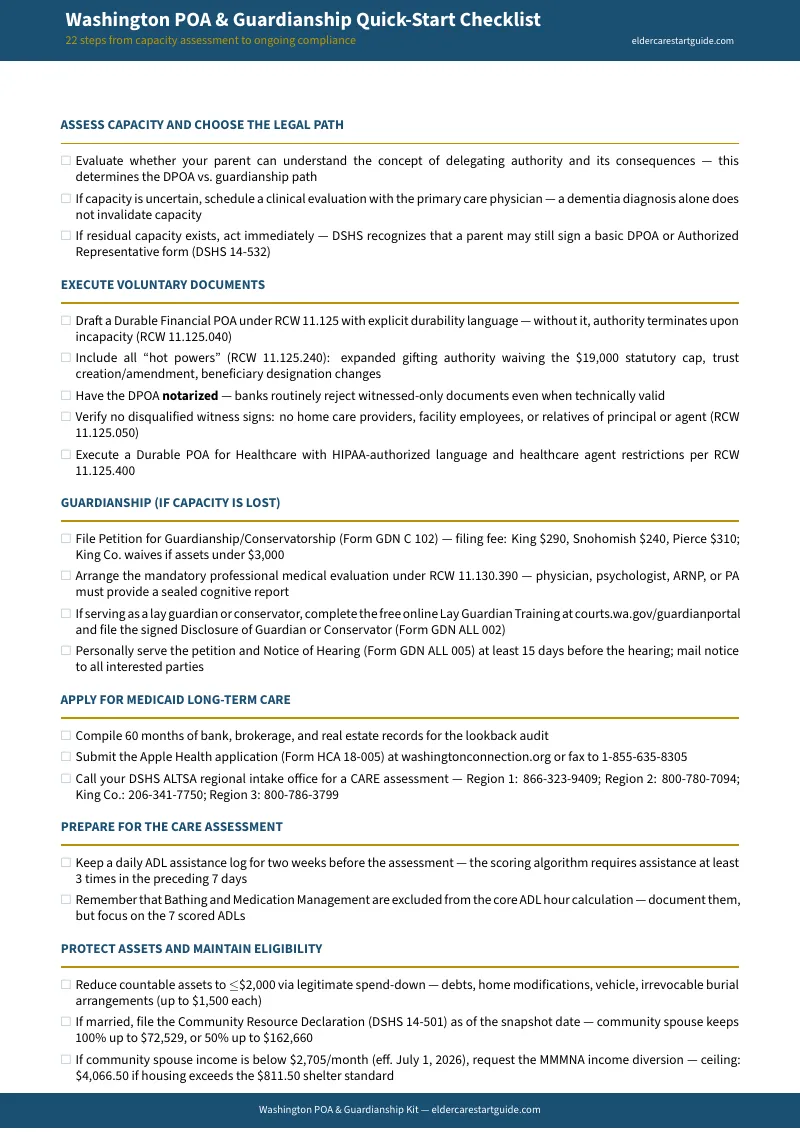
Washington POAs are not durable by default. Without specific statutory language, your parent's document self-destructs the moment incapacity arrives — exactly when you need it most. The guide walks through the durability clause requirement, the strict witness restrictions (no care providers, no relatives of the agent, no facility employees), and the practical recommendation to notarize even though witnesses are technically valid.
Hot Powers for Medicaid Planning
Under RCW 11.125.240, high-stakes financial maneuvers — gifts, trusts, beneficiary changes — require explicit "hot power" provisions that must be individually initialed. Without expanded gifting language, you are locked to the federal annual gift tax exclusion amount per recipient, which makes Medicaid asset protection strategies impossible. Generic templates from national form sites almost never include these provisions. The guide covers exactly which hot powers to include and how to draft them.
Bank Acceptance Toolkit
Banks in Washington have a strict statutory timeline: seven business days to accept a notarized POA or request certification, then five business days after certification is provided. They cannot demand their own proprietary forms. If they refuse, they face a court order and liability for your attorney's fees under RCW 11.125.200. The kit includes the statutory Agent's Certification form and a formal demand letter — hand it to the compliance officer and cite the statute.
Guardianship and Conservatorship Under RCW 11.130
When capacity is already lost, the court path is unavoidable. The guide covers the full filing process under Washington's 2022 Uniform Guardianship Act: petition preparation, service of interested parties, the Court Visitor investigation, the mandatory lay guardian training from the Administrative Office of the Courts, the Declaration of Completion filing, and the 60-day emergency appointment option for acute crises. It also covers the ongoing duties — the 90-day Care Plan, the 60-day financial inventory, annual reporting requirements, and what happens if you miss a deadline.
DSHS CARE Assessment Preparation
The Comprehensive Assessment Reporting Evaluation (CARE) tool is the gateway to paid home care in Washington. A DSHS case manager scores your parent's ability to perform Activities of Daily Living — bathing, transfers, medication management — and that score determines the care hours your parent receives. The guide prepares you for the home visit, explains how the scoring works, and covers the critical mistake families make when a parent says "I can do it myself" out of pride and loses care hours as a result.
Medicaid Long-Term Care Navigation
Washington's Medicaid long-term care programs — COPES, Community First Choice, the Tailored Supports for Older Adults program, the Medicaid Alternative Care program — each have different eligibility requirements and service packages. The guide maps the financial thresholds (the $2,000 asset limit for a single applicant, the $1,130,000 home equity limit), the spousal impoverishment protections that shield the community spouse's income and assets, the 60-month look-back period and transfer penalties, and the estate recovery rules under RCW 43.20B.080 that can reach the family home after a parent passes.
Personal Care Agreements
If you or another family member provides hands-on care, DSHS's Consumer Directed Employer model may allow you to be hired and paid as a caregiver. But informal cash payments without documentation trigger Medicaid transfer penalties during the 60-month look-back. The guide includes a Personal Care Agreement framework — a written, fair-market-value contract that protects the payment from being classified as an uncompensated gift.
Who This Is For
- Adult children managing a parent's daily life without legal standing — you need authority before the next bank refusal or hospital crisis forces you into court
- Families facing a parent's cognitive decline — a dementia diagnosis does not automatically void legal capacity, but the window for voluntary documents narrows with every week
- Caregivers navigating DSHS for the first time — the CARE assessment, Apple Health applications, and waiver programs are confusing by design; this is the operational sequence
- Families worried about Medicaid spend-down and estate recovery — the asset protection strategies require specific POA language that standard forms omit
Why Not Free Government Forms?
Washington LawHelp and the Administrative Office of the Courts provide excellent blank forms. They are legally valid. And they leave you with zero guidance on the practical sequence of steps — how to coordinate those forms with hospital discharge planners, how to prepare your parent for the DSHS home visit, how to handle a bank that refuses a technically valid document, or how to structure asset transfers so they survive the 60-month look-back. The forms are the starting line. This kit is the race.
Private elder law firms in Washington write extensive blog content about these topics, but every article deliberately stops short of actionable execution steps — the content is engineered to induce anxiety and present a $300-to-$500-per-hour consultation as the only solution. This kit fills the gap between free forms you cannot navigate and professional fees you may not need.
Satisfaction Guarantee
If the kit doesn't give you a clear path forward within the first hour, email us for a full refund. No forms, no hassle.
Get Started
Download the free Washington Power of Attorney Quick-Start Checklist for an overview of what needs to happen and in what order. When you are ready for the full step-by-step system — every document, every form, every DSHS navigation tool — the complete kit is waiting for .